Introduction: The Energy We Lack ⚡
The most powerful accelerator in the world, the Large Hadron Collider (LHC), can accelerate particles to energies of about 10⁴ GeV. That’s impressive — enough to discover the Higgs boson, to explore matter at the subatomic level, to set limits on supersymmetric particles.
But the Planck energy — where quantum mechanics meets general relativity, where strings become visible, where processes immediately after the Big Bang occur — is 10¹⁹ GeV.
The difference? Fifteen orders of magnitude. Like comparing the energy of a bee’s flight with the energy of a supernova.
Our strongest accelerators simply are not — and probably never will be — powerful enough to directly produce the particles or phenomena that theories predict at the Planck scale. This is not a matter of technology, but of fundamental limitations. To build an accelerator that could reach those energies, it would have to be the size of an entire galaxy. 🌌
The Cosmos as an Accelerator 🌠
But nature is generous. It has already conducted the experiment for us — 13.8 billion years ago.
The Big Bang was a manifestation of physical laws compared to which the LHC is but a child’s play. In those first moments, the universe was hot, dense, and full of energies we can only dream of today. Those energies shaped everything we see around us: the structure of space, the distribution of galaxies, the relationship between matter and radiation.
And while we cannot reproduce those conditions in the laboratory, we can observe their consequences. The two most powerful windows into those primordial moments are:
- Cosmic Microwave Background radiation (CMB) — the afterglow of the Big Bang, an image of the universe when it was just 380,000 years old
- Gravitational waves — ripples in the very fabric of space-time, direct witnesses of violent processes in the early cosmos
CMB: A Picture from the Universe’s Infancy 📸
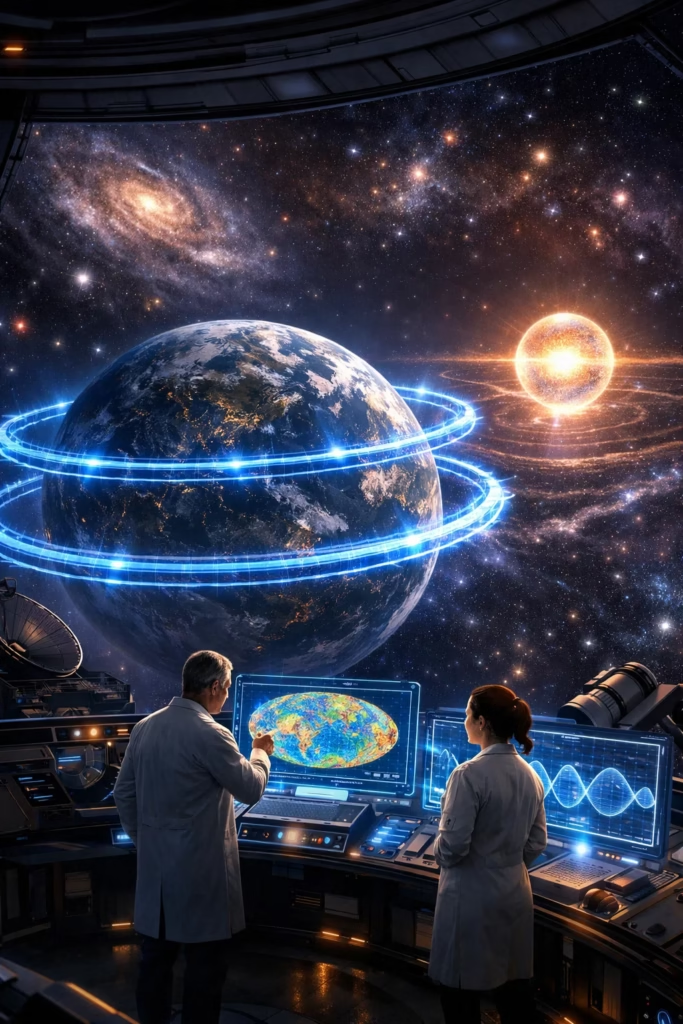
When satellites like the Planck mission or WMAP map the CMB, they don’t just measure temperature. They measure fluctuations — tiny temperature differences that reflect differences in matter density in the early universe.
These fluctuations are crucial. They are the seeds from which all galaxies, all stars, all planets formed. And their pattern — statistical distribution, size, shape — directly depends on the physics that reigned in the first moments of existence.
Inflationary theories, for example, predict a very specific pattern of these fluctuations. So far, CMB measurements confirm the basic predictions of inflation. But — and this is a big but — they cannot distinguish between different inflation models. Too many theories give the same predictions. The data are consistent with our models, but do not uniquely confirm them.
Gravitational Waves: A New Kind of Light 🌊
Gravitational waves are the newest window into the cosmos. When LIGO and Virgo first directly detected gravitational waves in 2015, they opened an entirely new field of astronomy.
But even more exciting is the possibility of detecting primordial gravitational waves — those generated immediately after the Big Bang, perhaps even during inflation itself.
These waves would carry information about energies far beyond the reach of any collider. They could tell us:
- Did inflation really happen?
- Which inflation model is correct?
- Did strings leave their mark on the fabric of space?
- Was supersymmetry present at those high energies?
Experiments like BICEP, Planck, and future missions like LISA are searching for exactly that: a specific polarization pattern in the CMB that would indicate the presence of primordial gravitational waves.
First Results: Doubting Our Best Theories 🤔
And here we come to the most fascinating part.
When BICEP2 announced in 2014 that it might have detected a signal of primordial gravitational waves, the excitement was enormous. But it soon turned out that the signal came from cosmic dust, not gravitational waves. 🧹
The Planck mission, for its part, has provided the most precise map of the CMB to date. The results? Mostly consistent with the standard cosmological model (ΛCDM model). But there are anomalies — deviations that shouldn’t exist if our model were perfect.
For example:
- Hubble tension — different measurements of the Hubble constant give different values, depending on whether we use the CMB or local measurements. The difference is small, but statistically significant.
- Large scales — on the largest scales, fluctuations in the CMB are somewhat weaker than the model predicts.
- CMB cold spots — there are several regions in the sky that are colder than they should be.
These deviations don’t necessarily mean the standard model is wrong. They could be statistical fluctuations, or the result of imperfections in the data. But they could also be the first hints of new physics.
What Does This Tell Us? 💭
We are in a strange situation. We have theories that are mathematically exceptionally elegant — string theory, inflation, supersymmetry — but they lack direct experimental confirmation. At the same time, we have cosmological observations that mostly agree with our models, but also show small, intriguing anomalies.
This is not a defeat. It is a signpost.
When data doesn’t agree with theory, that’s not a problem — it’s an opportunity. Every anomaly, every tension, every unexplained fluctuation can be a door to deeper understanding.
Perhaps nature, through these small signs, is whispering that we are on the right path, but that we are still missing some piece of the puzzle. Perhaps gravitational waves are already there, just waiting for more sensitive detectors. Perhaps the next generation of missions — like Euclid, the Nancy Grace Roman Telescope, or LISA — will bring answers.
Conclusion: Patience and Gaze Toward the Sky 🌟
Physics today faces an unprecedented challenge. Our theories have become so advanced that they exceed the capabilities of our experiments. But that doesn’t mean we are in a dead end.
It means we must be patient, creative, and lift our gaze. Because the answers to questions about the origin of the universe, about the deepest laws of nature, will not come from underground tunnels filled with magnets and detectors. They come from space — from light that has traveled billions of years, from the rippling of space-time itself, from the whispers of the cosmos waiting to be captured.
Our mission is not to lightly discard theories backed by the greatest minds simply because we cannot confirm them in our laboratories, but to test them in the only way nature allows — through observation. And if they turn out to be wrong, that will be the greatest discovery of all. Because then we will know that something entirely new awaits us.
Leave a Reply