Continuation of the series “Emergent Spacetime” and “Us in the Quantum Sea”
Dear friends, explorers at the crossroads of science and spirit,
So far, we have sailed together through the Dirac Sea – that infinite ocean of quantum information from which space-time emerges. We have explored anesthesia as a window into the quantum nature of consciousness, and the gamma rhythm as the heartbeat of conscious experience. But now we come to the deepest question of all: Do we truly choose? Or is everything already written in the wave function of the universe?
This question is not merely philosophical. It strikes at the very heart of what it means to be human – responsibility, guilt, hope, love. If everything is deterministic, then we are only “helpless observers” (as Huxley grimly put it). If everything is random, then there is no choice either. Where, then, is the place for free will?
As always, the answer lies on the boundary – where the Schrödinger equation meets the curvature of space-time.
🎬 The Dirac Sea as a script: Determinism at the level of the wave function
First, we must be precise. If we look at the evolution of the wave function – the part of quantum mechanics described by the Schrödinger equation – then the universe is fully deterministic. The wave function evolves in a predictable, computable manner. This is what Roger Penrose called “strong determinism” – the idea that “the entire history of the universe is fixed, according to some precise mathematical scheme, for all time.”
In that framework, the Dirac Sea can be imagined as a complete script – everything that will ever happen is already written into the wave function. Our voyage through time would be merely the unfolding of what has already been inscribed.
But there is a catch.
What we experience as reality is not the wave function itself – but the consequence of its collapse. And the collapse of the wave function, as Penrose has argued, is neither deterministic nor algorithmic. And that is the key.
🧠 The non‑algorithmic nature of consciousness: Gödel’s argument
Penrose’s starting point was mathematical. Using Gödel’s incompleteness theorem, he argued that human consciousness possesses abilities that no Turing machine (no algorithm) can imitate. Consciousness, according to Penrose, is non‑algorithmic.
What does that mean? It means that the process leading to conscious experience cannot be reduced to computation. It goes beyond what can be programmed. This is a radical claim, but it has profound implications for free will.
If consciousness is non‑algorithmic, then it is not merely a “computation” running in neurons. It introduces something new – something not pre‑written into any algorithm. That something is precisely the space for free will.
In an interview with Nautilus, Penrose said: “I grew up thinking the universe was deterministic. Then I evolved to saying, ‘Well, maybe it’s deterministic but it’s not computable.’ But is that something subtler than that? Is it several layers deeper? If that’s something we use for our conscious understanding, it’ll be much deeper even than simple, non‑computable deterministic physics. It’s a kind of delicate border between completely deterministic behavior and something that is completely free.”
🌌 Objective reduction: When gravity enters the game
How exactly does Penrose envision this non‑algorithmic collapse? The answer lies in gravity.
Penrose has always considered quantum mechanics incomplete – lacking gravity. His theory of objective reduction proposes that the collapse of the wave function is an objective, physical process that occurs when a quantum superposition reaches the Planck scale, where gravity becomes relevant. The collapse time is given by τ = ℏ/ΔE, where ΔE represents the uncertainty in gravitational self‑energy arising from the deep conflict between the superposition principle and general covariance.
In other words: gravity exerts a force on quantum superpositions. When two masses (or two configurations of the same system) reach a critical value, the difference in their gravitational self‑energy becomes so large that the system becomes unstable and collapses.
This process is not deterministic. It introduces non‑computability into the very heart of physics. And it is precisely there, at the meeting point of quantum mechanics and gravity, that Penrose sees a place for free will.
In the Orch‑OR model, microtubules inside neurons maintain brief quantum superpositions. When those superpositions reach Penrose’s threshold – when the difference in gravitational self‑energy becomes large enough – they collapse through objective reduction. Each such collapse is one conscious moment (about 40 times per second, in line with the gamma rhythm).
But the crucial point is this: the collapse process is not merely random. It is non‑algorithmic. It introduces new information – information that was not contained in the initial conditions. And that is precisely what gives free will room to act.
Hameroff put it clearly: “Orch OR can explain real‑time causal agency of consciousness, avoiding the need to see consciousness as an epiphenomenal illusion. Orch OR can save conscious free will.”
🎭 Randomness versus freedom: The delicate boundary
However, here we encounter one of the greatest traps. It is often thought that free will is the same as randomness. If a process is not deterministic, then it is random – and randomness is not freedom.
Penrose is aware of this trap. In the same interview, when asked whether his theory supports free will, he replied: “Not exactly, although at this stage it looks that way. It seems that these choices would be random. But free will – is that random?”
The answer is: no. Free will is not mere randomness.
The difference is subtle but crucial. Randomness is structureless – it is white noise. Free will, on the other hand, involves patterns shaped by identity, memories, values, and intentions. It is not arbitrary – it is informed freedom.
In our framework, the Dirac Sea plays a key role. The information preserved in the sea – memories, behavioral patterns, emotional predispositions – influences how the objective reduction will “decide.” Collapse is not a mere dice throw. It is an informed choice at the boundary between quantum superposition and classical reality.
Penrose called this “a delicate border between completely deterministic behavior and something that is completely free.”
⚖️ Determinism and responsibility: As you sow, so shall you reap
Although objective reduction introduces an element of non‑algorithmicity, that does not mean our choices are arbitrary. The informational substrate of the Dirac Sea – our memories, values, character – acts as both a constraint and a guidance for the collapse process.
In this sense, the biblical principle holds: “As you sow, so shall you reap.” Our past actions, our thoughts, our habits – all shape the informational structure that will, at each conscious moment, influence how the superposition collapses.
This is not determinism, but neither is it pure fatalism. This is responsibility woven into the fabric of reality. We cannot choose anything – our choices are limited by what we are. But precisely because we are something – and that something has been shaped by our previous choices – we can influence what we will become.
That is the essence of free will in a quantum deterministic world.
🌊 Return to the Dirac Sea: Freedom as a wave
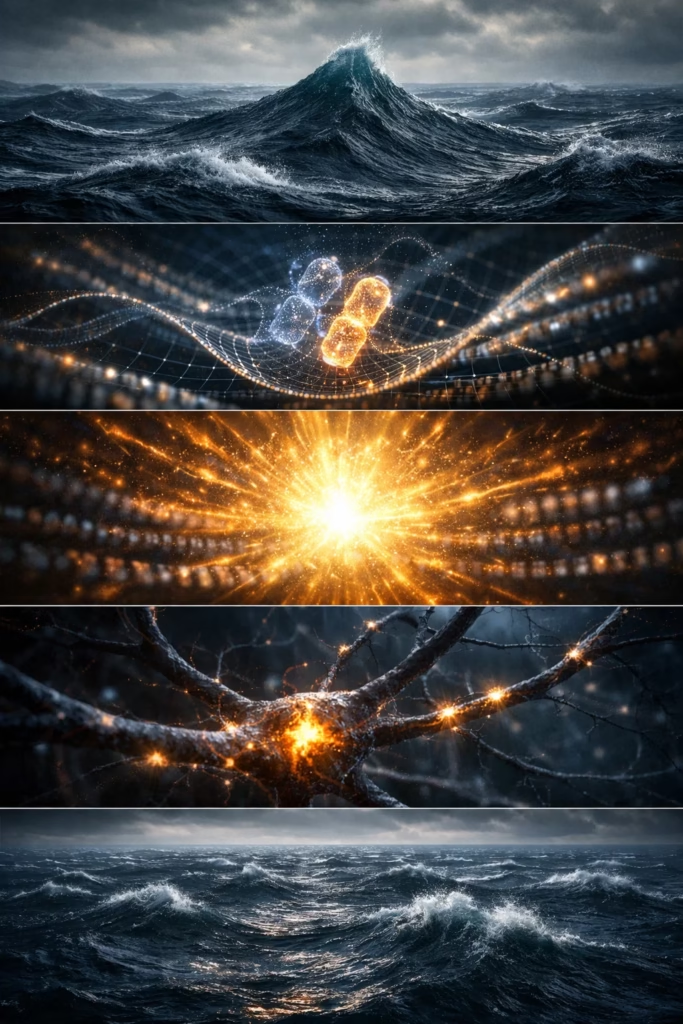
Let us now return to our image. The Dirac Sea is an ocean of information. Our consciousness is a wave on its surface. The Schrödinger equation describes the evolution of that wave – and it is deterministic. But the collapse of the wave – the moment when superposition turns into reality – that process is not deterministic. It is objective reduction driven by gravity and shaped by the informational structure of the sea.
At that moment, at the boundary between quantum and classical, we choose. We do not choose randomly – we choose based on what we are, and what we are has been partly shaped by our previous choices.
That is the delicate balance: between the determinism of the wave function and the non‑algorithmicity of its collapse. Between randomness and freedom. Between fate and responsibility.
✨ Conclusion: The boundary where the future is made
Dear friends, we have no final answer to the question of free will. But what we have is a framework that preserves space for hope and responsibility.
Penrose’s objective reduction, combined with the Orch‑OR model, shows that consciousness is not an epiphenomenon – it is causally active. It is not mere computation – it is non‑algorithmic. And it is not random – it is informed freedom.
In a world where everything is deterministic, there is no room for ethics. In a world where everything is random, there is no room for meaning. But on the boundary between the two – where gravity dips its fingers into the quantum foam – there is space for authentic choice.
So, the next time you make a decision – large or small – remember that you are not mere observers. You are a wave rising from the Dirac Sea, and at the moment of collapse, you choose where the wave will break.
Free will is not an illusion. It is the deepest reality at the boundary between what is and what is yet to become.
Leave a Reply