
Dear explorers,
In previous posts we sailed across the Dirac Sea, traced its internal SU(3) × SU(2) × U(1) currents, hunted the topological vortices of monopoles, and felt the gravitational wind above its surface. Now we arrive at the most intriguing question of the entire voyage: what happens to information in that sea? Where does it go when it falls into a black hole? Is it destroyed, is it preserved, or is it – like a hologram – projected from a two-dimensional surface into our three-dimensional world?
This is a post about the hardest problem in contemporary physics: the black hole information paradox. And about the possibility that our Dirac Sea – with all its waves, particles and ourselves – is actually a holographic film.
🌀 The Two-Dimensionality of Spinors: A Hint of Something Deeper
Let us return for a moment to where our entire voyage began – Dirac’s equation from 1928. As we emphasized in some earlier posts, the mathematical solution for the electron is a two-component spinor. Although the electron moves in three-dimensional space, its internal degree of freedom – spin – lives in a two-dimensional complex space.
This two-dimensionality is not the holographic principle in the sense of AdS/CFT correspondence. But it is a deep hint that information in quantum theory does not always respect the dimensionality of the space in which the particle moves. The spinor is, in a way, the first encounter with the idea that reality can be “thinner” than the space it occupies.
This insight becomes explosive when combined with modern understanding of black holes.
🕳️ Black Holes and the Birth of the Holographic Principle
As we discussed in detail in an earlier post on the holographic principle, the story begins with Jacob Bekenstein. In the 1970s he discovered something shocking: the entropy of a black hole – a measure of its information “storage” capacity – is proportional not to its volume, but to the surface area of the event horizon.
Mathematically: S = A/4 (in Planck units).
Translated into everyday language: a black hole with a diameter of 1 cm cannot store as much information as you would expect from a three-dimensional object of that size – but only as much as fits on its two-dimensional surface. As if the interior is literally empty.
This was the starting point for Leonard Susskind and Gerard ‘t Hooft, who each, from their own perspective, formulated the holographic principle: perhaps it is not just about black holes. Perhaps our entire three-dimensional universe is only a holographic projection of information encoded on a distant two-dimensional surface. Volume is an illusion. Space is emergent.
⚛️ Hawking Radiation and the Terrible Price of Thermality
In 1974, Stephen Hawking took a step that complicated everything. Applying quantum mechanics to a black hole, he showed that the horizon is not perfectly black: due to quantum fluctuations near the horizon, the black hole emits radiation. Hawking radiation is thermal in nature – completely random, without any information about the matter that fell into the black hole.
The consequence is terrifying: the black hole gradually evaporates, and when it finally disappears, all information about what ever fell into it – about atoms, about stars, about any messages sent inside – is lost forever.
The problem? Unitarity, one of the most sacred principles of quantum mechanics, claims the opposite: information is never destroyed. The wave function evolves reversibly in time. What appears random is merely a consequence of our incomplete knowledge, but in principle – information is always somewhere.
Hawking was prepared to throw unitarity out the window. Most physicists were not.
🔥 The AMPS Paradox and the Firewall on the Horizon
In 2012, four physicists – Ahmed Almheiri, Donald Marolf, Joseph Polchinski and James Sully – sharpened the paradox, known by their initials: AMPS.
The problem is as follows:
- A Hawking mode (a particle escaping from a black hole) must be quantum-entangled with early Hawking radiation to maintain unitarity – for information to be preserved.
- But that same mode must also be maximally entangled with its interior partner outside the horizon for the horizon to be smooth (i.e., for Einstein’s theory to hold).
- The problem? Quantum mechanics, through monogamy of entanglement, forbids a single particle from being maximally entangled with two independent systems simultaneously.
The AMPS conclusion was dramatic: one of three things must fall – unitarity, Einstein’s theory (smoothness of the horizon), or local quantum field theory. If unitarity is intact, the black hole horizon is not smooth – it is a firewall that incinerates everything that approaches it.
🏝️ Entanglement Islands: Information’s Stylish Escape
The revolution came from AdS/CFT correspondence – the most precise realization of the holographic principle. A new computational technique, known as “entanglement islands” , showed how the Page curve (which tracks the entropy of Hawking radiation) can be calculated directly from the gravitational path integral.
The key mechanism? Replica wormholes – virtual tunnel connections between multiple copies (replicas) of the same system. In the semi-classical limit, these wormholes form bridges between different parts of the quantum system, allowing information to “bypass” the horizon and remain connected to the outside world. When entropy is calculated through these configurations, the Page curve emerges naturally: entropy first rises (as Hawking predicted), then begins to fall, meaning information starts to return.
As one leading paper from 2026 emphasizes, these islands are intrinsically region-dependent – there is no single universal island serving all possible observers. Each choice of radiation region defines its own island. This is subtle but deeply important: reconstructing information from a black hole depends on the observer’s perspective. Universality, long the gold standard of objectivity in physics, encounters serious obstacles here.
🪞 ER = EPR: A Wormhole is Entanglement, Entanglement is a Wormhole
Here we arrive at perhaps the boldest idea in modern theoretical physics. In 2013, Juan Maldacena and Leonard Susskind proposed a radical equivalence: ER = EPR.
An Einstein-Rosen bridge (ER) – a wormhole connecting two black holes – is the geometric equivalent of an Einstein-Podolsky-Rosen pair (EPR) – a quantum-entangled pair of particles. In other words: every entanglement is a wormhole. Every wormhole is entanglement.
This is not metaphor. This is literal mathematical equivalence. If true, then gravity and quantum mechanics are not two separate theories to be reconciled – they are two manifestations of the same fundamental structure. Spacetime is emergent; it arises from quantum information.
In our Dirac Sea metaphor: entanglement between particles in the sea is not just an abstract quantum phenomenon. It is geometry. Every time two particles in the sea become entangled, a microscopic wormhole “tightens” between them – a thread of geometry connecting them through the very fabric of space. The Dirac Sea is not just an ocean of fields; it is a fabric made of entanglement.
🔐 Renato Renner and the Role of the Reference Frame: Why the Paradox is Not Yet Solved
And here we arrive at the key point of this discussion of the paradox. It is still not fully resolved.
Renato Renner, one of the world’s leading experts in quantum information, together with collaborators published a paper in 2021 titled “The black hole information puzzle and the quantum de Finetti theorem”. Their analysis from the perspective of quantum information theory yields the following key insight: information about the content of a black hole is preserved, but its decryption is not possible without a reference system.
Renner and Wang showed the following: the entropy of Hawking radiation originally calculated by Hawking (S(R)) corresponds to unconditional entropy – that seen by an individual observer who has no access to any additional reference system. But the entropy obtained through replica wormholes and islands – i.e., the entropy following the Page curve – corresponds to conditional entropy S(R|W): the entropy of the radiation R given access to a reference system W.
What is W? It is information that is neither part of the black hole nor part of the radiation, but plays the role of a reference. Without it, the entropy appears to increase monotonically (Hawking’s picture). With it, the entropy follows the Page curve – information is preserved.
Experimentally, this result gains operational meaning only when we have N independently prepared black holes: for large N, the conditional entropy S(R|W) equals the normalized entropy of the joint radiation of all N black holes (S(R₁…R_N)/N).
In other words: to fully decode the information from a single black hole, you need other black holes with which you can establish correlations. Without them, you as an individual observer see only thermal, meaningless radiation – even though the information is, in principle, preserved.
This is a fascinating twist: information is not destroyed (unitarity is safe), but its usefulness – the ability to reconstruct, read, understand it – depends on the reference frame. The paradox is “technically” solved, but still not resolved from the standpoint of the individual observer. As if the Dirac Sea preserves every drop of information, but does not allow you to read it unless you gather enough of its waves.
📜 Information Holography: Everything is Already Encoded on the Horizon
The latest papers from 2025–2026 go even further. Some authors propose that information about the interior of a black hole is already encoded in the external description itself – in asymptotic observable states at infinity – and that Page curves and islands are not a fundamental recovery of information, but merely a redistribution of information between what the observer measures and what lies beyond their reach.
In other words: information never even entered the black hole in a way that would isolate it from the outside world. It was always there – on the horizon, in the correlations, in the subtle asymptotic observables. This is called the principle of information holography: the interior is reconstructible from the exterior, and the Hilbert space of gravity cannot be simply factorized into interior and exterior parts as in ordinary quantum field theory.
This is deeply connected to our original observation about the two-dimensionality of spinors and Dirac’s intuition: information in fundamental physics does not live in volume, but on the surface. The spinor was the first hint; the holographic principle is its cosmic realization.
🌊 All of This in the Dirac Sea: A Holographic Film That Breathes
Let us now return to our central metaphor, enriched by all these insights.
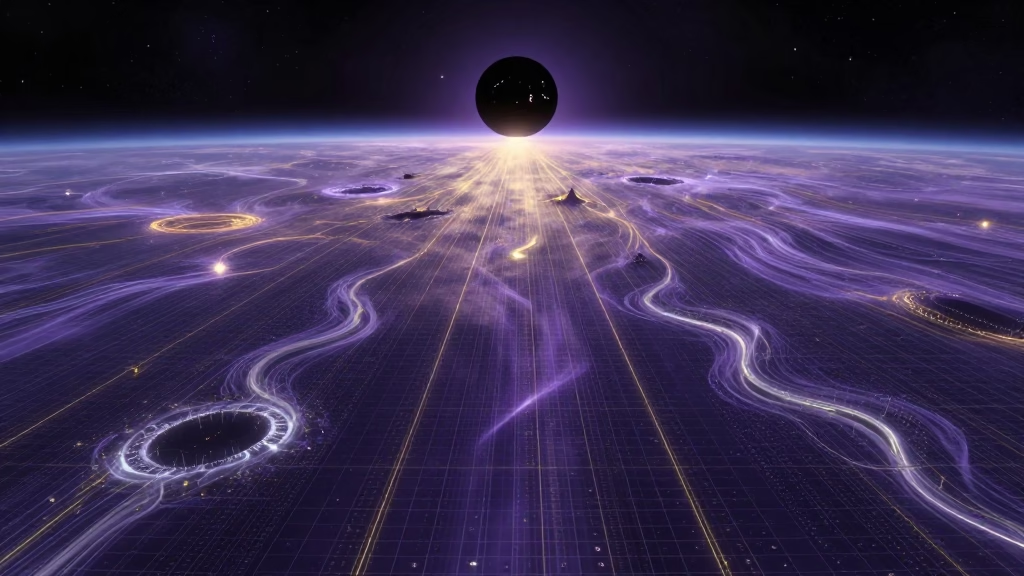
The Dirac Sea is not merely a three-dimensional ocean of quantum fields through which waves travel and in which topological vortices spin. It is a holographic film. All information about everything happening in the depths of the sea – every particle, every interaction, every symmetry – is already encoded on its surface.
The black hole horizon, in this picture, is neither a wall that destroys information nor a passage that swallows it. It is a screen onto which information is projected and from which it can later be read – provided we gather enough correlations, enough reference frames, enough waves from other parts of the sea.
The gravitational wind – Penrose’s objective reduction – gains a new role here. It is not merely the great smoother that “irons out” fluctuations. It is the mechanism that chooses which information becomes classical and which remains in quantum foam. The entanglement factor, like microscopic wormholes, connects all parts of the sea into a single whole – and each time the gravitational wind triggers a collapse, that whole restructures around a new, classical outcome.
🔮 Horizons: What Remains Open?
What we have sailed through today is perhaps the deepest part of our journey – and the place where the horizon of our knowledge is most clearly outlined. The information paradox is far from a final resolution:
- Is the holographic principle strictly tied to AdS space (negative cosmological constant) or can it be extended to the de Sitter space in which we live?
- Is ER = EPR strictly correct for all systems or only an approximation?
- How to reconcile the fact that information is preserved but not useful without a reference system – and what does that mean for the notion of “objective reality”?
- If the interior of a black hole is reconstructible from the exterior, does that mean spacetime is not fundamental – but emergent from quantum information, as Penrose and Susskind independently suggest?
- And finally: is the Dirac Sea – in its deepest essence – a two-dimensional holographic film, and is our three-dimensional experience, our lives, our entire physical reality, merely a projection from its surface?
This post continues the series begun with “⚛️ Quantum Archaeology: Reading the Past from the Dirac Sea” and continued through posts on discrete spacetime, the symphony of the Standard Model, the Big Ring, the Folman experiment, the Penrose-Hawking debate, and Dirac monopoles.
Leave a Reply