
In the post “Tesla Between Myth and Reality: Vacuum Energy, Longitudinal Waves, and QED”, we touched upon Tesla’s pursuit of longitudinal waves – what he called a “field of potential” – and asked whether modern physics leaves room for such a phenomenon. Today we go a step deeper, straight into the mathematics. And the story begins with a forgotten number system that was too far ahead of its time – quaternions.
🧮 What Are Quaternions, Anyway?
Most of us grew up believing that everything in mathematics is sufficiently described by real and complex numbers. But in 1843, the Irish mathematician William Rowan Hamilton, after years of searching, carved into a stone bridge in Dublin an equation that changed everything:
i² = j² = k² = ijk = -1
Thus, quaternions were born. Think of them as an extension of complex numbers, but instead of a single imaginary part *i*, we now have three: *i*, *j*, and *k*. Each quaternion is written as:
q = a + bi + cj + dk
where *a* is the scalar (one-dimensional) part, and bi + cj + dk is the three-dimensional vector part. The crucial thing: a single quaternion structure unifies a scalar and a vector. This property would prove fateful for physics.
Hamilton was convinced that quaternions are the natural language of the universe. Modern engineers surprisingly often use them for rotations in 3D graphics and robotics (because they avoid the problem of “gimbal lock” – a phenomenon that occurs in gyroscopes or systems with three axes of rotation (cardan joint) when two axes align in the same plane), but in physics they have been completely pushed aside in favor of simpler vector algebra. Was that a mistake?
📜 Maxwell’s Original: The Equations You’ve (Probably) Never Seen
When James Clerk Maxwell published his monumental theory of electromagnetism in 1865, he wrote it precisely in the language of quaternions. His original 20 equations combined the scalar and vector properties of fields into an inseparable whole.
What happened next was a turning point. Oliver Heaviside and Josiah Willard Gibbs, for the sake of practicality, “translated” and reduced Maxwell’s system to the mere 4 equations we learn today, using vector algebra. In doing so, the scalar part of the quaternion was simply discarded. It was considered physically irrelevant, perhaps a relic of mathematical form without a correlate in reality. As physicist Sergio Dutra explains, Heaviside and Gibbs “forcibly” removed the fourth component of the quaternion, which led to the “dismemberment” of the original quaternion product into the two types of products we know today – the scalar product and the vector product.
Dr. Goran Marjanović, a great connoisseur of Nikola Tesla’s work, points precisely to this: that discarded scalar component hides the possibility of longitudinal waves, similar to acoustic ones – exactly what Tesla was seeking.
🔬 Mathematical Proof: Longitudinal Modes Are Not Fantasy
The question arises: is this just empty speculation? The answer is – no. There are rigorous mathematical papers that, returning to the full quaternionic formalism and generalizing electrodynamics, derive a wave equation that naturally includes a longitudinal mode, alongside the standard transverse one.
Here are key examples from the scientific literature:
- Generalized Electrodynamics with a Scalar Field: Authors van Vlaenderen and Waser (2001), in their paper “Generalisation of classical electrodynamics to admit a scalar field and longitudinal waves,” showed how classical electrodynamics can be extended to include a scalar field and longitudinal waves. Their theory predicts the existence of a longitudinal electroscalar wave (LES wave) in the vacuum. This is not alternative physics; it is a valid mathematical generalization.
- A New Scalar Field Component: A more recent paper by Dunning-Davies and Norman (2020), “Deductions from the Quaternion Form of Maxwell’s Electromagnetic Equations,” analyzes the quaternionic form and concludes that a new, seventh scalar component of the electromagnetic field appears in it, one that has no counterpart in the standard Heaviside description. They derive a new scalar wave equation and point to possible connections with gravity and energy extraction from the vacuum.
- Quantized Maxwell’s Equations and Longitudinal Magnetism: There are also works that explore the quantized version of these equations and find solutions with zero magnetic field that lead to longitudinal waves accompanied by a scalar magnetic field.
These solutions are mathematically valid. The question is no longer “do the equations allow them,” but “are these solutions physically realized in our universe, and how can we produce them experimentally.”
⚡ Return to Tesla: A Coil That Emits the “Impossible”?
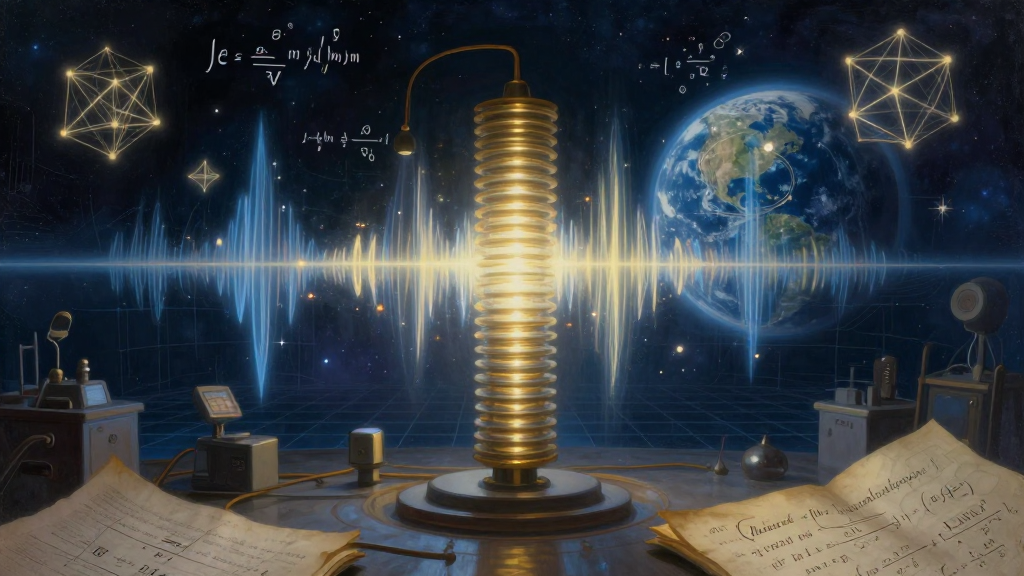
When this theoretical framework is put in place, Tesla’s experiments gain a new dimension. Engineers like Handwerker (2011), in the paper “Longitudinal dielectric waves in a Tesla coil and quaternionic Maxwell’s equations,” directly claim that a Tesla coil is not an ordinary transformer. It also emits powerful longitudinal dielectric waves, which can be described precisely by the extended, quaternionic Maxwell theory.
Tesla worked with extreme voltages and steep impulses – a regime in which dielectrics and the ether (i.e., the vacuum) behave nonlinearly. What he called a “longitudinal wave” or “scalar wave” could be a macroscopic, coherent excitation of precisely that scalar field component that was lost in the standard Maxwell description.
This fits remarkably well with the picture from the mentioned post: modern physics has discovered the Higgs field (a fundamental scalar field), vacuum energy, and the Casimir effect. And now we see that even the core electromagnetic equations, in their original, richer form, leave the door ajar.
💎 Conclusion: Is It Worth Going Back to the Beginning?
Heaviside’s and Gibbs’s simplification of Maxwell’s equations gave us technological civilization – radio, radar, telecommunications. That undertaking was an incredible success. But in the process, perhaps we, like careless restorers, painted over a part of the picture we didn’t know was important.
Returning to the original Maxwell, through the lens of quaternions and in light of new discoveries in fundamental physics, is not a mere archival exercise. It is a legitimate, albeit alternative, path of research that could explain Tesla’s anomalies and open entirely new channels for the transmission of energy and information.
Tesla did not have the mathematics to describe what he sensed, but he had the hands and the intuition to touch it experimentally. Today’s “scalar hunters” may, following those same footsteps but now with a firm mathematical tool, find what Tesla was seeking.
What do you think? Will we finally solve Tesla’s mysteries through the combined efforts of theorists and engineers inspired by Tesla’s work?
Leave a Reply