This post continues our technical analysis of Tesla’s transformer with an extra coil, in which we established that the three-coil magnifier is one of Tesla’s greatest works. Now we go a step further – into the heart of the ambition that cost Tesla almost everything: Wardenclyffe Tower, his “cursed child.”
🌍 The Tower That Was to Change the World
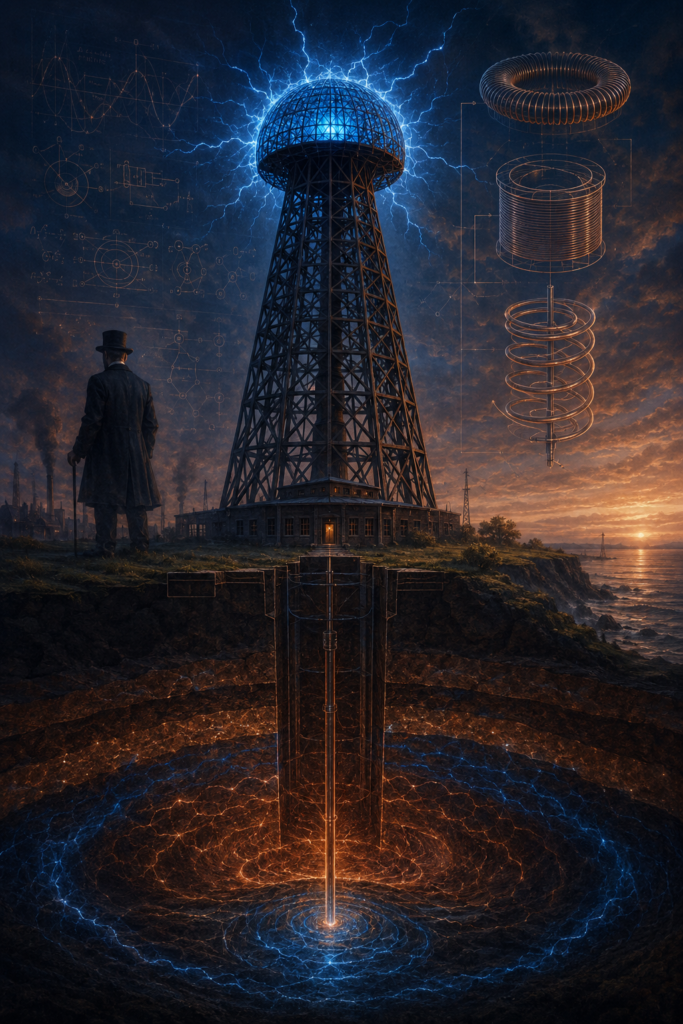
Imagine Long Island, 1901. Nikola Tesla, at the peak of his fame, convinces America’s most powerful banker, J.P. Morgan, to build a station that will wirelessly transmit messages across the Atlantic – a direct competitor to Marconi. Morgan invests 150,000(around 5.5 million today), and Tesla begins constructing a tower 57 meters tall, with a dome 20 meters in diameter, above a 36-meter-deep shaft with grounding tunnels. Architect Stanford White designed the structure. The planned transmitter power was 300 kW, driven by Westinghouse generators – almost 17 times Marconi’s 18 kW.
But Tesla sold Morgan the story of telecommunications, while secretly nurturing a far greater dream: global wireless electrical power transmission. When Morgan discovered the true purpose, he pulled funding in 1903. A decade of Tesla’s desperate attempts to win Morgan back and find new investors followed, culminating in his expulsion from Morgan’s office in 1904. By 1917, the tower was demolished – not because it didn’t work, but because no one wanted to pay for it anymore.
🔬 The Technical Core: The Magnifier as the Heart of Wardenclyffe
To understand why Wardenclyffe was so different from anything that existed, we must return to the device we analyzed in detail in the previous post – Tesla’s magnifier with an extra coil.
The basic tower configuration was exactly the three-stage system: the primary (a few turns, low inductance) created the initial magnetic field; the secondary (“driver”) raised the voltage to hundreds of thousands of volts; the extra coil (a helical resonator with no direct magnetic coupling to the first two coils) further amplified the voltage through the principle of resonant amplification to the desired millions of volts. The tower’s dome (20 meters in diameter) served as a high-voltage terminal electrode – a capacitive “reservoir” that enabled energy to be delivered in controlled pulses.
But this was no ordinary transmitter. Tesla claimed that his system did not emit standard Hertzian (transverse) waves that fall off with the square of distance, but used a completely different transmission mechanism through the Earth. In his 1916 court testimony, Tesla explained that 90–95% of the energy manifests as “current waves” traveling through the ground, while only a small portion goes to the antenna structure and results in standard EM radiation.
In patent 1,119,732, he describes in detail an apparatus for transmitting energy. The key idea was to excite the Earth with standing waves – precisely what he discovered that night of July 3, 1899, in Colorado Springs – so that the entire planet would become a resonant conductor. As he himself said: “In place of an echo, I obtained a stationary electrical wave, a wave reflected from afar.”
🌊 The Mystery of the Waves: Non-Hertzian, Longitudinal, or Something Else?
Here we come to the most controversial aspect of Tesla’s work. What exactly did Tesla mean by “non-Hertzian waves”?
First interpretation – longitudinal (scalar) waves: Tesla explicitly stated that his waves were non-Hertzian and did not fall off with the square of distance. This led many researchers (such as Tom Bearden) to conclude that Tesla was using longitudinal scalar waves – precisely what standard Maxwell’s equations in vector form do not permit, but which becomes possible in the original quaternionic formalism we covered in detail in our post on quaternions. Supporting this interpretation is the tower’s design itself: documentation explicitly states that the dome was designed to project “longitudinal electrical waves through the ground and atmosphere.”
Second interpretation – Zenneck surface waves: More recent research suggests that Tesla’s waves may be something quite concrete within existing physics – Zenneck surface waves. This type of wave travels along the interface between earth and air, does not spread like radiation, and falls off with the square root of distance, not the square. As Dr. James Corum explains: “The distinguishing feature of the Zenneck wave was that the propagating energy didn’t spread like radiation, but was concentrated near the guiding surface.” Recent investigations have confirmed that these waves can indeed be generated, especially at low frequencies.
Third interpretation – standing waves and Earth resonance: There is also an interpretation that Tesla was simply using the phenomenon of standing waves in the Earth-ionosphere system – what we today know as Schumann resonances. He believed the entire planet could resonate like a tuning fork, with minimal losses, enabling efficient energy transmission. Modern measurements have shown that the Q factor of this system is low, but the principle itself is not wrong.
Fourth interpretation – solitons: Given the extreme voltages and pulses Tesla used, some researchers suggest that solitons could have formed in the ground – nonlinear wave packets that travel without dispersion or energy loss.
⚡ Voltages and Power: Limits That Still Inspire Awe Today
To understand the scale of Tesla’s ambition, we need to look at the numbers. Based on available documentation and his notes from the Wardenclyffe construction period, Tesla aimed for voltages of 100 megavolts (100 MV). This is the voltage he experimentally achieved in his earlier experiments – and which, as far as is known, no one has ever repeated in public, civilian research. Today’s record-holding Tesla coils reach only a few megavolts (Greg Leyh’s largest modern coil reaches about 3 MV).
As for power, the theoretical emission capacity of Tesla’s system was estimated at as much as 10 gigawatts (10 GW). For comparison, the generator Tesla had at Wardenclyffe was merely 300 kVA (about 300 kW) – meaning the input-to-output power ratio was supposed to be 1:33,000. This is not a perpetuum mobile, but the key concept of the magnifier: resonant amplification. Tesla wasn’t “creating” energy; he was accumulating relatively small input power over many cycles in a high-Q resonant circuit, then releasing it in short, powerful pulses – giving enormous instantaneous power without changing the total energy equation. This is the same principle used today by pulsed lasers and particle accelerators.
As one researcher noted: “In his experiments, Tesla managed to derive a voltage of 100 Mega volts, but this (as far as is known) no one did again.” This fact – that Tesla’s voltage records have stood for more than a century – speaks volumes about the level of his engineering genius.
🔬 Mathematical Modeling – Still Open Questions
As with the extra coil, precise mathematical modeling of the Wardenclyffe system remains a challenge. It is not an ordinary resonant circuit with lumped parameters, but a distributed system where the extra coil functions as a “slow-wave helical resonator” with distributed inductance and capacitance. The wave propagation velocity through such a coil can be just 1–10% of the speed of light.
Particularly intriguing is the possibility that Wardenclyffe functioned as a quadruple resonant system: primary, secondary, extra coil, and the Earth itself as the fourth resonant element. This would mean Tesla was attempting to align (i.e. “tune”) the resonant frequencies of all four elements – an engineering feat that would still be extremely demanding today.
The nature of the waves the system generated also remains an open question. Were they longitudinal (scalar) waves? Zenneck surface waves? Standing waves in the Earth’s crust? Or a combination of all the above, depending on the operating regime? The fact that we still cannot agree on the answer shows how far ahead of his time Tesla was.
🎯 Conclusion: The Price of Vision
Wardenclyffe is a story of engineering genius that went too far for its time – and for its financiers. Let us recall: while Marconi successfully sent the letter “S” across the Atlantic with 18 kW, Tesla designed a 300 kW system intended to send energy, not just signals. Marconi’s technology was simpler, cheaper, and – most importantly for investors – immediately profitable. Tesla’s system promised a revolution but required enormous initial investment without quick returns.
Nevertheless, the questions Tesla posed through Wardenclyffe remain alive today: Can energy be transmitted through the Earth with minimal losses? Do longitudinal waves exist that do not fall off with the square of distance? Can the Earth resonate like Tesla’s magnifier – a few primary turns exciting the entire planet? Science is still searching for answers.


Leave a Reply