This post continues our renewed series on Tesla, in which we now, with greater technical and scientific depth, re-examine his most important insights. Today we turn to a topic that was both personally important to Tesla and an engineering challenge – his contribution to medical therapeutics.
🔬 Tesla’s Medical Patents: The Engineer Who Took the Body Seriously
When we hear the words “Tesla” and “medicine” in the same sentence today, we often think of dubious devices from the internet. But the truth is far from that. Tesla indeed held patents and developed apparatus for medical application, and with genuine engineering grounding.
His most famous medical invention was the Tesla therapeutic current – high-frequency, high-voltage, but with extremely low amperage, making it safe for the human body. Tesla discovered that such a current, when passed through the body, induces deep tissue heating without skin damage – a principle that is today at the foundation of diathermy, a standard physical therapy modality. As early as 1891, he demonstrated how a current of 100–200 kHz could pass through the human body without pain, producing a sensation of pleasant warmth and increased blood circulation.
Tesla also patented high-frequency generators for medical application, including ozonators for sterilization and the treatment of skin conditions. His work with X-rays (which he called “Roentgen rays”) was pioneering – he imaged human extremities and described the therapeutic use of radiation, along with safety measures that were far ahead of his time (use of lead aprons, limiting exposure time).
In a review published in Vojnosanitetski pregled in 2018, the authors systematically enumerate Tesla’s medical innovations: from the first X-ray images and wireless transmission through the body, to the concept of the “electromagnetic skeleton of man” and the idea that the organism can be treated as an electromagnetic system – decades before mainstream medicine accepted such an approach.
🧬 From Intuition to Science: The Body as an Energy System
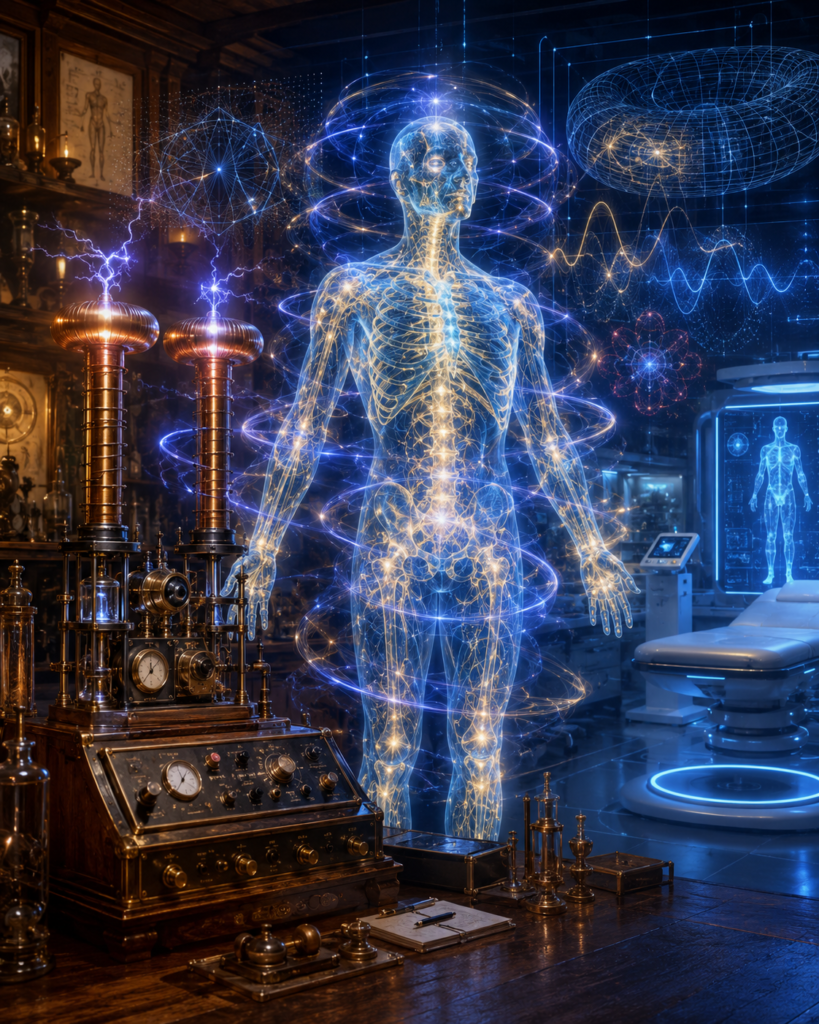
What sets Tesla apart from his contemporaries is his ability to see the human body not only as an anatomical structure, but as an electromagnetic system. This was no mere metaphor for him. He believed that every cell, every nerve, every organ possesses its own electrical resonance and that disease arises when that resonance is disturbed. His therapeutic idea was simple and profound: return the body to its natural frequency.
This idea, radical for the Victorian era, is today part of mainstream medical research. Modern biophysics confirms that cell membranes function as electrical capacitors, that mitochondria generate measurable EM fields, and that intercellular communication includes electromagnetic signals. Specifically, research shows that weak EM fields can modulate cellular processes such as proliferation, differentiation, and apoptosis, opening the door to non-invasive therapies for tissue regeneration and the treatment of chronic wounds. Tesla’s “intuition” here acquires concrete biophysical mechanisms.
It is important, however, to understand the nature of this Tesla’s intuition. It did not come from mystical visions, as some popular portraits would have us believe. It came from immense dedication to the problem, extraordinary breadth of education and interests, and a unique ability to look at the world simultaneously through the eyes of an engineer and a scientist. Tesla read medical journals, followed the work of physiologists, experimented on himself. His intuition was the distillate of knowledge and experience, not an irrational flash.
Quantum Medicine: Tesla’s Unacknowledged Successor in Kyiv
What is particularly fascinating is that Tesla’s vision found its institutional continuation not in the West, where the medical establishment was more conservative, but in the then USSR.
The term “quantum medicine” was officially coined by the Soviet, and later Ukrainian physicist Serhiy Sitko. He began systematic research in Kyiv on the idea that the human organism is fundamentally an electromagnetic system and that many pathological conditions can be understood and treated through the lens of quantum physics. In 1986, under the auspices of the USSR Ministry of Health, Sitko founded the Scientific Research Center for Quantum Medicine “Vidhuk” in Kyiv – which is, as far as is known, the first state institute in the world dedicated precisely to this approach.
Sitko’s approach, known as Microwave Resonance Therapy (MRT), differed from Tesla’s in frequency range – Tesla worked with high frequencies (on the order of hundreds of kHz to MHz), while Sitko used microwaves (on the order of GHz) – but the philosophy was nearly identical: the organism is a resonant system and the goal of therapy is to restore its natural electromagnetic balance. The Vidhuk Center conducted rigorous clinical testing on thousands of patients and documented positive effects of MRT for a range of conditions, including chronic pain, autoimmune diseases, and circulatory disorders. Published papers from this institution passed peer review and are part of the scientific literature, although the concept of “quantum medicine” still remains outside the mainstream in the West.
💪 Personal Drive: Health as a Prerequisite for Genius
Reading his autobiography “My Inventions”, one cannot help but notice how dedicated Tesla was to his own health and the preservation of vitality. His famous daily routine – precisely measured meals, walks of exactly 13 kilometers, strict maintenance of body weight at 64.5 kg – was not mere eccentricity. It was an engineer’s care for his own organism. Tesla understood, better than most of his contemporaries, that health is a prerequisite for long-term intellectual productivity. He could not afford illness and drops in energy if he wanted to fulfill his mission. His involvement with medicine had, therefore, a deeply personal impetus as well – he was the first patient on whom he tested his ideas about vitality, frequency, and energy.
Moreover, Tesla repeatedly emphasized that the role of the innovator and scientist is to ease human life and raise its quality. In that, health and its preservation are among the most important aspects. His altruism was not naive – it was rooted in the conviction that technology should serve humanity, and not the other way around. “The scientist does not seek an immediate result,” he wrote. “He does not expect his advanced ideas to be readily accepted. His work is to lay the foundations for those who will come, and to point the way.”
⚠️ Where Science Ends and Legend Begins?
Here we must draw a clear line. Tesla’s name is today, unfortunately, often used to sell “miracle” devices that allegedly cure everything – from cancer to depression – using “Tesla frequencies” or “scalar energy”. The vast majority of these products have nothing to do with Tesla’s actual work and have not passed any clinical testing. This is an exploitation of Tesla’s name for commercial purposes, and Tesla, knowing his attitude towards pseudoscience and spiritualists, would almost certainly have been appalled.
Even quantum medicine, such as that developed by Sitko at the Vidhuk Institute, which has passed rigorous testing, represents an alternative and a supplement to official medicine, not a replacement for it. It cannot replace surgical intervention, antibiotics, or oncological therapy. What it can do is offer additional options where conventional medicine has limitations – particularly in the domain of chronic pain, regeneration, and functional disorders. And anyone who claims otherwise, whether invoking Tesla or quantum physics, deserves a healthy dose of skepticism. Tesla’s legacy deserves honesty, not mythologization.
🎯 Conclusion: Foundations for the Future
New breakthroughs and research in the field of quantum biology – from cryptochromes in the eye of birds to quantum effects in photosynthesis and cellular respiration – are opening the door to broader application of these principles in the future. What Tesla sensed at the end of the 19th century, and Sitko formalized at the end of the 20th, is today becoming the subject of serious scientific research around the world.
In doing so, we must be aware that there will always be those willing to profit from others’ hope. Tesla’s name will continue to be used to sell magical devices. But that does not diminish the value of his real contribution – on the contrary. The true tribute to Tesla is not blind faith in his words, but the continuation of his method: boldly pose hypotheses, rigorously test them, and never give up the search for truth.
Tesla laid the foundations. We are only just entering the building.
What do you think? Is Tesla’s vision of medicine as an energetic balance a path to follow, or has it remained at the level of an intriguing, but outdated intuition?
Leave a Reply