This post continues our renewed series on Tesla, in which we now, with greater technical and scientific depth, re-examine his most important insights. Today we turn to a topic that established Tesla as one of the spiritual fathers of modern automation, robotics, and drones – his pioneering work on teleautomatics.
🔬 Three Patents That Changed Everything
Tesla’s contribution to automation was not merely theoretical – it was deeply engineering, rooted in concrete technical solutions. Three patents form the core of this legacy.
Patent 613,809 – Method of and Apparatus for Controlling Mechanism of Moving Vessels or Vehicles (1898)
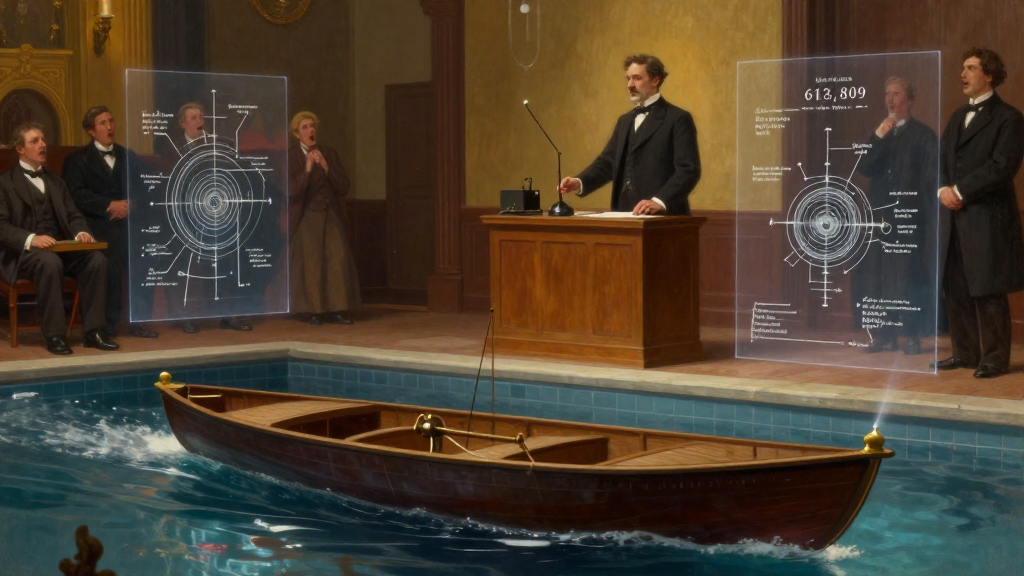
This is Tesla’s most famous patent in the domain of teleautomatics, filed on July 1, 1898, and approved on November 8 of the same year. The patent covers a system for remote control of vessels or vehicles using electromagnetic waves. Tesla already foresaw that this was not just about vessels – the patent explicitly states that the same method can be applied to “any mechanism that is moved or controlled by its own power.” This is, in essence, the world’s first patent for a drone.
The device was exceptionally advanced for its time. It used a receiver with a coherer – an early type of radio detector containing metal filings. When a radio signal struck the coherer, the filings would clump together, changing resistance and activating the circuit. After each received signal, the coherer had to be reset – Tesla patented a mechanism with continuous rotation that did this automatically, without the need for manual shaking.
The demonstration at Madison Square Garden in 1898, at the first annual Electrical Exhibition, became legendary. Tesla, before a live audience, controlled a boat about one meter long, which could turn, start, stop, go forward and backward, and even light lamps on it – all wirelessly. While people of that time thought it was a trick, Tesla was already building the future.
Patent 723,188 – Method of Signaling (1903)
This patent, filed in 1902 and approved in 1903, represents a key advancement in remote control systems. Tesla elaborated the principle of selective signaling that enabled multiple devices to be controlled simultaneously over a single channel – each reacting only to its specific frequency or code. This concept is a direct predecessor of today’s multiplexed communication systems and remote controllers that use different frequencies for different commands.
Patent 725,605 – System of Signaling (1903)
A supplementary patent, further elaborating mechanisms for coding and transmitting commands. Tesla here anticipated what would later become the standard in remote control: the idea that complex commands can be broken down into a series of simple pulses and transmitted through the ether.
🧠 Man as an Automaton: Tesla’s Vision of Biological Systems
What is even more fascinating than these patents is Tesla’s reflection on the nature of life itself. Tesla repeatedly put forward the idea that biological organisms, including human beings, are to a certain extent automata – systems that react to external stimuli according to the laws of physics.
This was not cynical mechanism. Tesla saw organisms as exceptionally complex electrochemical machines whose behavior can be understood through the lens of energy, frequency, and vibration. His conviction that the human brain is an electrical organ that receives and emits signals – today confirmed by neuroscience – was at the foundation of this idea. “Automata are what we are,” Tesla wrote, “but automata driven by forces we have yet to understand.”
This philosophy is directly connected to his work on teleautomatics. If a living organism is an automaton, then artificial automata can also be designed on the same principles – to receive, process, and execute commands.
🌐 From Patents to Drones: Tesla’s Legacy in the 21st Century
Tesla’s patents and demonstrations from 1898 laid the foundation for an entire industry. Today’s remote-controlled drones, whether military unmanned aerial vehicles or commercial quadcopters, are direct descendants of Tesla’s boat. The principle is the same: wireless transmission of commands, receiver, actuators executing commands.
Moreover, Tesla also foresaw autonomy – the idea that an automaton can act without direct human control, reacting to environmental conditions according to predefined rules. This is the basis of today’s artificial intelligence in robotics: from self-driving cars to autonomous exploration drones.
If we look at today’s trends, Tesla’s vision gains even more weight. Even the modern company Tesla, under the leadership of Elon Musk – named precisely after Nikola Tesla – recently announced in its Master Plan 4 that 80% of the company’s future value will come from the humanoid robot Optimus. This is no coincidence: Musk’s plan, with its focus on AI and autonomous robots, explicitly continues the vision of the man whose name the company bears – a vision in which automata take over monotonous and dangerous work, freeing people for higher goals.
🎯 Conclusion: The Man Who Launched the First Drone
When Tesla demonstrated his remote-controlled boat in 1898, the audience was amazed, but few understood what was really happening. They thought it was a trick, that a trained monkey was hidden inside the boat, that everything was rigged. Only Tesla knew: he had just launched the first drone in history.
His three patents – 613,809, 723,188, and 725,605 – are not just historical documents. They are the foundation upon which today’s drone, autonomous vehicle, and robotics industry rests. And his philosophy of humans as automata, however controversial in his time, today opens doors for understanding consciousness through the lens of neuroscience and quantum biology.
Tesla was not just an electrical engineer. He was also the first robotics engineer – a man who understood that machines could be freed from wires and controlled from a distance, and that this was only the beginning of a new era.
What do you think? Was Tesla’s boat from 1898 truly the first drone in the world? And were his ideas about humans as automata a forerunner of today’s neuroscience, or have they remained at the level of fascinating but outdated intuition?
Leave a Reply