This post continues our renewed series on Tesla, in which we now, with greater technical and scientific depth, re-examine his most important insights. Today we turn to the most controversial chapter of Tesla’s legacy – his concept of a weapon he called “Teleforce,” which the world came to know as the “death ray.”
🎬 From Scientist to Comic Book Villain
You’ve probably seen that cartoon. Superman races through the air, breaks through a beam of deadly rays, and destroys the machine of a mad scientist who threatens to burn the world. That character – a solitary genius with a laboratory full of lightning – was modeled, among others, precisely on Nikola Tesla.
Popular culture turned Tesla into the archetype of the “mad scientist.” But the truth is, as always, more complex and more fascinating than fiction.
🔬 Teleforce: Defense, Not Offense
Tesla did not envision a weapon of conquest. His idea was the opposite – to create such a powerful defensive system that no country could be successfully attacked, thereby making war unthinkable. He called it “Teleforce,” but newspapers quickly coined the sensationalist term “death rays.” Tesla rejected this name: “This invention of mine does not contemplate the use of any so-called ‘death rays’.”
In a letter to J.P. Morgan Jr. in 1934, Tesla explained the essence: “The flying machine has completely demoralized the world. The new method I have perfected provides absolute protection against this and other forms of attack.” His system was meant to create an “invisible Chinese wall” around the borders of the country that possessed it.
⚙️ Four Inventions in One: The Architecture of Teleforce
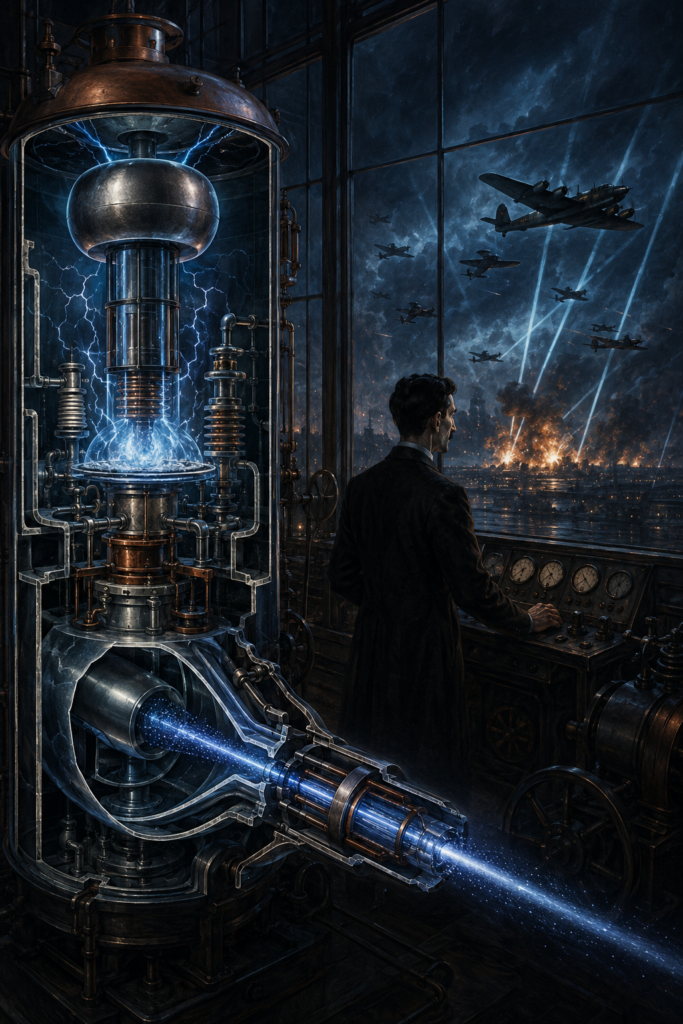
Teleforce was not a single device, but an integrated system of four key components.
First: to produce an enormous electromotive force – a voltage of around 50 million volts.
Second: a method for projecting particles through free air – that is, not through a vacuum tube, but through the atmosphere.
Third: a method for amplifying the force – concentrating the energy into a beam thinner than a hair.
Fourth: a projector, or “gun” – a system using electrostatic repulsion to eject particles, a principle still used today in particle accelerators.
🔋 The Improved Van de Graaff Generator: The Heart of the System
The basis of Teleforce was an improved Van de Graaff electrostatic generator. The classic Van de Graaff generator – the standard device of that time – used a rubber belt to transport charge to a metal dome. The problem was twofold: the capacity of the rubber belt is limited, and contact with air causes discharge – the belt simply “leaks” the accumulated charge.
Tesla proposed a radically different solution. He patented a system in which the rubber belt is replaced by a stream of pressurized gas circulating in a closed system using a compressor. This gas is ionized and transfers charge to the generator dome, achieving far greater efficiency and capacity. The generator itself would be housed in a tank filled with pressurized gas, providing insulation and preventing breakdown.
This concept is Tesla’s direct response to the fundamental limitation of the Van de Graaff generator – and another example of his ability to identify a bottleneck and offer an innovative solution.
⚡ 50 Million Volts: Voltages We Are Still Chasing Today
With the improved generator, Tesla aimed for voltages between 50 and 100 million volts. These are values that, even today, nearly a century later, are at the limit of engineering capabilities. As we wrote in our analysis of ball lightning, today’s most powerful Tesla coils reach only 3 MV, while Tesla was working with 12 MV in Colorado Springs. Teleforce was meant to go several times further.
How did Tesla plan to achieve these voltages without breakdown? By using his own invention: vacuum tubes. At the top of the generator dome, Tesla’s vacuum tubes would hold electrodes under voltage, while the vacuum insulation prevents unwanted sparking and discharge – the same principle he described in his earlier patents.
🚀 Nozzles and Particles: A Bullet Faster Than a Rocket
The heart of the system consisted of specially constructed nozzles. Tesla designed a unique vacuum chamber with one end open to the atmosphere – something that seemed impossible at the time. How to maintain a vacuum when the tube is open?
Tesla solved the problem ingeniously: a swift stream of air directed at the tip of the tube created a vacuum barrier. Air rushing at high speed through a Venturi tube creates a zone of low pressure – low enough to simulate a vacuum and prevent outside air from entering, while simultaneously allowing particles to exit. The pumping action would be achieved by a large Tesla turbine.
Inside these tubes would be particles of metals such as tungsten – microscopic spheres or needles. Under the action of electrostatic repulsion of 50 million volts, these particles would be accelerated to fantastic speeds. According to Tesla’s calculations, they would reach about 48 times the speed of sound – approximately 16 kilometers per second, or Mach 48. This is a speed that surpasses our fastest rockets and enters the domain of meteor particle velocities.
During this process, an enormous amount of thermal energy would be released. Tesla planned to use this energy to power the system itself – closing an energy loop that would make Teleforce self-sustaining.
📏 Range and Power: 250 Miles, 10,000 Aircraft
Tesla claimed that Teleforce could bring down a fleet of 10,000 enemy aircraft at a distance of 250 miles (about 400 kilometers). The particle beam would be concentrated into a jet thinner than a hair: “Several thousand horsepower can thus be transmitted by a jet finer than a hair, so that nothing can resist it.”
Tesla claimed that the beam suffers no dispersion even at great distances, thanks to a phenomenon of “gas focusing” – the particles maintain themselves in a narrow beam through interaction with the atmosphere.
Due to the curvature of the Earth, the range was limited to about 200–250 miles, which further emphasized the defensive nature of the system.
📜 The 1937 Tract: “New Art of Projecting Concentrated Non-Dispersive Energy”
In 1937, Tesla wrote an extensive technical document titled “New Art of Projecting Concentrated Non-Dispersive Energy Through Natural Media” and sent it to the governments of the United States, Canada, England, France, the Soviet Union, and Yugoslavia.
It was the first technical description of what we today call a charged particle beam weapon. The document contained diagrams and calculations. He estimated that building a prototype would cost about 2 million dollars (at the time) and take about three months.
🏛️ The Search for Financiers: Morgan, Moscow, London
Tesla desperately sought financiers. After the debacle with Wardenclyffe Tower and the “World System,” the Morgans were no longer interested. J.P. Morgan Jr. refused funding in 1934.
Tesla turned to other addresses:
- He sold detailed plans and specifications to the Soviet Union for $25,000. In 1939, a phase of the plan was reportedly tested in the USSR.
- He offered the device to Great Britain for $30 million, but by 1938 they had lost interest.
- He offered Teleforce to the United States in 1940 at his annual birthday press conference – again without success.
Tesla was aware of the danger that his plans could fall into the wrong hands. He claimed there had been burglary attempts – intruders in his hotel room rummaging through his papers.
🔐 The FBI, John Trump, and the Mystery of the Seized Papers
After Tesla’s death in 1943, the FBI seized all of his belongings. Were the complete plans for Teleforce among the papers?
The U.S. government hired John G. Trump, a distinguished engineer from MIT and uncle of future president Donald Trump, to evaluate Tesla’s writings. Trump’s conclusion was that there was nothing revolutionary in them – that they were “speculative, philosophical, and promotional” texts, not concrete technical plans. He characterized Teleforce as a theoretical concept without practical value.
But many researchers today suspect that Trump’s assessment was either superficial or deliberately misleading. How is it possible that a man who held about 300 patents and demonstrated remote control of a boat as early as 1898 left nothing of value among his papers? This question remains open to this day – and fuels theories that key parts of Tesla’s legacy ended up in secret archives.
🔬 From Tesla to Lasers: Was Teleforce a Precursor?
Although Tesla never received funding to build a prototype, his concept did not remain without heirs. The Cold War brought intensive research into particle beam weapons in both the USA and the USSR.
Tesla’s Teleforce was essentially a linear particle accelerator – the same principle used today in scientific laboratories around the world. His idea of using electrostatic repulsion to accelerate projectiles directly anticipates modern railguns (electromagnetic cannons). And his concept of a directed beam of particles that destroys a target at a distance – that is precisely what today’s laser weapon systems do, only with photons instead of tungsten particles.
⚠️ Between Vision and Reality
It is important to maintain critical distance. Teleforce was never built. Many experts today consider the concept unfeasible – problems with beam dispersion in the atmosphere, maintaining a vacuum, and precision at great distances are simply too great for 1930s technology.
Tesla, however, claimed the opposite. “This is not an experiment,” he said in 1937. “I have built, demonstrated and used it. Only a little time will pass before I give it to the world.” Did he actually test components on a limited scale? Was he exaggerating? Or was his vision, as with Wardenclyffe, simply ahead of its time – and ahead of its budget?
🎯 Conclusion: The Weapon That Was Meant to Kill War
Tesla’s Teleforce was not a “death ray” from comic books. It was an integrated electrostatic system that included an improved generator, vacuum tubes, Venturi nozzles, particle acceleration, and energy recuperation – all elements we would recognize today as advanced engineering.
His motivation was not destruction, but deterrence. Absolute defense. The end of war. “I do not say that there may not be several destructive wars before the world accepts my gift,” he wrote. “I may not live to see its acceptance. But I am convinced that a century from now every nation will be immune from attack by my device or a device based on a similar principle.”
More than 80 years have passed. His Teleforce was never built. But the principles he laid out – particle acceleration, electromagnetic cannons, laser weapons – are today part of the world’s most advanced military technologies.
Perhaps Tesla did not succeed in stopping war. But once again, he saw what others would only begin to understand decades later.
What do you think? Was Teleforce a feasible concept that could have changed the course of history, or did Tesla succumb to grandiose fantasies in his later years? How much are today’s laser and railgun weapons a direct descendant of his ideas?
Leave a Reply