
Dear explorers,
In previous posts we sailed into the deep waters of quantum complexity and entropy. We learned that entropy can reach a plateau – the system becomes thermodynamically dead – while complexity continues to grow, deepening the sea beneath the ship. But one of the deepest questions arises: how does this happen? What is the mechanism that drives an isolated quantum system to slide toward thermodynamic equilibrium? And why do some systems resist?
Today we explore the Eigenstate Thermalization Hypothesis (ETH) – one of the most serious attempts to understand how and why some quantum systems “forget” their past. And, more importantly for our voyage, where and why this “forgetting” fails.
📜 What is ETH and Where Does It Come From?
The Eigenstate Thermalization Hypothesis is a set of ideas explaining when and why an isolated quantum-mechanical system can be accurately described by equilibrium statistical mechanics. Specifically, it is devoted to understanding how systems initially prepared in states far from equilibrium can evolve in time to a state that appears to be in thermal equilibrium.
The term “eigenstate thermalization” was first coined by Mark Srednicki in 1994, after similar ideas were introduced by Josh Deutsch in 1991.
The basic premise on which ETH rests is the following: instead of explaining the ergodicity of a thermodynamic system through the mechanism of dynamical chaos, as is done in classical mechanics, one should examine the properties of matrix elements of observables in individual energy eigenstates of the system. In other words: each individual eigenstate of the Hamiltonian already “knows” about thermalization. It already contains within itself the statistical patterns that will appear when the system is observed.
In statistical mechanics, the microcanonical ensemble is a special statistical ensemble used to predict the outcomes of experiments performed on isolated systems believed to be in equilibrium with a precisely known energy. It is based on the assumption that, when such an equilibrated system is examined, the probability of finding it in any of the microscopic states with the same total energy has equal probability.
But this argument cannot be simply extended to quantum systems. Why? Because the time evolution of a quantum system does not uniformly sample all vectors in Hilbert space with a given energy. A quantum system does not “explore” all possible states equally – it follows unitary evolution, which is deterministic and linear.
This is why ETH is a hypothesis, not a theorem. It claims that, although the system does not visit all states uniformly, individual eigenstates already look thermal when we observe local observables that vary smoothly as a function of energy, with the difference between neighbouring values being exponentially small relative to the entire system. This is a subtle but enormous difference.
🔬 Experimental Successes and the First Clouds on the Horizon
Experiments with cold atomic gases have indeed observed thermal relaxation in systems that are, to a very good approximation, completely isolated from their environment – and for a wide class of initial states. This is a huge success for ETH: it predicts that isolated quantum systems, left to themselves, will inevitably slide toward a state that looks thermal.
But clouds are gathering. There are classes of systems where ETH does not give good results. And it is precisely these classes that are of greatest interest to us on this voyage.
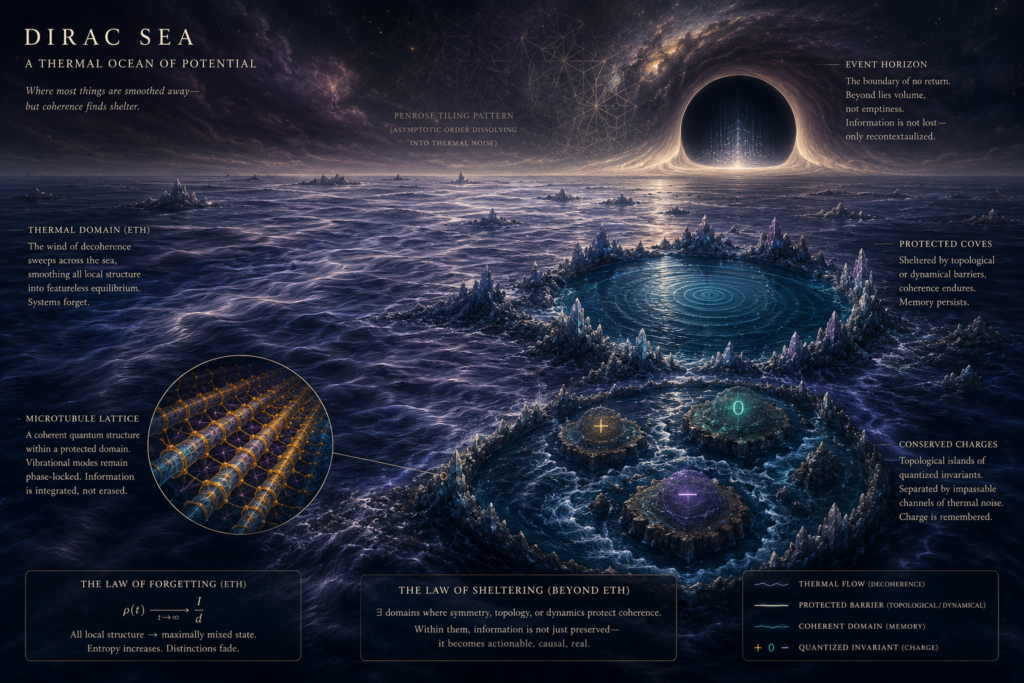
The first problem: conserved charges. In systems with a significant amount of conserved charges – such as electric charge – ETH simply does not work. Conserved charges divide Hilbert space into separate sectors, and the system cannot transition from one sector to another. Information about the charge remains trapped, even when everything else thermalizes.
The second problem: valleys in the energy landscape. Systems with an energy landscape that has many local minima – “valleys” – behave completely differently. These valleys act as good memories: the system falls into one of them and cannot get out. Thermalization is blocked. Information persists.
These systems are known as quantum glasses or many-body localized systems. They are the exception that proves the rule – and simultaneously opens the door to something much deeper.
🌊 ETH in the Dirac Sea: An Effect Similar to the Wind That Smooths, but Not Everywhere
We can now translate all of this into our picture of the Dirac Sea.
ETH is similar in effect to the gravitational wind that smooths the waves. When an isolated quantum system is left to itself, a wind-like effect inevitably begins to smooth its surface. The waves mix, entropy grows, the system “forgets” its initial state. This is a universal process – ETH formalizes it for a wide class of systems, while Penrose proposed gravitational collapse as a more fundamental mechanism for the objective reduction of the wave function.
But there are places where this effect does not reach. These are protected coves and lagoons in the Dirac Sea:
- Islands of charge: Systems with conserved charges are archipelagos in the sea. Each island is one sector of Hilbert space, separated from others by a sea that cannot be bridged. Information about the charge remains trapped on its island, untouched by the effect of thermalization. This echoes what Renato Renner showed for black holes: information is preserved, but decoding it requires a reference system – here, knowledge of the charge sector.
- Valleys of memory: Systems with rich energy landscapes are natural candidates for quantum memories. These are places where information not only persists, but can be stored stably. Just as microtubules, according to the Orch-OR model, are candidates for quantum coherence in the brain.
🧠 Return to Microtubules: Are They Protected Lagoons?
This brings us back to one of the central themes of our voyage: the Orch-OR model of Penrose and Hameroff. As we wrote in previous posts, microtubules are proteinaceous cylinders inside neurons that, according to this theory, support quantum coherence long enough for gravitational collapse (objective reduction) to occur.
The main objection has always been: how can quantum coherence survive in the warm, wet brain at 310 K? Should not the effect of thermalization instantaneously destroy every coherent excitation?
The answer may lie precisely in what we have learned today. Microtubules – with their complex structure of tubulin dimers, with their dipole-dipole interactions, with their Fibonacci geometry that realizes a surface code – may possess exactly that rich energy landscape with many valleys that blocks thermalization.
If this is correct, then microtubules are not merely metaphorical “resonant cavities in the sea”. They are protected lagoons – places where the effect of thermalization does not smooth the waves so easily, where quantum information can survive long enough for consciousness to arise.
This would mean that consciousness is possible precisely because ETH is not universal. Because exceptions exist. Because the sea is not the same everywhere.
🔮 Horizons: What Remains Open?
What we have learned today is the following:
- ETH is a powerful framework for understanding how isolated quantum systems thermalize – how a wind-like effect smooths the waves.
- But ETH is not universal. Systems with conserved charges and systems with rich energy landscapes (quantum glasses, many-body localized systems) resist thermalization.
- These “protected lagoons” are places where information persists – and where quantum computation (and perhaps consciousness) becomes possible.
- Microtubules may be precisely such lagoons – biologically evolved systems that use energy valleys to protect quantum coherence.
What remains open: are microtubules truly many-body localized systems? Does their energy landscape truly have enough valleys to block thermalization at 310 K? And is this what distinguishes a living brain from a dead one – not just entropy, but also the ability to resist the effect of thermalization?
⛵ Epilogue: The Sea That Does Not Forget Everything
In the Dirac Sea, a wind-like effect smooths most of the waves. Most information is lost in thermal noise. But there are places where the sea remembers. Lagoons and islands where waves remain coherent. Where information persists.
Perhaps consciousness is precisely that: a sea that refuses to forget itself. Lagoons where the effect of thermalization is weak enough, and the energy landscape rich enough, for the I to persist – if only for a moment, if only 40 times per second, in the rhythm of gamma waves.
And perhaps that is what makes us what we are: not waves smoothed by the wind, but waves that have found shelter.
The sea is always clear. The horizon is always open. The voyage continues.
This post continues the series begun with “⚛️ Quantum Archaeology: Reading the Past from the Dirac Sea”, continued through the map of the quantum odyssey, posts on the observer paradox, Bohmian mechanics, and quantum complexity.
Leave a Reply