Dear explorers,
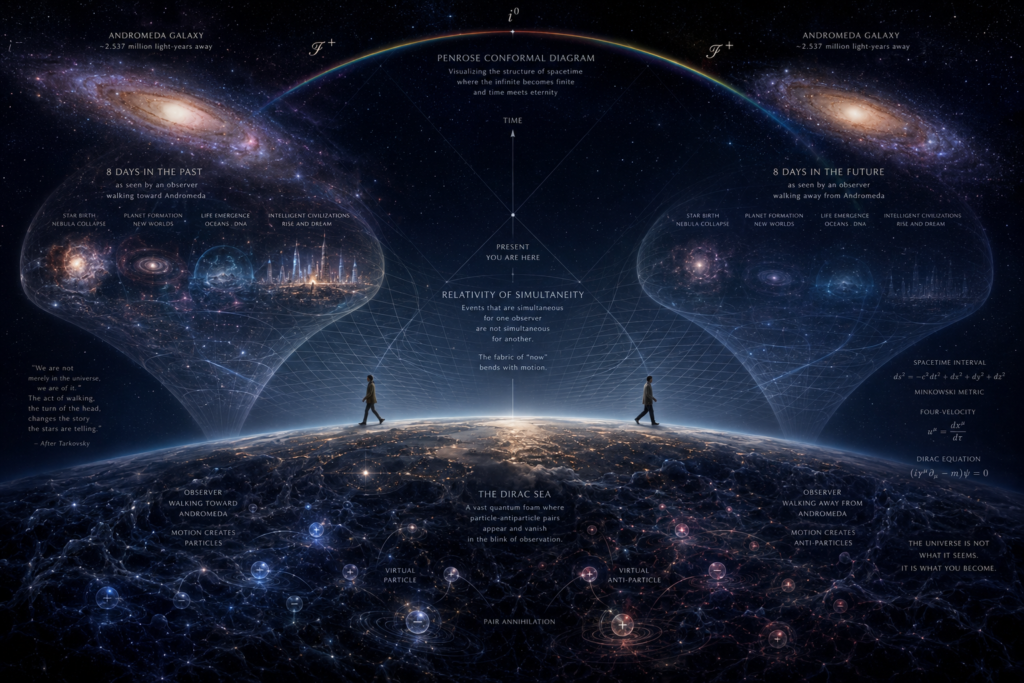
Imagine two people on Earth. One begins a brisk walk toward the Andromeda Galaxy. The other, at the same speed, in the opposite direction – toward a part of the sky familiar to us, but farther from Andromeda. Their relative speed is barely 2.68 metres per second – a brisk walking pace. Entirely non-relativistic.
And now ask yourselves: what is happening right now in Andromeda?
According to the one walking toward it, some event in that galaxy – say, the birth of a star or the fall of a civilization – is taking place about eight days earlier than it is for the one walking away from it. Two people walk past one another, and their “now” in a galaxy 2.5 million light-years away differs by more than a week.
This is not a metaphor. This is not an observational illusion. This is a direct consequence of the geometry of Minkowski – the very same geometry woven into the Dirac equation and into the fabric of the Dirac Sea itself. And this, argues Roger Penrose, is proof that our ordinary notion of a fixed, objective present is a parochial illusion.
🪞 The Geometry That Erases “Now”
In special relativity, the plane of simultaneity – the three-dimensional slice of spacetime we label with the word “now” – depends on the velocity of the observer. Two inertial observers with a relative velocity do not agree on which distant events are simultaneous. The time difference for an event at a distance is approximately:
Let us plug in the numbers. The relative speed of the two walkers: . The distance to Andromeda: light-years metres. The speed of light squared: c.
Eight days. From a single brisk walk.
But here is the crucial point: both observers look through their telescopes and see the same image of Andromeda – photons that departed 2.5 million years ago and have just now reached Earth. That light belongs to the past light cone, not to the plane of simultaneity. That is why there is agreement on what is seen, but not on what is happening right now at that distant location.
This is the heart of the misunderstanding for many: they confuse the signals we receive with the assignment of time to a distant event. Special relativity teaches that the latter is not absolute – so statements like “it has already happened”, “it is unalterable”, “it is fixed” are not universal. What is already a concluded past for one observer is still a future for another. And this does not create a paradox of causality, because no signal can carry information between those pockets of spacetime faster than light.
🧊 The Block Universe and the Illusion of Free Will
Penrose used this paradox to pose a question that reaches far deeper than relativity itself. If a single walk can shift which events the past has “already fixed”, then there is no single privileged layered slicing of spacetime into past, present, and future. The entire four-dimensional block is equally real. If everything is already there, then the future is, in some sense, already fixed – not only for Andromeda, but for the observers on Earth as well.
Penrose draws precisely that conclusion: special relativity – and even more so general relativity – leads to a picture of a deterministic block universe in which our experience of the flow of time and free will is something that requires an explanation beyond pure geometry. That is why he has, ever since his 1989 book The Emperor’s New Mind, and even more explicitly thereafter, searched for a place where quantum mechanics might break the block – might introduce an objective now and a genuine flow of time.
🌊 From Andromeda to the Dirac Sea
And now we come to the reason why this paradox is so important for our voyage.
The Dirac equation is a relativistic wave equation for fermions. It carries within itself the full structure of Minkowski spacetime, including the relativity of simultaneity. When you solve the Dirac equation, negative-energy solutions naturally emerge. Their interpretation – the Dirac Sea – is a picture that respects special relativity, yet simultaneously shows that the vacuum is not empty and structureless: it is charged with virtual excitations, and that structure changes depending on the reference frame.
The consequence: even the very definition of a particle, and of the vacuum itself, depends on the choice of time coordinate. An accelerated observer (the Unruh effect) detects a thermal ensemble of particles where an inertial observer sees a cold vacuum. This is a direct quantum cousin of the Andromeda paradox: two observers with different velocities not only disagree on the simultaneity of distant events, but also on the number of particles in space. What is “real” – particles, fields, excitations – becomes relational.
When we take quantum field theory into curved spacetime, the situation becomes even more dramatic: there is no unique decomposition of the field into positive- and negative-frequency modes. There is no unique vacuum. There is no unique definition of a particle. That is what leads to Hawking radiation: the event horizon separates modes and makes one observer see real particles where another sees vacuum.
In our picture of the Dirac Sea, this means that the sea is not the same for all observers. The wind, the waves, the plankton – all of it depends on how you sail, at what speed, in which direction. There is no “transcendent objective realm” detached from the physical system that measures. Every description of reality is a description from within, from a system that participates in it.
🧠 Penrose’s Answer: Consciousness as the Breaker of the Block
And here we return to Penrose and his boldest proposal.
If the block universe is real, why do we experience a “now” that flows? Penrose’s hypothesis (Orch-OR) proposes that gravitationally-induced objective reduction of the quantum state breaks the symmetry of the block. The act of reduction is not invariant under smooth spacetime mappings – it effectively selects a preferred layered slicing. In other words, quantum events in the brain – in the microtubules – continually “tailor” one real history out of all possible ones, and that process is what we feel as the flow of time.
If you accept that thread, then the Andromeda paradox ceases to be a paradox the moment you include quantum gravity: there is an objective now, only special relativity fails to see it because it ignores the effects of wave function reduction. The past would then be fixed not only by decoherence, but by a gravitational threshold that “selects” one branch.
And that opens the door to a deeper connection between consciousness and physics – for consciousness is precisely the process that continually resolves superpositions. Consciousness is not a passive observer of the block. It is an active participant in its tailoring.
🔮 Horizons: Between Andromeda and Us
What have we learned today?
- There is no universal “now”. Already in classical special relativity, the simultaneity of distant events depends on the motion of the observer. A walk toward Andromeda shifts “now” in that galaxy by eight days.
- The visible is not the same as the really-now. Telescopes show the same image, but that is an image of the past, not proof of a fixed present.
- The block universe is real – unless something breaks it. If there is no objective collapse, everything is already there: past, present, and future are equally real.
- The Dirac Sea is relational. Particles, the vacuum, excitations – all depend on the observer. The Andromeda paradox is the classical version of this relational fact.
- Penrose offers a way out. Objective reduction, triggered by gravity, may be precisely what breaks the block and creates an authentic flow of time – and consciousness is the place where this happens.
⛵ Epilogue: The Sea That Changes With Every Stroke of the Oar
In the Dirac Sea, there is no privileged island from which you could observe the sea “objectively”. Every ship has its own perspective. Every captain has their own “now”. And while one sees a wave that has already broken, another still expects it.
But perhaps there is something that connects all these perspectives. Something that continually resolves superpositions and tailors a single history. Something we feel as the flow of time, as “now”, as I.
If Penrose is right, then that something is the sea – a sea that does not rest, a sea that constantly changes, a sea that has become aware of itself.
And perhaps that is precisely what we seek. Not a fixed past. Not a determined future. But now – the only now we have, and which is, in every moment, an act of creation.
The sea is always clear. The horizon is always open. And now – now is all we have.
This post continues the series begun with “⚛️ Quantum Archaeology: Reading the Past from the Dirac Sea”, continued through the map of the quantum odyssey, posts on the observer paradox, Bohmian mechanics, quantum complexity, eigenstate thermalization, entropy, infinities, broken symmetries, and dark matter.
Leave a Reply