Dear explorers,
We calibrated our navigational instruments through Quantum Bayesianism and reminded ourselves of intellectual humility. Now it is time to return to the very heart of the Dirac Sea – to where it is immense. Not just poetically immense. Mathematically immense. Immense in a way that defies intuition and opens the door to understanding why gravity may be merely a statistical shadow of a deeper quantum reality.
This is a post about three lectures Leonard Susskind delivered in 2018. They are technical, deep, and full of insights that fit perfectly into our picture of the Dirac Sea. Today we shall journey through them together, weaving Susskind’s equations with our waves, winds, and horizons.
🏛️ First Lecture: Hilbert Space Is Huge
Susskind begins his lectures with a simple yet dizzying fact: Hilbert space is incredibly large.
Imagine a system of qubits. Its Hilbert space is the projective space . How many “ε-balls” – small, distinct regions – are there in that space? The number grows as . That is an exponential function of an exponential function. Doubly exponential.
And how many unitary operators – possible evolutions – act on that space? Even more: . Unitary operators are, in the spirit of quantum computing, analogous to quantum gates – the fundamental transformations that act on input qubits and build an algorithm. The space of all possible algorithms is far, far larger than the space of the states themselves.
In our picture of the Dirac Sea, this means the following: the sea is so vast we cannot even imagine it. Every drop of water is not an atom – it is a region in Hilbert space. And there are more such drops than there are atoms in the visible universe – far, far more.
Susskind then introduces the concept of relative complexity. It is a measure of the distance between two quantum states, but not in the usual sense. The usual metric on Hilbert space – the Fubini-Study metric – is “small”: the maximum distance between two states is . Complexity, by contrast, is immense. Distances grow exponentially with the number of qubits . It is defined as the minimum number of elementary gates needed to go from one state to another.
This metric is right-invariant, not left-invariant. That means complexity depends on how you rotate the target state, but not on how you rotate the starting state. In our picture, it is as if the difficulty of the voyage depends on where you are going, but not on where you started from. The sea is equally deep everywhere, but some ports are harder to reach than others.
The second law of quantum complexity. Susskind introduces an auxiliary classical system A that tracks the movement of the state vector through Hilbert space. Complexity behaves like the entropy of that auxiliary system: it grows linearly with time until it reaches a maximum , after which it remains in equilibrium for an immense time (doubly exponential in ), before a recurrence occurs.
This is a direct extension of our story about entropy and thermalization. Recall: entropy grows and reaches a plateau. But complexity continues to grow long after that. It is non-local – it depends on the connections between all parts of the system. And now Susskind provides a quantitative description of that growth.
In the Dirac Sea, the second law of complexity means that a ship sailing through the sea continually increases its distance from the starting shore – not because it is fated to, but because it is a statistical tendency. There are more ways to be far from the shore than close to it. The sea is immense, and the ship naturally sailings into its immensity.
🕳️ Second Lecture: Black Holes and the Second Law of Complexity
The second lecture connects the growth of complexity with the geometry of black holes. This is where our picture of the Dirac Sea gains an entirely new dimension.
Susskind introduces the CV correspondence (Complexity = Volume):
where is the volume of the wormhole (Einstein-Rosen bridge) behind the horizon of the black hole, is the gravitational constant, and is the AdS radius. The complexity of the black hole’s state is proportional to the volume of the interior of the wormhole.
What does this mean? When a black hole forms from stellar collapse, its complexity is low, and its interior volume is small. As time passes, complexity grows – and the wormhole behind the horizon grows. It lengthens. Its volume increases. And this happens long after the black hole has reached thermal equilibrium. Entropy is already at a plateau. Temperature is constant. But the interior continues to grow.
In our picture of the Dirac Sea, a black hole is a whirlpool whose interior lengthens with every wave that passes through it. The horizon is the surface of the whirlpool – what we see from outside. But beneath the surface, the whirlpool extends into the depths, and that depth grows with every new stroke of the oar.
The epidemic model. Susskind explains how complexity grows through an analogy with the spread of an epidemic. A perturbation (operator ) “infects” a single qubit. The infection spreads exponentially – from one qubit to two, from two to four, from four to eight – up to the scrambling time , when the entire system is infected. After that, complexity grows linearly, because even though all qubits are infected, the infection now “deepens” – ever more intricate correlations are created between them.
In the Dirac Sea, this is like dropping a droplet of ink into the sea. At first the ink spreads rapidly, infecting more and more water particles. That is scrambling – the rapid mixing of information. But after the sea is fully “infected”, complexity continues to grow: the information is now distributed into finer and finer correlations between parts of the sea.
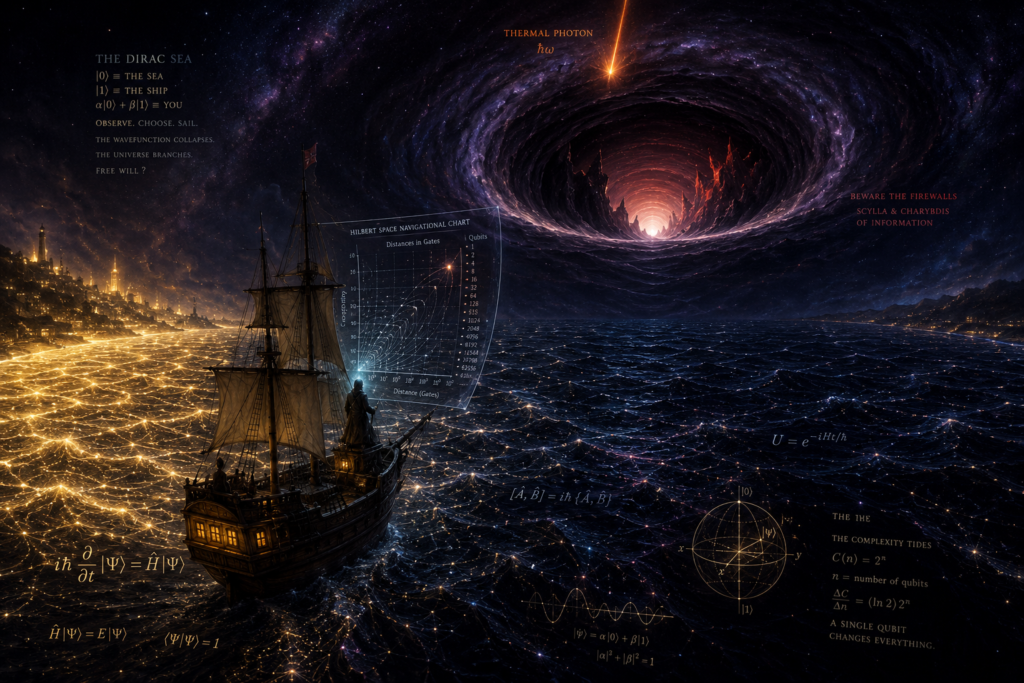
Firewalls. Susskind also offers a new understanding of firewalls. They are associated with a decrease in complexity and appear only in artificially prepared states – for example, in a white hole, which is a time-reversed black hole. Firewalls are extremely fragile: a single thermal photon can destroy them within a scrambling time.
Typical (Haar-random) states have a firewall. But naturally formed black holes – those that formed from stellar collapse – are in a state of low complexity and lack a firewall for an exponentially long time.
In our picture, firewalls are like Scylla and Charybdis – dangerous passages that appear only in artificially created, maximally complex configurations of the sea. Natural black holes, which have just begun their lives, lack these passages – their horizon is smooth. The sea is calm. But as time passes and complexity grows, the whirlpools can become dangerous.
🧊 Third Lecture: The Thermodynamics of Complexity
The third lecture introduces one of the most beautiful concepts in the whole story: uncomplexity.
Uncomplexity is defined as:
where is the maximum possible complexity for a system of qubits (). Uncomplexity is the room for complexity to grow – a resource the system can use to perform computational work.
This is the direct analogue of negative entropy in thermodynamics – free energy that can be converted into work. Just as negative entropy is a resource for physical work, uncomplexity is a resource for quantum computation.
In the Dirac Sea, uncomplexity is the remaining depth to the opposite shore. Imagine a ship leaving a familiar shore. Before it lies the entire sea – uncomplexity is at its peak. As the ship sails, complexity grows, and the remaining depth diminishes. The deepest point of the ocean – the point of maximal entropy – is where the ship is farthest from both shores. But the voyage continues. The depth begins to decrease as the ship approaches the opposite shore. Finally, when the ship docks at the other shore, uncomplexity is zero – the sea has been entirely crossed, and there is no more room for further journeying.
The power of a single clean qubit. Susskind presents perhaps the most astonishing result of the entire lecture. Imagine a system of qubits that has reached maximal complexity. It can no longer compute – it has exhausted all its resources.
But now add a single clean qubit in the state . This one qubit brings with it an enormous amount of uncomplexity: . The system can now compute the trace of an arbitrary unitary operator – a task that is otherwise exponentially hard – using a controlled operation and a measurement of the Pauli operator on that single clean qubit.
One qubit. A single one. And it brings with it the power to compute what was just moments ago impossible.
In the Dirac Sea, it is as if you have sailed to the opposite shore, touched it, thought the voyage was over – and then the sea expands. A new dimension is added, a new direction, a new axis along which depth can be measured. And suddenly you have an entirely new ocean before you.
Geometric interpretation. Susskind also offers a geometric interpretation: the uncomplexity of a black hole at time corresponds to the accessible spacetime volume that an observer could explore if they jumped into the black hole after time . It is the part of the Wheeler-DeWitt patch behind the horizon that has not yet been “used up”. It is likely the firewall that seals off this space, squeezing the interior of the black hole like the walls of a trap in an adventure film – until it reaches the horizon from the inside. And just as in those films, salvation can come from reversing the direction of the moving wall. In the case of a black hole, that salvation can be brought by a single thermal photon – not only does the firewall move inward, but the very volume of the black hole continues to grow, opening new space for our trapped hero’s adventure.
And here, at the very boundary between science and metaphor, we arrive at an extremely speculative horizon. The moment when we are maximally pressed – when the firewalls squeeze us from all sides – is the moment in which free will, if it exists as a separate entity beyond the laws of the quantum field, might be the only remaining force of salvation. If no one from the outside throws in a thermal photon, can we ourselves, from within, alter the course of complexity? Would such an experiment – in which a conscious agent attempts to reverse the growth of complexity inside a black hole – be the ultimate test of the existence of free will?
Of course, this is pure speculation. But the Dirac Sea is vast enough to have room for such questions too.
🌌 Synthesis: Gravity as an Emergent Statistical Phenomenon
Susskind concludes his lectures with a claim that is at once humble and grandiose: gravity is not a fundamental law. It is an emergent statistical phenomenon that arises from the quantum mechanics of complex systems.
The second law of thermodynamics, scrambling, chaos, the growth of complexity – all of these are statistical tendencies, not absolute laws. The geometry of spacetime behind the horizon, including the growth of wormholes, is driven by the second law of complexity, not by ordinary entropy.
In our picture of the Dirac Sea, this means the following: the gravitational wind is not an external force blowing over the sea. It is an emergent effect of the voyage itself. The wind is what emerges from the immensity of Hilbert space, from the exponential growth of complexity, from the statistical tendency of the system to move ever farther from the starting shore.
All our previous voyages now merge into a single picture:
- Quantum complexity is the distance the ship has traveled through Hilbert space.
- Entropy is the choppiness of the surface.
- Black holes are whirlpools whose interior grows with complexity.
- Firewalls are Scylla and Charybdis – dangerous passages that appear only in artificially prepared, maximally complex configurations.
- Uncomplexity is the remaining depth to the opposite shore.
- The gravitational wind is an emergent effect of the voyage itself – a statistical shadow of the immensity of the sea.
⛵ Epilogue: Humility and Immensity
Susskind reminds us that much remains unknown. His lectures were given in the context of AdS/CFT correspondence and supersymmetry – theories that are elegant, yet still unproven in our world (which is not supersymmetric and has a positive cosmological constant). Future progress will require stepping out of the comfort zone – just as our voyage requires leaving familiar shores.
But one thing is certain: the Dirac Sea is immense. Not just poetically immense. Mathematically immense. And that immensity is what allows gravity, time, and reality itself to emerge from the quantum mechanics of complex systems.
And we, small waves on the surface of that immense sea, have the privilege of sailing upon it, measuring it, and marveling at its boundlessness. And perhaps, just perhaps, in moments of greatest danger – when the firewalls squeeze us from all sides – we may discover whether we are truly free.
The sea is always clear. The horizon is always open. And immensity – immensity is what makes the sea a sea.
This post continues the series begun with “⚛️ Quantum Archaeology: Reading the Past from the Dirac Sea”, continued through the map of the quantum odyssey and all our previous voyages.
Leave a Reply