Dear explorers,
In our previous voyage we broke the ice of the block universe and confirmed that the Dirac Sea is alive, dynamic, and open. But today we sail toward one of the boldest ideas ever to stir these waters – an idea born from the ruins of perfect symmetry.
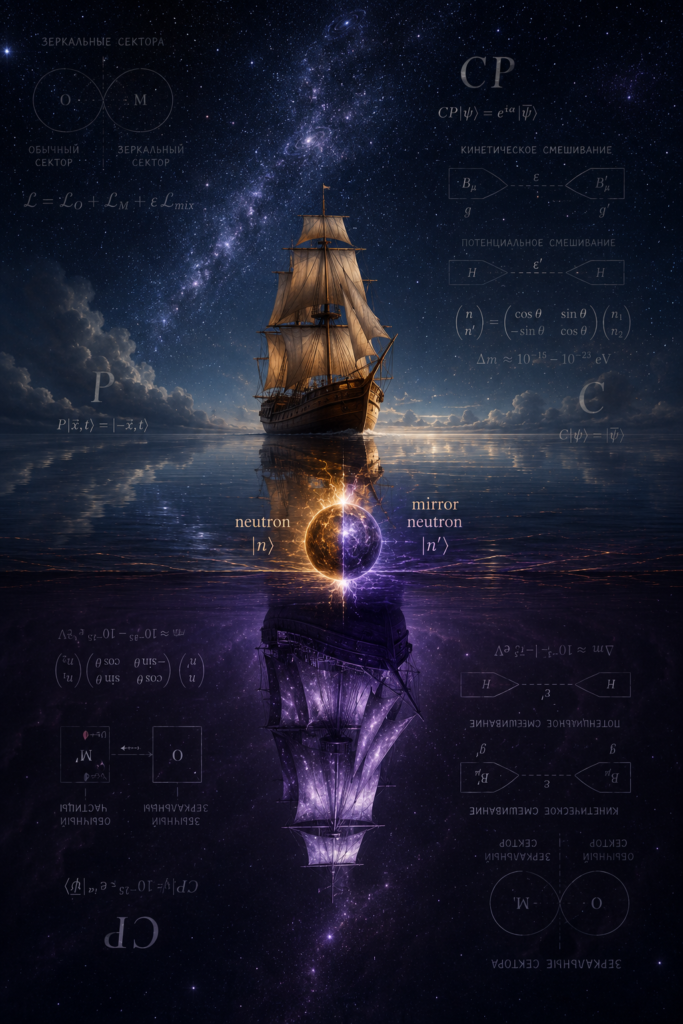
Imagine that everything you see has a twin. Every particle, every force, every wave on the surface of the sea. But that twin is utterly invisible – hidden behind a mirror you cannot pierce. This is not fantasy. This is mirror matter, a theory born in 1966 from the pens of three Soviet physicists, which today offers an elegant answer to the questions of dark matter, the neutron anomaly, and much more.
Today we dive into the world behind the mirror of the Dirac Sea.
💥 The Fall of Parity and the Rise of CP Symmetry
Recall our voyage through broken symmetries. In 1956, Tsung-Dao Lee and Chen-Ning Yang proposed a bold hypothesis: in weak interactions, parity (P) – mirror symmetry – might not be conserved. Nature might distinguish between left and right hands.
The experiment by Chien-Shiung Wu in 1957 with the beta decay of cobalt-60 confirmed this suspicion in dramatic fashion. The electrons emitted during the decay preferred one direction – that opposite to the spin of the nucleus. In the mirror world, they would have preferred the opposite direction. The mirror image of this experiment does not exist in nature. It was a Nobel-worthy shock: the universe is not perfectly mirror-symmetric.
Lev Landau, a physicist of fearsome intuition, immediately tried to save the situation. He proposed that the true, untouched symmetry was not just P, but CP – the combined inversion of charge (C) and parity (P). If we replace matter with antimatter and look in the mirror, the weak force would once again become symmetric. Thus hope for a perfect balance between matter and antimatter took on a new form.
💔 CP Violation and the Birth of the Mirror World
The hope did not last long. In 1964, Christenson, Cronin, Fitch, and Turlay discovered CP violation in the decays of neutral kaons. Nature not only distinguished left from right – it distinguished matter from antimatter in a way that is not completely symmetric. It was precisely this blow that opened the door for the boldest idea.
Just two years later, in 1966, three Soviet physicists – Igor Kobzarev, Lev Okun, and Isaak Pomeranchuk – published a paper that introduced mirror matter into the scientific literature. Their idea was audacious: perhaps there exists an entire parallel sector of particles, identical to our own, but completely separated in the strong and electromagnetic interactions. The two sectors would share only gravity and, possibly, extremely weak mutual influences. Mirror CP violation in that parallel world would be exactly opposite to our own, so that the overall symmetry of the universe would remain untouched.
It was an idea ahead of its time: while others were trying to explain the absence of symmetry within a single particle zoology, the Soviet trio expanded the very stage. Their work became the cornerstone for all subsequent research into the mirror sector.
🪞 The Dirac Sea as a Mirror: Two Sides of the Same Film
Recall our voyages through relational quantum mechanics and negative frequencies. The Dirac Sea is not a static background – it is a dynamic, relational film whose contents (particles and antiparticles) manifest only in interaction. An accelerated observer sees thermal particles where an inertial observer sees an empty vacuum. The division into positive and negative frequencies is not absolute.
Mirror matter takes this metaphor to its ultimate consequence:
- If ordinary matter is what we see as “real” excitations on the surface of the Dirac Sea – particles that interact with our photon field, our bosons, our detectors – then mirror matter is the world behind the looking glass.
- These are excitations that belong to another, parallel vacuum. That vacuum is identical in structure (the same symmetry groups, the same types of interactions), but its degrees of freedom are connected to ours only extremely weakly.
- What appears to us as empty space could be densely populated with mirror electrons, photons, and atoms – dark matter that does not shine in our electromagnetic spectrum, yet perfectly feels gravity.
Just as Alice steps through the looking glass into a world where things are subtly different, physicists today search for the weakest possible interactions – such as kinetic mixing of photons – that would represent a “passage” between the two sides of the Dirac film.
🧪 From Anomalies to a Precise Model: The Neutron Puzzle and Dark Matter
Decades passed, and the idea of mirror matter smouldered. It came back to life when cosmologists were trying to explain dark matter. Why should dark matter be some exotic particle (WIMPs, axions) when it could be an entire hidden sector that is simply – our reflection?
The problem, however, was that early models of mirror matter required ad hoc mechanisms of interaction between the two sectors. That changed when precise measurements of the neutron lifetime began to show an unexpected anomaly.
There are two ways to measure how long a neutron lives before it decays: the “beam” method and the “bottle” method. Researchers long believed that the bottle method gives the true value for beta decay, but the results stubbornly differed by about 1%.
Physicist Wanpeng Tan put forward a bold hypothesis: the beam method measures the actual beta decay, while the bottle method shows the disappearance of neutrons due to oscillation into a mirror neutron. When a neutron crosses over into its mirror partner, to our detectors it simply – vanishes.
This two-parameter model not only resolved the neutron anomaly, but also elegantly explained the density of dark matter in the universe. Far-reaching predictions followed: unexpectedly large rates of invisible decays of neutral hadrons (kaons), violation of CKM matrix unitarity, and a characteristic second GZK component in the spectrum of ultra-high-energy cosmic rays. Instead of a single mystical solution, mirror matter became a testable theory with concrete experimental signatures.
🔗 Where Next: From Strings to Superconductivity
The modern development of mirror matter theory reaches down to the very foundations. Connections with string theory, where mirror symmetry represents an orientational symmetry of local spaces (T-duality, Calabi-Yau mirror symmetry), have provided a firmer mathematical basis. Supersymmetric mirror models in various spacetime dimensions offer insight into the dynamics of the Big Bang, the nature of dark energy, and even a new mechanism for high-temperature superconductivity.
The entire edifice rests on three principles: the quantum action principle (formalism), the principle of consistent observation (symmetries and constraints), and the principle of spacetime inflation (physical content). Within that framework, gravity emerges as a classical phenomenon from smooth spacetime, and black holes become two-dimensional boundaries of a four-dimensional world.
⛵ Epilogue: The Mirror That Changes Everything
The story of mirror matter began with three Soviet physicists who dared to ask: what if the universe is twofold? Today, nearly six decades later, that question is no longer just philosophical speculation – it has become a research programme offering solutions to the neutron anomaly, dark matter, broken unitarity, and much more.
The Dirac Sea, that infinite reservoir of virtual excitations, now reveals itself as a mirror surface. Beneath it lies not only antimatter, but an entire world – dark, silent, and invisible, yet perhaps precisely the one whose effects we are already detecting, only we do not yet understand them.
To pass through that mirror would mean not only resolving the mysteries of the cosmos, but touching the deepest symmetry of all that exists.
For perhaps we are not the only waves on this sea. Perhaps, on the other side of the surface, someone else is sailing – and wondering the same things we are.
The sea is always clear. The horizon is always open. And the mirror – the mirror waits for us to sail into it. 🪞🌊
This post continues the series begun with “⚛️ Quantum Archaeology: Reading the Past from the Dirac Sea”, continued through the map of the quantum odyssey and all our previous voyages.
Leave a Reply