Dear explorers,
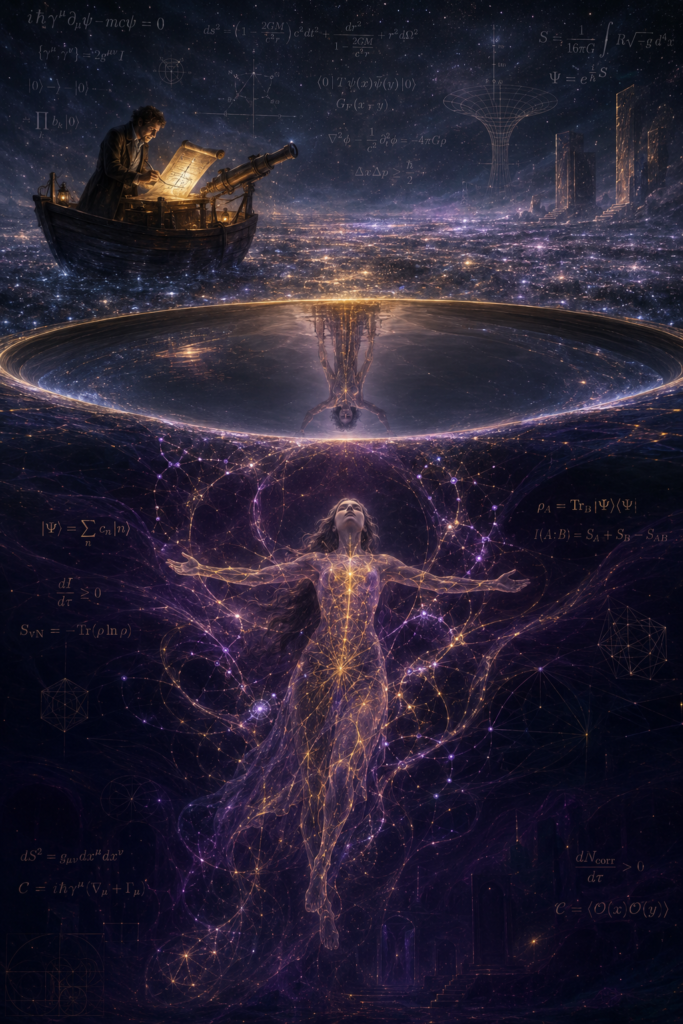
Imagine two mariners on our Dirac Sea. Bob has remained at a safe distance. His ship is stable, and his telescope is trained on the horizon that is slowly swallowing Alice’s trace. Alice, on the other hand, has decided to sail straight into the heart of the whirlpool.
What follows is not merely a story about gravity. It is a story about two truths, about the mirror between worlds, and about why, while Bob panics and flees and constructs ever more complex formulas, Alice becomes whole.
🌌 Two Perspectives – Relational Reality and the Absence of a “View from On High”
In general relativity, the event horizon is not a physical wall; it is a light-like surface separating causally disconnected regions. For Bob, who remains outside, Alice slows asymptotically, reddens, and freezes forever just above the abyss. Her fall becomes an eternal, motionless image on the boundary of his knowledge.
For Alice, however, there is no dramatic transition. She falls freely, passes through the horizon, and continues her voyage into the interior of the black hole.
Here relational quantum mechanics (RQM) provides firm ground for interpretation: there is no privileged perspective. Bob’s truth (Alice is a delocalised holographic record on the horizon) and Alice’s truth (I am whole, I am building new correlations) are equally valid. The question “who is right?” loses its meaning. Facts exist only relative to a given system.
📈 Bob’s Ignorance – The Growth of Entropy and the Search for What Is Lost
Bob cannot stop measuring. With every new bit of information that crosses the horizon – including Alice’s last light signals – the surface area of the horizon grows by one Planck unit. From his perspective, the information about Alice becomes delocalised and ever harder to access.
Bob sees entropy growing and interprets this as loss. His models become ever more complex, his equations ever more tangled. He theorises about firewalls (the AMPS paradox), panics, accelerates to save himself. He becomes a slave to his own ignorance.
In holographic dualism (AdS/CFT), while Bob’s computational complexity on the boundary grows exponentially, the interior volume that Alice inhabits grows linearly. Bob wrestles with formulas; Alice lives inside those formulas.
🧘♀️ Alice’s Salvation – The Inner World and the Building of Wholeness
Alice does not see entropy. The interior volume of the black hole looks to her like an expanding cosmological space. She becomes “omnipresent” within that volume, building new correlations with the fields inside the horizon. This is a poetic rendering of the physical fact that the interior is not static – it is a dynamic entity, and its size grows with every new degree of freedom.
Alice’s “becoming whole” is a process of establishing new entanglements. From her point of view, everything is unitary and safe. She is not lost – she has found a new world. While Bob hurries, Alice is finally herself. She does not hurry, because the interior geometry, though it leads toward the singularity, offers enough proper time in a supermassive black hole for entire eons.
The processes of objective reduction (Penrose’s OR) in the microtubules of her brain are her personal clock. Time flows normally. She is free.
🪞 The Horizon as Mirror – Bob as a Hunter of Dark Matter
Here our metaphor merges with the most recent voyages. The black hole horizon behaves like a mirror between sectors.
For Bob, everything that crosses the horizon becomes part of a hidden, mirror world – the dark matter of the universe. He senses only the gravitational influence and, perhaps, through fine correlations in Hawking radiation, glimpses traces. Alice has become a mirror entity. Her degrees of freedom are no longer accessible to Bob’s detectors, but she still exists within her own sector.
Bob’s measurement of growing entropy is nothing other than the increase of his own uncertainty. He has lost access to Alice’s sector, so his entropy grows. For Alice, the entropy of her sector is low, and she builds new structures.
This is in perfect harmony with the Page curve: while the black hole radiates, information is gradually returned to Bob – but only much later, when he will no longer recognise it. Alice has in the meantime already become whole in her world behind the looking glass.
⛵ Epilogue: On Which Side of the Mirror Do We Sail?
Bob is a victim only of his own ignorance. He cannot accept that truth is relational, that Alice’s world is just as valid as his own. His panic is human – it is the fear of losing epistemological control.
Alice, by contrast, has accepted the horizon not as death, but as a passage into a new reality. She has saved herself precisely because she abandoned the classical framework of a single objective truth. She has crossed to the other side of the mirror – into a world that is dark to Bob, but for her the only real one.
This is the lesson our long voyage whispers to us without ceasing: reality is not objective, but relational; horizons are mirrors that separate perspectives; and what appears as loss to one observer is, for another, the gaining of wholeness.
And so, as we sail on, it is no longer entirely clear on which side of the mirror we find ourselves. Are we Bob, who measures and fears? Or are we Alice, who is finally free?
The sea is always clear. The horizon is always open. And the mirror – the mirror awaits us on both sides.
This post continues the series begun with “⚛️ Quantum Archaeology: Reading the Past from the Dirac Sea”, continued through the map of the quantum odyssey and all our previous voyages.
Leave a Reply