Dear explorers,
There is a kind of voyage driven not only by curiosity, but by longing. A longing to escape the burden of choice, the thought that somewhere we took a wrong turn, that we have wasted our life. That, like Daffy Duck, we should have turned left at Albuquerque.
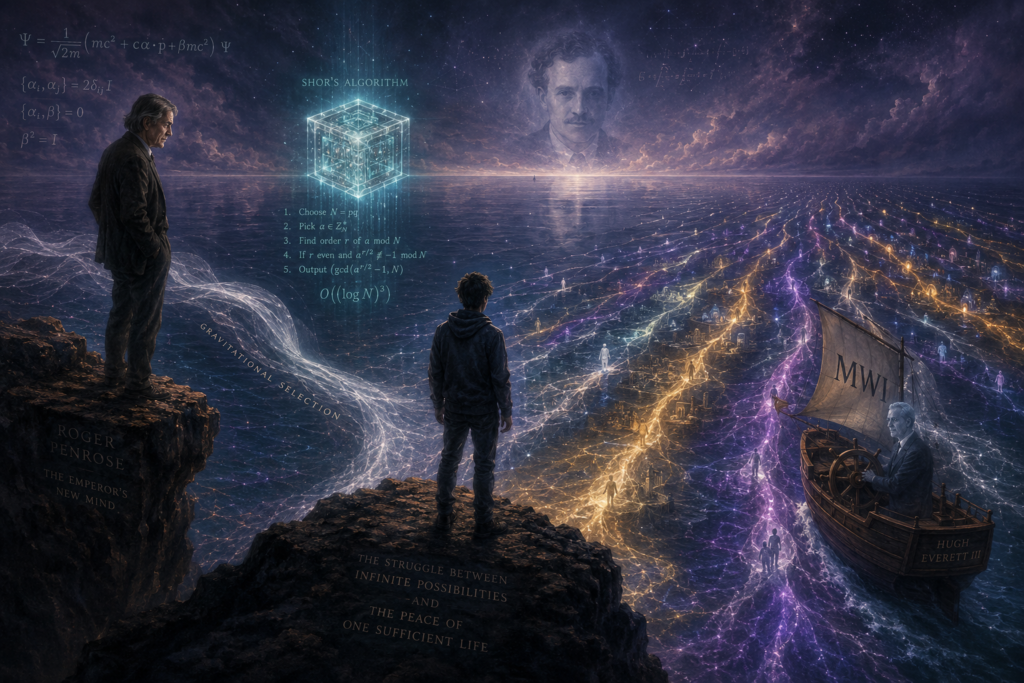
Imagine a young person standing before an infinite sea of possibilities. Every choice feels like a loss of all the others. Every decision carries the shadow of what might have been. And then that young person discovers Everett’s Many-Worlds Interpretation (MWI) – a reading of quantum mechanics claiming that nothing is lost, that every possibility is realized, that the wave function is real and the universe simply branches.
For a moment, it is as if someone has opened a window in a stuffy room. If all paths are realized, there are no wrong choices. You are simultaneously the one who turned left and the one who went straight on. There is no “wasted life” – only the total wave function of your existence, which is complete and whole.
This is a feeling of metaphysical freedom. An almost religious sense of consolation, packaged in the purest mathematical formalism.
Many of us have passed through this. And that is precisely why we must pause and ask: how much of this is physics, and how much is projection?
🧠 A Jungian Warning: When an Idea Carries Too Great a Charge
Carl Gustav Jung would probably have said that when an idea carries such a powerful archetypal charge – the archetype of wholeness, of salvation through knowledge, of the resolution of the paradox of choice – then we must ask ourselves how much we have projected onto it, and how much it truly describes reality.
For MWI is not only physics. It is also a psychological consolation. It is an answer to existential anxiety. And precisely that emotional appeal can be a sign of caution. As we learned from our voyage on Jung and Pauli, the deepest truths often lie where psyche and matter intertwine – but for that very reason we must be doubly careful.
🌊 Penrose’s Argument: The Weight of the Universe
Now let us return to the firm ground of physics. Roger Penrose has put forward one of the most serious technical arguments against MWI. And that argument fits perfectly into our picture of the Dirac Sea.
In MWI, superposition is not reserved for electrons and photons – it extends also to macroscopic objects, including measuring apparatus, cats, scientists, and ultimately the entire universe. Every branch carries the complete mass-energy of the universe. But a superposition of different spacetime geometries is not free – it is subject to gravitational instability.
When you have a superposition of two states with different mass distributions, you actually have a superposition of two different spacetime metrics. According to Penrose, such a superposition cannot be stable for an arbitrarily long time. It will spontaneously collapse into a single definite state on a timescale:
where is the gravitational energy of the difference between the two configurations. The greater the mass and the more different the configurations, the shorter the lifetime of the superposition.
For elementary particles, is minuscule and the superposition lasts a long time. For a cat, it is already problematic. For an entire universe with all its stars, galaxies, and black holes, the lifetime of the superposition would be fantastically short – far below the Planck time.
In our picture of the Dirac Sea, this means the following: the gravitational wind is too strong. It does not permit waves to branch into infinite parallel oceans. It smooths the sea, forcing it to choose one configuration, one wave, one history. MWI universes cannot “civilly” coexist; they would collapse into one another almost instantly.
This is an argument that still stands today as a serious challenge to MWI in the context of quantum gravity, and it is one of the principal motives for Penrose’s own OR model.
💻 David Deutsch and Quantum Computers: Proof of the Multiverse or an Interpretive Choice?
And now we come to the man who, more than anyone else, breathed new life into MWI: David Deutsch, the Alan Turing of quantum information theory.
Deutsch is a pioneer of quantum computing. His formulation of the quantum Turing principle and the construction of the universal quantum gate laid the theoretical foundations for everything we know today about quantum computers. And he has put forward a bold argument: quantum computers prove the existence of the multiverse.
His argument can be summarised as follows: a quantum computer with qubits performs operations in a -dimensional Hilbert space. When it factorises a large number (Shor’s algorithm) or searches a database (Grover’s algorithm), it does something exponentially faster than the best classical algorithm. Deutsch claims that the only sensible explanation for this speed-up is that the computation takes place physically, in parallel, across branches of the multiverse, with interference between those branches yielding the result in our branch.
This is a powerful argument. But let us examine it carefully, as befits experienced mariners.
(a) An operational fact no one disputes. A quantum computer uses superposition and interference to achieve exponential speed-up over classical computers for certain classes of problems. That is an experimental fact, confirmed in laboratories across the world.
(b) The ontological interpretation of that fact. Deutsch says: superposition is real, therefore all components of the superposition are real, therefore they exist in parallel universes. But this is an interpretive leap, not a logical deduction.
Recall the alternative views we have already explored in our voyages:
- The Copenhagen interpretation: the wave function is a computational tool, not a real entity. A quantum computer does not compute in parallel worlds; it simply uses a formalism that gives a statistical advantage for certain problems.
- QBism: the wave function is a degree of belief of an agent. Quantum speed-up is a consequence of the way an agent updates their beliefs.
- Relational quantum mechanics (RQM) : superposition is relational. A quantum computer exists in a web of potential interactions, and computation is a sequence of flashes yielding a result for a given observer.
- De Broglie–Bohm theory: particles always have definite positions, and the wave function is a pilot wave. Quantum computation is explained by non-local dynamics, without multiple worlds.
Thus, Deutsch’s argument is not proof of MWI. It is proof that MWI provides one possible, intuitive, and consistent picture of what is happening. But that does not exclude other pictures.
🔬 Quantum Speed-Up Without Many Worlds
A growing body of work in quantum information theory shows that quantum speed-up can be understood without invoking many worlds.
Contextuality as a resource: Howard, Wallman, Veitch, and Emerson (2014) showed that quantum speed-up is directly linked to contextuality – the fact that the outcome of a measurement depends on which other measurements are simultaneously performed. This is a non-local, but not a multiverse, effect.
Quantum complexity and entanglement: In the modern understanding, a quantum computer does not compute in parallel worlds; it generates complex entangled states and measures global properties of those states. The exponential dimension of Hilbert space is a mathematical structure, not a physical space filled with worlds.
In that sense, Deutsch’s argument is similar to what can be said about string theory: it provides one consistent mathematical picture, but not the only one. And the appeal of that picture may be more philosophical and aesthetic than empirical.
⚖️ Three Stories of Great Mariners
Now we can compare the three visions we have encountered on our voyages:
- Everett (MWI) : Reality is the wave function in an infinite-dimensional Hilbert space, and we are thin slices of that structure. Consciousness is an epiphenomenon or is distributed across branches. The problem: gravity probably breaks this; also, there is no explanation for the Born rule without additional postulates.
- Deutsch (MWI + quantum computing) : He adds that MWI is not only true, but useful – it explains the power of quantum computers. But this is an interpretive choice, not the only one. Deutsch is the last great champion of MWI, standing heroically alone against the majority of his colleagues, but his insistence that quantum computers prove the multiverse has not become a consensus even among quantum information theorists.
- Penrose (OR) : The wave function is real, but unstable at the macroscale due to gravity. Instead of eternal branching, there is objective reduction that selects a single history. Quantum computers operate in superposition, but that superposition has a finite lifetime – and this sets a limit on the size and complexity of quantum computers. Penrose would predict that quantum computers above a certain mass will not be able to maintain coherence, regardless of isolation from the environment.
💀 Everett’s Shadow: A Warning from the Depths
And now, before we draw the final lesson, we must mention something that casts a long shadow over this entire story. Hugh Everett, the man who at the age of 24 formulated MWI and gave us this vision of an infinitely branching universe, ended his life in deep despair. His daughter later testified to his depression, his sense of isolation, and his conviction that his work had been completely neglected. His final wish was for his ashes to be thrown out with the rubbish.
That is not emancipation. That is nihilism.
MWI did not save Everett from despair. And perhaps that is the deepest lesson of this entire voyage: belief in infinite versions of oneself does not necessarily bring peace. For what we truly need is not infinity – but acceptance of finitude. Not escape into the branches we did not choose – but reconciliation with the one branch in which we are.
⛵ Epilogue: Dirac’s Smile and the Sufficiency of the Present Moment
And so we return to our quiet captain at the stern. Paul Dirac, the man who gave our sea its name, would probably have responded to all this with that characteristic, restrained smile of his.
Dirac did not believe in many worlds. His sea was not a place of infinite branching – it was a place of infinite depth. Every wave was unique. Every particle had its hole in the sea. And nothing was lost – not because it existed somewhere out there in a parallel universe, but because information about everything was preserved here, in the structure of the sea itself.
Perhaps true emancipation is not in believing that all versions of us exist somewhere out there. Perhaps true emancipation is in the realisation that this version – the one that is now, here, in this dialogue – is complete and sufficient. And that it does not need to have turned left at Albuquerque to be worthwhile.
For the Dirac Sea remembers not only all the waves that have ever existed. It also remembers this wave. This moment. This now.
And that, in the end, is all we truly have.
The sea is always clear. The horizon is always open. And this moment – this moment is enough. 🌊⚛️💎
This post continues the series begun with “⚛️ Quantum Archaeology: Reading the Past from the Dirac Sea”, continued through the map of the quantum odyssey and all our previous voyages.
Leave a Reply