
Dear explorers,
In our previous voyages we have come to know the Dirac Sea as an infinite ocean of quantum fields. We have sailed through its currents (SU(3) × SU(2) × U(1)), felt its gravitational wind, and peered behind its looking glass. But there is a question we have been circling around, one that is crucial to the very existence of everything we see: why do particles have mass at all?
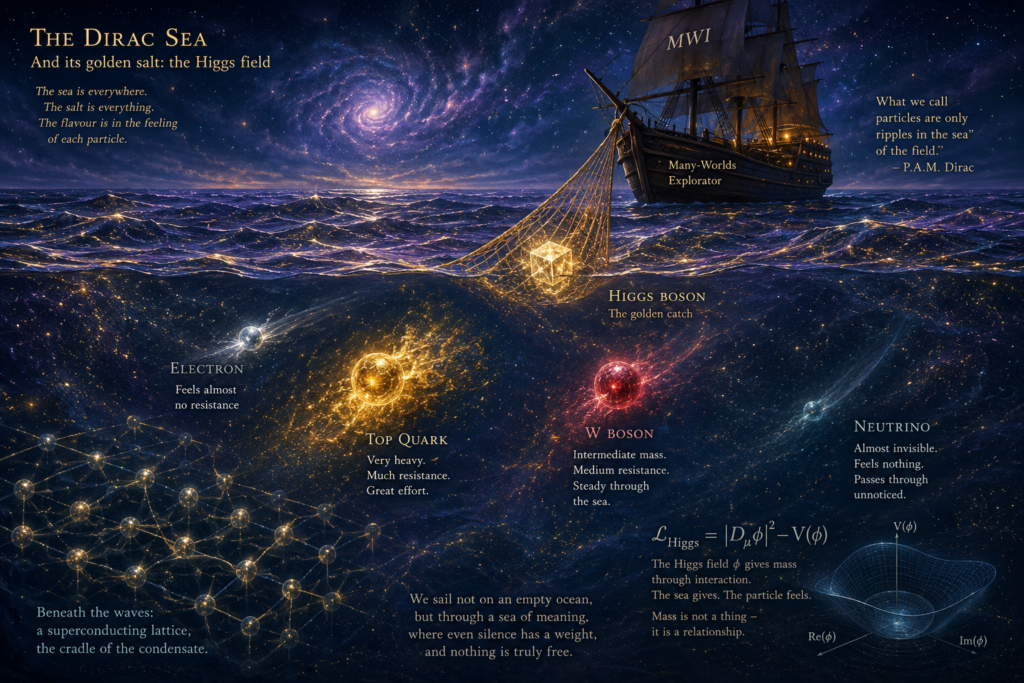
The answer to this question lies in an ingredient the Dirac Sea needs to become what it is – something like salt in seawater. That ingredient is the Higgs field. But the story of it is far from simple. It reaches into the very heart of the ontology of the Standard Model and reveals a hidden layering that cannot be reduced to popular headlines about the “God particle”.
Today we dive into the Higgs field. And we shall discover that the Dirac Sea, like any real sea, is salty.
🧂 One Sea, One Ingredient – Two Roles
In the Standard Model there exists precisely one fundamental scalar field: the Higgs doublet. It is a complex two-component field under the SU(2) × U(1) group. Its Lagrangian density reads:
where the potential is . This field has two fundamentally different kinds of interactions.
The first is gauge coupling, via the covariant derivative . When the field acquires a non-zero vacuum expectation value, this coupling gives mass to the W and Z bosons – the particles that carry the weak force.
The second is Yukawa coupling with fermions:
where the are the Yukawa coupling constants, different for each fermion.
Here we arrive at a key insight: the “Yukawa field” is not a separate field. It is simply the way in which the same Higgs field couples to fermions. The name comes from Hideki Yukawa, who in 1935 proposed a similar mechanism for the strong interactions, but in the context of electroweak theory, the Yukawa terms are just interaction terms between one and the same Higgs field and the fermions. So there is only one “salt” in the sea. But that salt acts differently on different “swimmers”.
🔬 Why Then Do We Speak of a “Yukawa Particle”?
Here we enter a subtler point, which is a source of potential confusion. When the Higgs field is expanded around its vacuum expectation value GeV:
the field describes fluctuations around the vacuum – this is the Higgs boson, a scalar particle of mass GeV.
When we insert this expansion into the Yukawa terms, we obtain:
The first term is the mass term for the electron, with . The second term is the interaction of the Higgs boson with the electron. Thus, the excitation of the field that gives mass to fermions is the very same Higgs boson, not some special “Yukawa particle”.
However, the intuition that “there must also be a Yukawa particle” is not entirely wrong. In some extensions of the Standard Model – for example, in models with multiple Higgs doublets or in composite Higgs models – Yukawa interactions can be mediated by new scalar or pseudoscalar particles, sometimes called “Yukawa bosons” or “sfermions” in supersymmetry. But in the minimal Standard Model, that role is assigned to the Higgs field itself.
🧊 The Connection to Superconductivity: The Higgs as a Condensate of Something More Fundamental?
The historical roots of the Higgs mechanism reach into solid-state physics and the phenomenon of superconductivity. Philip Anderson showed in 1962 that in a superconductor, the photon acquires mass inside a charged condensate of Cooper pairs. This was the first example of spontaneous symmetry breaking in a gauge theory. Peter Higgs, François Englert, and Robert Brout applied this mechanism to relativistic gauge theory in 1964 – and thus the “Higgs mechanism” was born.
In a superconductor, Cooper pairs are not fundamental particles; they are emergent, composite objects formed from electrons and phonon interactions. The Meissner effect, the expulsion of a magnetic field from a superconductor, is a direct consequence of the fact that the photon becomes massive within that medium.
This opens one of the deepest questions of modern physics: is the Higgs field fundamental, or is it also a condensate of something even deeper?
The Standard Model treats the Higgs field as fundamental. But many theorists, including Penrose, ‘t Hooft, and Anderson himself, have speculated that the Higgs might be composite – for example, a condensate of techniquarks in technicolor theories, or some emergent phenomenon from quantum gravity. If that is so, then the Dirac Sea is actually layered: what we call the “Higgs field” is only a low-energy manifestation of a deeper, more fundamental condensate. Just as the superconducting condensate is made of Cooper pairs, so too might the Higgs condensate be made of some more fundamental degrees of freedom – perhaps strings, perhaps loops of quantum gravity, perhaps even mirror fermions.
🧪 Yukawa Flavours: Why the Sea Is Different for Every Particle
If the Higgs field – its non-zero vacuum expectation value – represents the salt dissolved uniformly throughout the Dirac Sea, through which particles swim acquiring mass, then the Yukawa interactions are what add a particular flavour for each particle individually.
An electron swims through the same sea as a top quark, yet feels a drastically different resistance – that is, mass – because its Yukawa coupling constant is , while for the top quark . The “soup” is identical, but the “seasoning” – the Yukawa coupling – differs from particle to particle.
This is one of the greatest mysteries of the Standard Model. Why are the Yukawa constants what they are? No principle explains the enormous hierarchy among them – why the top quark is 300,000 times heavier than the electron, and the neutrino almost massless. In the context of mirror matter, one could pose an even deeper question: does the mirror sector have the same Yukawa constants, or are they different – and could that explain why mirror matter is dark?
🔗 Synthesis with Our Previous Voyages
How does all this fit into the archipelago of our voyage so far?
The Dirac Sea and PT symmetry. If we view the Higgs mechanism through the lens of PT-symmetric quantum mechanics, we may ask whether the Higgs condensate is a manifestation of spontaneous breaking of PT symmetry, and not merely of SU(2) × U(1). Perhaps what we experience as “mass” is actually a consequence of interaction with PT-symmetric partners in the mirror sector.
Mirror matter. If a mirror sector exists with its own Higgs field, then there also exist mirror Yukawa interactions. Mixing between the sectors could explain anomalies in the CKM matrix, which Tan attributes to neutron oscillations, and perhaps connect the problem of mass more deeply with the problem of dark matter.
Mannheim and conformal gravity. Mannheim’s theory predicts that particle masses are dynamically generated through conformal anomalies, and not through a fundamental Higgs mechanism. In that picture, the Higgs field is effective, and the Yukawa constants are emergent – which is radical, but consistent with his idea that gravity is more fundamental than the electroweak scale.
⛵ Epilogue: New Saltiness, New Horizons
Like the real sea, the Dirac Sea is salty. But extracting that salt – the discovery of the Higgs boson in 2012 – did not represent the end of physics, final answers, and the end of the voyage. It was a triumph of brave mariners, but not the discovery of the edge of the sea that ancient mariners feared.
Instead of an edge and an abyss, new horizons opened up. Why is the sea exactly this salty? Why do different particles feel a different saltiness? Is the salt fundamental, or is it itself only a manifestation of something even deeper – a hidden current flowing beneath the surface?
Our voyage continues. For every answer gives birth to new questions. And the Dirac Sea – the Dirac Sea is vast enough to hold all our curiosities, all our equations, and all our metaphors.
The sea is always clear. The horizon is always open. And the salt – the salt is what gives the sea its taste. 🧂🌊⚛️
This post continues the series begun with “⚛️ Quantum Archaeology: Reading the Past from the Dirac Sea”, continued through the map of the quantum odyssey and all our previous voyages.
Leave a Reply