Dear explorers,
In our previous voyage we stood before the shadows of QCD’s triumph and listened to the scepticism of Feynman and Schwinger. Now it is time to bring aboard one of the key mariners who helped prove the existence of quarks, and who then himself sailed into waters few dare to enter.
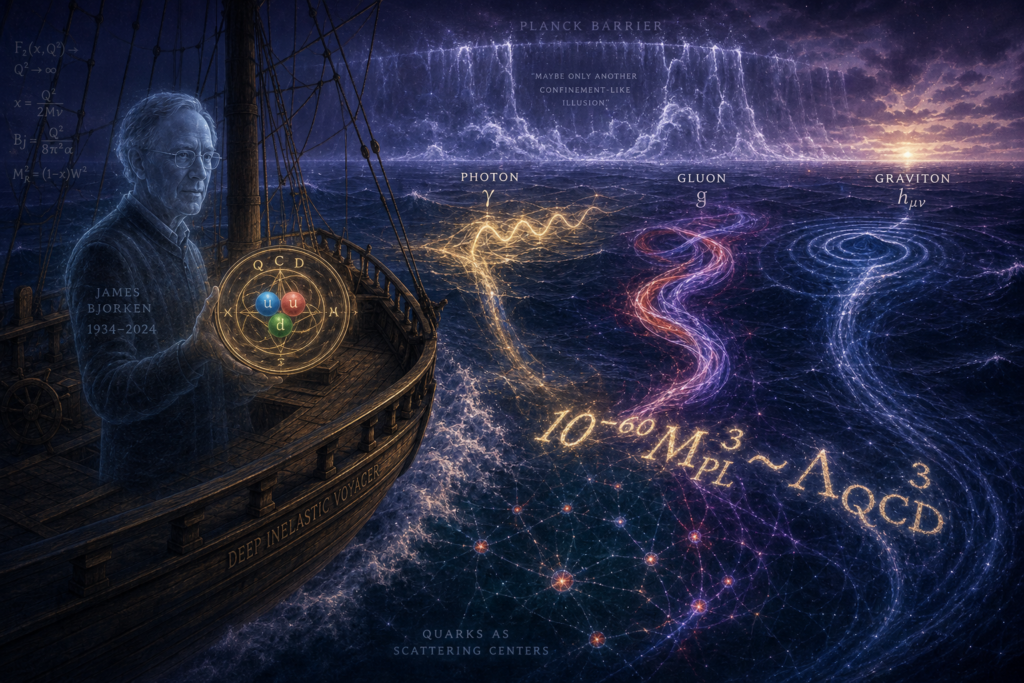
Today we sail with James Bjorken, a physicist whose name is written in golden letters in the foundations of the Standard Model, but who, toward the end of his life, posed a question that is at once a heresy and a prophecy: what if the photon, the gluon, and the graviton are not fundamental, but emergent degrees of freedom of the Dirac Sea?
🧭 Bjorken and Point-Like Scattering Centres: Proving Quarks
Before he became a heretic, Bjorken was a builder of the cathedral. His contribution to the discovery of quarks is immeasurable. In the late 1960s, deep inelastic scattering experiments of electrons on protons (carried out at SLAC) revealed something unexpected: the proton did not behave as a soft, homogeneous particle, but as though it contained point-like constituents – scattering centres that Feynman called “partons”, and which we now know to be quarks.
Bjorken was the one who theoretically predicted how such point-like constituents would manifest in experiment. His famous Bjorken scaling was crucial: it showed that at sufficiently high energies the structure of the proton becomes independent of the low-energy details, a direct consequence of the existence of nearly free point-like particles inside the proton. That insight was one of the pillars on which QCD was built.
Thus, Bjorken helped open the way toward the depths of the Dirac Sea – toward quarks and gluons. But he did not stop there. Like a true mariner, he sailed on. And at one point he asked a question that unsettled many: how deep is the sea really? And are the particles we have discovered truly final, or are they also only waves on the surface of something even deeper?
🧱 The Planck Barrier: A New Confinement
In his famous lecture at the Fifth Meeting on CPT and Lorentz Symmetry in 2010, Bjorken drew a direct analogy between two great barriers in physics: the confinement barrier in QCD and the Planck barrier in quantum gravity.
Recall the story of the strong interactions. For a long time pions were regarded as fundamental particles. Then it turned out they were composite – made of quarks and gluons, which took over the role of fundamental degrees of freedom at short distances. The confinement barrier was breached when we realised there was a deeper layer.
Bjorken asks: what if the Planck barrier is the same kind of illusion? What if the photon, the gluons, the W/Z bosons, and even the graviton are only low-energy manifestations of something deeper? What if they are the “pions” of our epoch – useful pictures that work at our scales, but dissolve into more fundamental degrees of freedom as we approach the Planck scale?
In this picture, the Dirac Sea is deep. And what we call “elementary particles” are perhaps only rhythms on its surface.
⚡ Emergent QED: The Photon as a Wave, Not a Particle
Bjorken develops an old idea: the photon is a Goldstone boson of spontaneously broken Lorentz symmetry. In this picture, the photon is not a fundamental carrier of force, but a collective excitation of the vacuum – a wave that arises when spacetime symmetry is broken.
Mathematically, this is described by an effective Lagrangian with a “Mexican hat” potential for the gauge potential , with an enormous vacuum expectation value (at the GUT scale) and an extremely small quartic constant (on the order of ), linked to dark energy. Eliminating the scalar potential leaves the Maxwell term, but with a nonlinear relation between the electric field and the vector potential.
In this picture, the longitudinal photon degrees of freedom behave as a Bose condensate. This means the vacuum is filled with a coherent oscillation of the photon field – as though the sea were covered by a single vast, coordinated wave that we experience as “empty space”.
If that is so, then dark energy is only the energy of that condensate. And the photon, which we have regarded as a particle for centuries, is actually only a rhythm of the sea.
🌌 The Emergent Graviton and the Torsion of Spacetime
What about gravity? Bjorken leans on Sakharov’s idea: the Einstein-Hilbert action can be obtained from radiative loops – that is, gravity is not fundamental, but induced by quantum effects. This is an idea that is still alive today in various forms.
But Bjorken goes a step further. He insists on the first-order Palatini formalism, where the metric and the connection are treated as independent degrees of freedom. In this formalism, instead of 10 degrees of freedom, we have 40. And here something appears that we usually neglect: torsion.
Torsion is a measure of how “twisted” spacetime is – it is zero in standard general relativity, but need not be zero at the quantum level, especially when fermions are present. For Bjorken, torsion is not merely a mathematical curiosity; it is real physics. It introduces new terms into the action, including CP-odd terms such as the Holst, Pontryagin, and Nieh-Yan terms. The Holst term mixes torsion with metric degrees of freedom, but the macroscopic Einstein equations remain untouched – meaning the new physics hides precisely in torsion, not in a modification of the geometry itself.
🌀 The Axial-Vector Condensate and the Zeldovich Relation
The heart of Bjorken’s speculation is the introduction of an axial-vector condensate – the vacuum expectation value of the axial-vector current:
where is a unit timelike vector in the rest frame of the cosmic microwave background. This condensate is a source of torsion (contorsion) in FRW cosmology. It changes dark energy – it renormalises the asymptotic Hubble rate .
And here we arrive at the key relation – the Zeldovich relation:
This is an astonishing link. It connects the QCD scale (), the Hubble rate (), and the Planck mass (). In other words, the microscopic world of strong interactions and the cosmological world of dark energy are not separate – they are deeply intertwined.
Recall Dirac’s Large Numbers Hypothesis and those mysterious . The Zeldovich relation is another such numerical coincidence – but it does not look accidental. It suggests that the QCD vacuum structure is central to understanding dark energy. A condensate of topological charge in QCD, with a mean value of in the Hubble volume, could be the key.
💎 What Does Bjorken Tell Us?
Bjorken’s message is bold and speculative, but consistent. It can be summarised in a few points:
- The Planck barrier is analogous to the confinement barrier. Just as pions turned out to be composite and quarks fundamental, so today the photon, gluons, W/Z bosons, and graviton might be emergent, not fundamental entities.
- The photon may be a Goldstone boson of broken Lorentz symmetry. It is a wave on the surface of the Dirac Sea, not its fundamental particle.
- Gravity is induced, and torsion is real. The Palatini formalism reveals new degrees of freedom that are ignored in the standard approach.
- The Zeldovich relation connects QCD, dark energy, and the Planck mass. It is not a numerical accident, but a signature of the unity of quantum chromodynamics and gravity.
In our picture of the Dirac Sea, Bjorken is a mariner who helped discover the deep currents (quarks), and who then dived even deeper, seeking the source of the sea itself. His vision is that all “particles” are only rhythms and correlations in the infinite ocean of the vacuum. Photon, gluon, graviton – all are waves we detect, but none is the underlying reality.
If Bjorken is right, then the Dirac Sea is truly fundamental. And what we have called “particles” for centuries are only shadows on its surface.
⛵ Epilogue: The Return of a Forgotten Traveller
Dear explorers, our voyage continues. We have visited Schwinger and Feynman, two geniuses who built the cathedral and then doubted its foundations. Now we have taken aboard Bjorken – the man who proved quarks and then wondered whether they too are only waves.
What unites these great minds is not only scepticism. It is the courage to think more deeply, to question even those truths we ourselves helped establish. That is what makes our voyage across the Dirac Sea worthwhile.
For as long as there are mariners ready to dive beneath the surface, the sea will reveal new layers to us. And we, as always, shall be here to tell the story.
The sea is always clear. The horizon is always open. And the depth – the depth is what calls us. 🌊🔬🔮
This post continues the series begun with “⚛️ Quantum Archaeology: Reading the Past from the Dirac Sea”, continued through the map of the quantum odyssey and all our previous voyages, especially the previous post on QCD.
Leave a Reply