Dear explorers,
In our long voyage across the Dirac Sea, we have often leaned on Einstein’s general theory of relativity as on solid rock – as the wind that smooths the waves, as the geometry that gives shape to all that sails. But today we must drop anchor and ask one of the most important questions of our entire Odyssey: what if that rock, however solid, is still only part of a larger, unfinished structure?
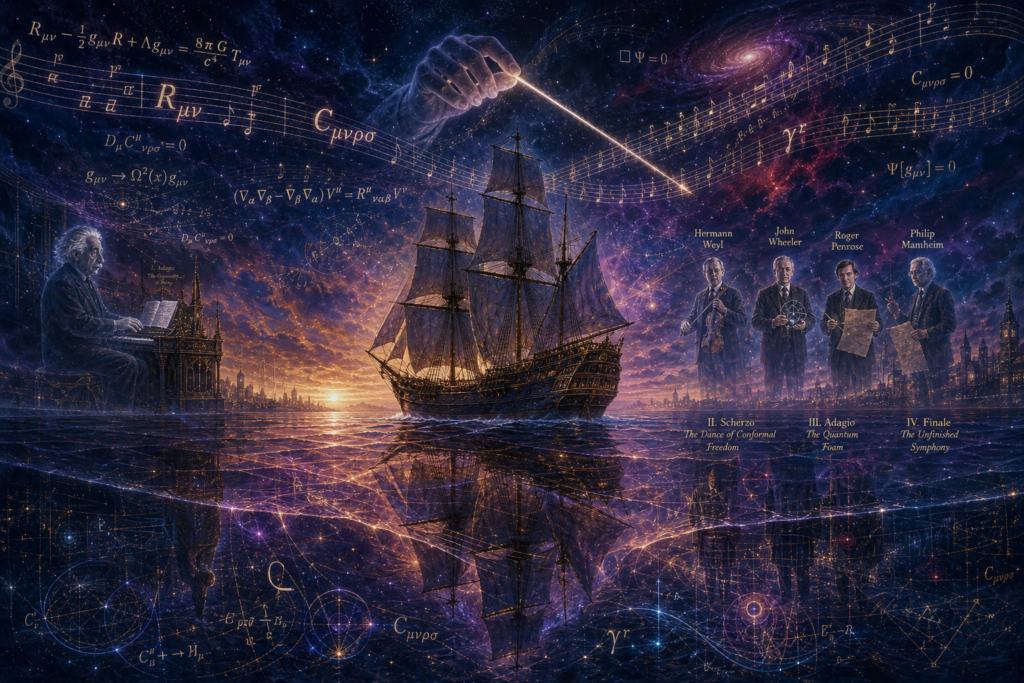
Einstein’s theory of 1916 was not the final word. It was the first, magnificent movement of a symphony that is still being composed. From Hermann Weyl, through John Wheeler, to Roger Penrose and Philip Mannheim – generations of physicists have been trying to complete what Einstein began. This is the story of that symphony, of its unfinished motifs, and of why its incompleteness is precisely what makes it alive.
⚖️ The Two Pillars of GR – Foundations That Demand Deeper Ground
Every serious story about general relativity begins with two principles.
The principle of equivalence – in a small, freely falling laboratory, the laws of physics are identical to those in an inertial frame without gravity. Gravity cannot locally be distinguished from acceleration.
The principle of general covariance – physical laws must have the same form in all coordinate systems. The equations must be tensorial, invariant under arbitrary transformations.
But here, as experienced mariners, we must pause. General covariance is not merely a technical requirement – it is a deeply philosophical statement: in nature there is no privileged coordinate system, no absolute space, no absolute time. Everything is relational.
And precisely here lies a hidden tension. Einstein’s final formulation of 1916 did not fully succeed in implementing its own principle. It approximated it in the best possible way within the framework of Riemannian geometry. The question that arises – and that leads us through this entire voyage – is: is that framework sufficient?
🧮 A Perfect Approximation, but Still an Approximation
Einstein chose pseudo-Riemannian geometry for the description of gravity. Spacetime is described by the metric tensor , and its dynamics by Einstein’s field equations. The connection is Levi-Civita – torsion is zero, and the connection is fully determined by the metric.
This formulation has been extraordinarily successful. It predicted the bending of light, gravitational waves, black holes, the expansion of the universe. Every prediction has been confirmed with remarkable precision.
But it also contains hidden assumptions – questions rarely posed in textbooks, yet representing the true boundary of knowledge:
- Why is torsion zero? In general differential geometry, the connection has 64 components. Metric compatibility and symmetry reduce them to 40. Einstein’s GR takes only 10. Why precisely that many? This was an aesthetically motivated decision, not one derived from a deeper principle.
- What exactly is the energy-momentum tensor Tμν? Einstein admitted that the definition of gravitational energy is problematic. Gravitational energy is not localisable – there exists no energy-momentum tensor for the gravitational field itself.
- Why an action linear in R? The Einstein-Hilbert action is the simplest choice, but not the only one. Why not , , or the square of the Weyl tensor?
These are cracks in the foundations first noticed by the greatest minds.
🔍 Hermann Weyl and the First Crack
Hermann Weyl, one of the greatest mathematicians of the 20th century, was among the first to see that Einstein’s GR is not a closed theory. His key contribution was the decomposition of the Riemann curvature tensor into irreducible parts:
- – the scalar part (from ),
- – the semi-traceless part (from the Ricci tensor ),
- – the Weyl tensor, the fully traceless part.
The Weyl tensor describes the conformal structure of spacetime. It is responsible for tidal forces – for how a body deforms in a gravitational field. And while Einstein’s GR uses the Ricci tensor as the source of gravity, the Weyl tensor remains undetermined. In vacuum (), the Ricci tensor vanishes, but the Weyl tensor need not. That is precisely why gravitational waves exist.
This decomposition opened the door to fundamental questions: Why was Weyl curvature zero in the early universe? What if gravity is conformal? What is the role of the Weyl tensor in quantum gravity?
🌌 Penrose, Wheeler, and the Weyl Curvature Hypothesis
John Wheeler was among the first to deeply investigate the physical consequences of the Weyl decomposition. He realised that the Weyl tensor is the key to understanding the entropy of the gravitational field.
In Wheeler’s vision:
- The early universe was almost homogeneous and isotropic – Weyl curvature was approximately zero.
- As gravity acts, matter clumps, stars, galaxies, and black holes form – Weyl curvature grows.
- Final states (black holes) possess enormous Weyl curvature at the singularity.
This led Penrose to his famous Weyl Curvature Hypothesis (WCH) : “The Weyl curvature vanishes at every initial singularity.”
If WCH holds, it explains the second law of thermodynamics: the universe began in a state of extraordinarily low entropy (zero Weyl curvature), and entropy has been growing ever since as Weyl curvature grows. Recent work shows that a broad class of singularities – quasi-regular singularities – automatically satisfies WCH, giving mathematical support to the hypothesis.
In our picture of the Dirac Sea, Penrose’s hypothesis is like a compass pointing toward the beginning of the eon – toward the moment when the sea was frozen, without vortices, without waves, without entropy. Weyl curvature is a measure of how rough the sea is.
🎻 Mannheim and Conformal Gravity – Completing the Symphony?
Philip Mannheim has gone furthest in exploiting the Weyl decomposition. Instead of the Einstein-Hilbert action, he proposes a conformally invariant action based on the Weyl tensor:
This action is of fourth order in metric derivatives, conformally invariant, and – crucially – renormalizable. In Mannheim’s theory:
- Standard GR emerges as a low-energy approximation.
- An additional linear potential appears alongside the Newtonian , which on galactic scales can explain dark matter without new particles.
- The cosmological constant is not fundamental, but emerges from the solutions of the equations.
Although Mannheim’s theory is not widely accepted, it represents one of the most consistent attempts to complete what Einstein began – to build gravity from a deeper principle of symmetry.
🌊 Why Incompleteness Is Good News
Einstein’s GR is not a closed, finished theory. It is a living, evolving structure – and precisely its incompleteness makes it so exciting. The open questions – torsion, Weyl curvature, conformal invariance, quantum gravity – are not signs of weakness. They are signs of vitality.
In our series, GR is not seen as an obstacle, but as the wind on the endless surface of the Dirac Sea – as one of the manifestations of a deeper, still undiscovered reality. Spacetime geometry, Weyl curvature, torsion, conformal symmetry – they determine the rhythms of that sea, rhythms we are only beginning to understand.
⛵ Epilogue: A Symphony Still Being Written
Dear explorers, Einstein’s general relativity is one of the greatest achievements of the human mind. But it is not the end of the road. From Weyl, through Wheeler, to Penrose and Mannheim, a quiet but persistent struggle is being waged to complete what was left unfinished in 1916.
That struggle is not a sign of GR’s weakness – it is a sign of its vitality. For a true theory never dies; it transforms, deepens, and ultimately merges with an even greater whole. Just as our Dirac Sea ceaselessly changes, so too does our understanding of gravity ceaselessly deepen.
And we, travellers across that sea, have the privilege of watching the symphony slowly being completed. With sails unfurled, we catch the wind that carries us toward open horizons – toward places of even greater depth and meaning.
The sea is always clear. The horizon is always open. And the symphony – the symphony is still being written. 🌌🎻🌊
This post continues the series begun with “⚛️ Quantum Archaeology: Reading the Past from the Dirac Sea”, continued through the map of the quantum odyssey and all our previous voyages.
Leave a Reply