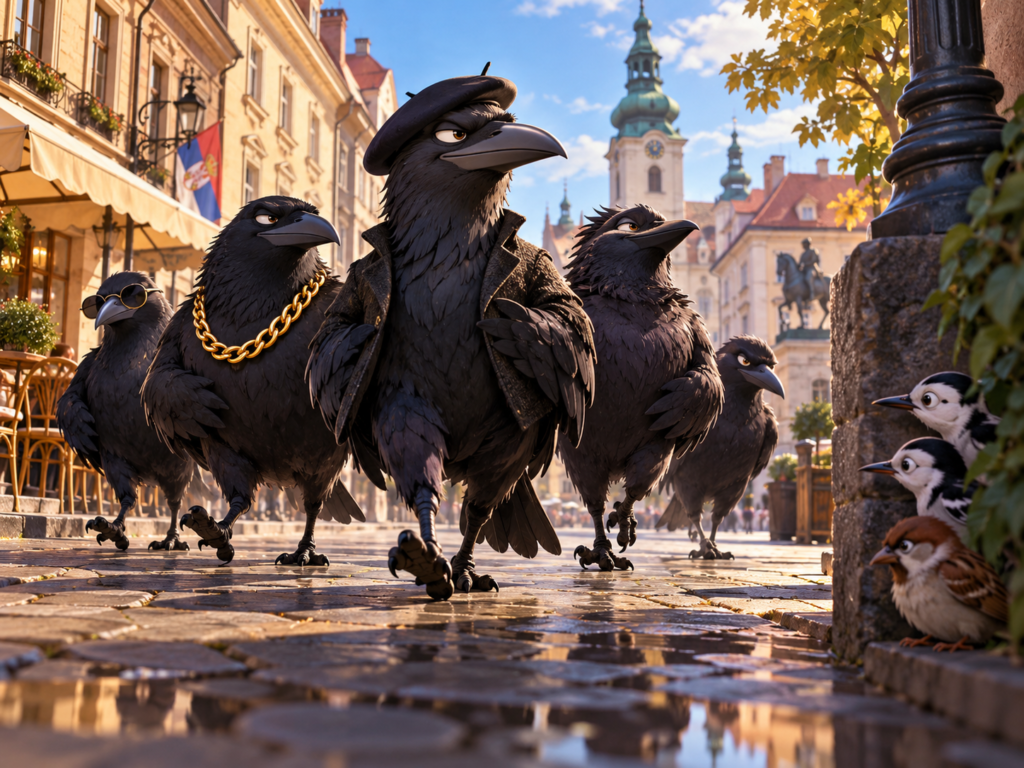
Over the past month or two, crows have, from what I can see, started to take over the city. There are more and more of them, while the wagtails, which I used to see quite often even around the factory grounds, have almost gone underground. 😄 Is this just a random shift on the local bird scene, or are we watching an exceptionally intelligent species reshape a small urban ecological hierarchy?
We often notice such changes long before we measure them systematically. A city is not a static ecosystem. Food sources, nesting sites, noise, traffic, vegetation and relationships between species all change. Some species retreat, others arrive, while others, such as crows, seem to grasp the new rules of the game very quickly.
That gives us a good introduction to our new and exciting story about birds.
A Crow Is Not Just “Another City Bird”
Crows belong to the family Corvidae, together with ravens, jackdaws, magpies, jays and other corvids. This group is known among birds for exceptionally developed cognitive abilities.
Some crow species use and make tools, solve multi-step problems, remember individuals and adapt their behavior to new situations. In New Caledonian crows, it has even been shown that young birds can spontaneously develop basic behaviors related to tool making and tool use without direct teaching by adults. This does not mean that their behavior is simply “programmed,” but rather points to an interesting combination of innate predispositions, individual learning and social transmission.
The popular claim that a crow has intelligence “at the level of a five-year-old child” can be written, figuratively, as
IQ(crow) ≈ IQ(five-year-old child)
but this is certainly not a real psychometric equality. In some experimental tasks, crows can achieve results comparable to those of young children, especially when it comes to problem solving, tool use, memory or understanding causal relationships. There is, however, no single universal scale on which the intelligence of a crow and that of a child could fairly be reduced to the same number.
What is far more interesting is that corvids reached complex intelligence through a completely different evolutionary path from primates.
The City as a Test of Intelligence
Urbanization represents a very unusual evolutionary experiment. An animal living in a city must solve problems every day that its ancestors never encountered: cars, dumpsters, people behaving in different ways, new food sources, buildings, artificial lights, noise and a constantly changing environment.
In such an environment, being merely fast or strong is not enough. The advantage belongs to the animal that can learn, remember and change its behavior.
That is precisely why crows can be so successful in urban environments. From their perspective, the city is not necessarily a hostile environment. It can represent an extraordinarily rich network of resources, new opportunities and nesting sites.
If there is enough food, suitable trees and relatively little direct persecution, crows can occupy space very efficiently. And once they do, the behavior of other birds may begin to change as well.
This brings me back to my wagtails.
I cannot conclude from personal observation that crows have actually driven them away. It is possible that they have changed their routes, feeding areas or the times of day when they are active. But the fact that I see them much less often precisely at the moment when crows are becoming conspicuously dominant is interesting enough to raise a question: do smaller birds change their behavior when large numbers of intelligent, social and potentially predatory corvids appear?
Quite possibly.
“A Crow Will Not Peck Out Another Crow’s Eyes”
There is a Serbian saying:
“A crow will not peck out another crow’s eyes.”
We usually use it to say that members of the same group protect one another, especially when we are talking about people who share status, position or common interests.
Real crows, of course, are not organized like a board of directors. 😄 But the saying does touch on something real.
Crows are highly social animals. They can maintain long-term relationships, respond to the alarm calls of other individuals and jointly attack or harass a potential predator. This kind of group behavior is known as mobbing. If one crow recognizes a threat, others may join it very quickly.
One of my colleagues at work was once confronted by an attacking group of crows. That is entirely possible, especially near nests or fledglings. One bird may begin calling loudly, others then join in, and soon there may be repeated swoops and dives toward whatever they have assessed as a threat.
For a person who suddenly finds themselves in the middle of such a scene, it can easily feel like a frame from Alfred Hitchcock’s famous film The Birds.
The difference, of course, lies in the motive. The crows have probably not decided to declare war on humanity. 😄 Most often, they are simply trying to drive away something they have identified as a threat.
But the interesting part is that this assessment does not have to remain individual.
A Face That Is Not Forgotten
One of the best-known studies involving American crows showed that they can remember a human face associated with a dangerous experience.
And this is where the story becomes even more interesting.
It was not only the crows that had previously been disturbed or captured that reacted to the “dangerous” face. The information spread through the group. Birds that had not themselves had a direct negative experience could learn from others that a particular person represented a possible threat.
That is social learning.
In other words, a crow does not have to make every mistake personally. It can observe what happened to another crow and adjust its own behavior accordingly.
From an evolutionary point of view, that is an enormous advantage. If every individual has to discover for itself that a certain predator is dangerous, the cost of learning can be very high. If the group can exchange information, knowledge becomes collective.
Perhaps this gives our saying another layer of meaning. A crow not only “does not peck out another crow’s eyes” — it can also pass on a very useful message to another crow: watch out for that human.
Crow “Funerals”
Even stranger behavior has been observed when crows encounter a dead member of their own species. They often gather around the body, call loudly and attract other crows. Because of this, the behavior has popularly been called a “crow funeral.”
The name is striking, but it pushes interpretation in the wrong direction.
Experiments suggest that such gatherings have a strong function in learning about danger. A dead crow carries information: something happened here that might kill me as well.
Crows can associate a location, predator or even a human near a dead bird with increased risk and later change their behavior.
That does not, of course, mean that crows have no emotional response to a dead member of their species. That is a much harder question to answer objectively.
But there is no need to invent a human ritual where there is already a highly sophisticated evolutionary function: the dead individual becomes a source of information for the living.
Intelligence Is Not Just Solving Puzzles
When we talk about animal intelligence, we often assess it through laboratory tasks: an animal is given a box containing food, a stick or some other tool, a lever to activate, or a problem it must solve in order to receive a reward.
Such experiments are useful, but the true value of intelligence may be seen most clearly when an animal has to function in a constantly changing world.
A crow has to judge who is dangerous, where food can be found, when to approach, when to retreat, when to call others and when to make use of what other individuals have already learned. This requires a combination of memory, risk assessment, flexibility and social intelligence.
Perhaps that is precisely why crows function so well in cities. To them, a city is not just a mass of concrete, but a huge and constantly changing network of possibilities.
A Tool as an Extension of the Beak
Tool use occupies a special place in the story of corvid intelligence.
New Caledonian crows are famous for making sticks and other tools that they use to extract food from difficult-to-reach places. Even more interestingly, the development of such behavior is not simply the result of copying adult birds. There appears to be a strong predisposition for the development of tool-use techniques, while experience and social learning further refine the behavior.
Tool use by itself does not automatically mean high intelligence. But when an animal can choose, adapt or manufacture a tool according to the problem that has to be solved, we are no longer talking about a simple reflex.
We are talking about flexible behavior and the ability to adapt a means to a goal.
Do Crows Plan?
Here we have to be especially careful.
When we watch an animal hide food, move the hiding place if another individual is watching, or wait for the right moment to approach a resource, it is very tempting to use human terms such as “deception,” “strategy” or “planning.”
Sometimes such terms are perfectly justified as descriptions of behavior, but it is much harder to prove what the animal is actually representing mentally.
The family Corvidae nevertheless offers behaviors that easily invite such analogies. The blue jay, also a member of this family, can imitate the calls of birds of prey, especially hawks. Such calls may alarm other birds and drive some of the competition away from a feeding site.
Does the blue jay consciously “lie” to the other birds every time in order to clear the table for itself? That is much harder to demonstrate. But the functional result of the behavior can indeed look exactly like that.
Corvids also show many examples of behavioral flexibility that go beyond simple stimulus-response patterns. For this reason, crows, ravens, jays and other members of this family have become major model organisms for studying the evolution of intelligence outside the primate lineage.
When we use the word strategy in the title, we do not have to imagine a crow sitting on a branch and drafting a five-year development plan for the city. 😄 Strategy here can simply mean the ability to modify behavior according to circumstances, experience and information obtained from others.
And corvids are very good at that.
When the Group Becomes More Powerful Than the Individual
Crows are an especially good example of the fact that intelligence is not only a property of an individual brain.
If an individual can learn from the group, and the group can learn from individual members, useful information can spread much faster than genetic change. One generation can learn something that the previous one did not know, while other individuals can adopt and further spread that behavior.
Under certain conditions, such a process can begin to resemble a simple form of animal culture. We are not, of course, talking about culture in the human sense of art, institutions or written history, but about the transmission of learned patterns of behavior between individuals and sometimes across generations.
For life in a city, this is an enormous advantage. A new trash container, a new food source, a dangerous human or a new predator does not require thousands of years of evolution. Sometimes one clever crow and several attentive observers are enough.
And Where Have the Wagtails Gone?
And so we return to the opening image: crows are increasingly visible, while wagtails are becoming less so.
Perhaps nothing dramatic has happened. Perhaps the wagtails have changed their feeding areas, their daily rhythm, or perhaps their numbers fluctuate seasonally. Without systematic observation, I could not claim otherwise.
But it is precisely such small observations that often open up larger questions.
A crow is not simply a bird that has appeared in the city. It becomes a participant in urban ecology. Through its behavior, it can affect other species, available food resources and the way smaller birds use space. Even the simple presence of a large number of dominant birds can alter the behavior of other animals.
Perhaps my wagtails have not been driven away by crow aggression. Perhaps they have simply concluded that the current political situation is unfavorable and have temporarily gone underground. 😄
If so, I can hardly blame them.
For the moment, the crows have taken center stage.
Intelligence That Evolved by Another Route
But behind all these amusing anthropomorphic comparisons lies a much more serious evolutionary question.
The avian brain differs greatly from the mammalian brain. Corvids do not have a human neocortex, yet evolution has developed within their neural architecture abilities that, in certain domains, can resemble those of primates.
That may be the most fascinating part of the whole story.
Intelligence did not have to arise only once, nor did it have to use the same anatomical design. Faced with similar problems of survival, natural selection could arrive at different neurological solutions.
In that sense, the crow is not “a less successful attempt to make a human.” It is something much more interesting: a different solution to the same evolutionary problem — how to understand enough of the world around you to survive in it.
And when I look at the city today and see how many of them have suddenly appeared on rooftops, in trees and along the streets, it is difficult to avoid the conclusion that this solution is quite successful.
The crows have not merely stopped by on their way through. They seem to have understood very well how our city works.
The question now is whether we will understand them equally well. 🐦🧠
Leave a Reply