
In our previous voyages across the Dirac Sea, we have mostly followed great theorists and mathematicians. Dirac, Pauli, Fermi, and others who drew conclusions about particles no one had yet seen from equations, symmetries, and the internal logic of nature. The neutrino may be one of the finest examples of such physics: a particle first introduced to preserve conservation laws, and later confirmed experimentally as a real part of nature.
But physics is not only the art of good equations. It is also the art of asking nature a sufficiently good question — and building an instrument capable of hearing the answer.
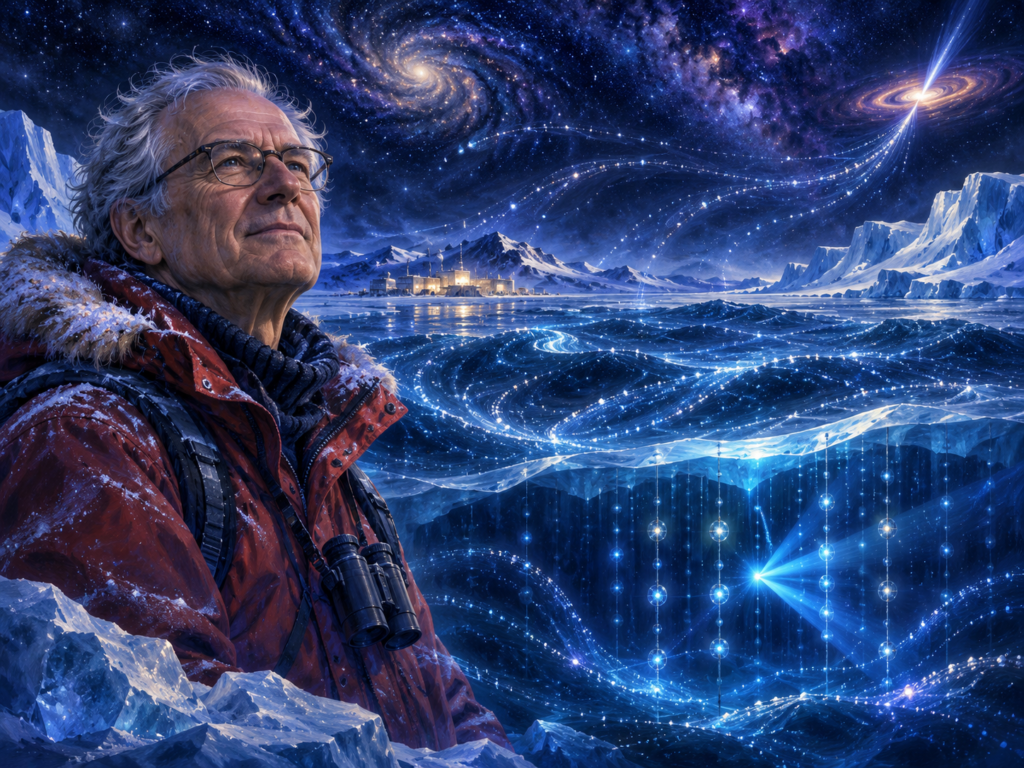
That is why the 2026 Nobel Prize in Physics awarded to Francis Halzen is especially interesting. He was recognized for decisive contributions to the IceCube Neutrino Observatory and for the discovery of high-energy neutrinos of astrophysical origin. Halzen was one of the key figures behind the idea of using Antarctic ice as a detection medium and turning that idea into a functioning cubic-kilometer neutrino observatory.
If, in an earlier post, we called the neutrino the plankton of the Dirac Sea, then Halzen may be its Jacques Cousteau.
Except that these plankton are not drifting idly through the cosmic ocean. They carry information from some of the deepest, most energetic, and least accessible regions of the Universe.
When Photons Are No Longer Enough
Almost the entire history of astronomy is based on light. We first observed the visible part of the spectrum, then learned to see radio waves, infrared, ultraviolet, X-rays, and gamma rays. We changed telescopes and detectors, but the fundamental messenger remained the same — the photon.
The problem is that the photon is not an ideal witness to every cosmic event. It interacts easily with matter, can be absorbed, scattered, or completely blocked. In extremely dense environments, photons may remain trapped for long periods or lose information about the place where they were created.
The neutrino is almost the exact opposite. It interacts so weakly with matter that enormous numbers of neutrinos pass through our bodies, the Earth, and other objects almost undisturbed.
Precisely what makes the neutrino extraordinarily difficult to detect also makes it an exceptional cosmic messenger. If it is created inside an extreme astrophysical process, it can escape almost unchanged and travel through immense quantities of matter before reaching us.
A photon often shows us what managed to escape from a certain cosmic process.
A neutrino can bring us news from its interior.
A Giant Detector Buried in Ice
The problem is obvious: if a neutrino almost never interacts with matter, how do we detect it?
The answer from experimental physics was almost banal in its basic idea: if the probability of interaction is small, build an enormous detector.
IceCube uses approximately one cubic kilometer of Antarctic ice as an active detection medium. More than five thousand optical sensors are embedded deep beneath the surface.
The neutrino itself is not seen. But in the rare case when it interacts with an atomic nucleus in the ice, it can produce a charged secondary particle. If that particle moves through the ice faster than light can propagate through that medium, Cherenkov radiation is produced — a flash of light registered by the optical sensors.
We do not, therefore, detect the neutrino directly. We detect the consequences of its rare collision with matter.
From the arrival times of light at different sensors and its spatial distribution, it is possible to reconstruct the direction, energy, and character of the event. In this way, an enormous mass of natural Antarctic ice becomes an instrument for studying some of the most extreme phenomena in the Universe.
Rehabilitating “Practical” Physics
In popular science stories, the theoretical physicist often occupies a privileged position. An equation on a blackboard looks elegant, and a new concept may fit into a few lines of mathematics. An experiment, with thousands of sensors, kilometers of cables, electronics, calibration, logistical problems, and years of data analysis, seems less romantic.
But nature does not accept a theory simply because it is beautiful. Experiment is where theory has to pass its exam.
Halzen’s story therefore reminds us of something we may have emphasized too little in our own series: experimental physics is not an auxiliary service of theoretical physics. It is an equal way of discovering nature. Sometimes theory predicts a phenomenon and experiment checks whether it truly exists. But sometimes a new instrument opens a window through which no one has ever looked before, and only then do questions appear that we previously did not even know how to ask.
IceCube belongs precisely to that second category. A technical solution became a new way of observing the Universe.
From Detector to Telescope
One of the key moments in IceCube’s development was the demonstration that part of the high-energy neutrino flux it detected could not be explained by the known atmospheric background alone.
Atmospheric neutrinos are produced when high-energy cosmic rays strike atomic nuclei in the upper layers of Earth’s atmosphere. These collisions create unstable particles, primarily pions and kaons, whose decays produce neutrinos. They form a well-known and very important background for neutrino experiments.
IceCube, however, showed that at high energies there is an additional population of neutrinos whose origin must be astrophysical.
In other words, a neutrino detector became a telescope.
From that point onward, the search for their sources began. Neutrino emission has been associated with active galactic nuclei, and IceCube has also revealed diffuse neutrino emission from our own Galaxy.
This represents a fundamental change. An astronomer no longer has to ask only: “Where does the light come from?” The question can now also be: “Where does the neutrino come from?”
The answer may lead us to regions around black holes, active galactic nuclei, explosive transients, and other environments in which particles are accelerated to energies that are difficult to achieve even in the largest accelerators on Earth.
This is how neutrino astronomy is born.
The Neutrino as a Cosmic Messenger
High-energy neutrinos are especially interesting because their presence points to highly efficient particle-acceleration processes. They often arise when accelerated protons or other nuclei collide with matter or radiation, producing unstable particles whose decays generate neutrinos.
If we detect such a neutrino, we obtain a trace of a place where extreme hadronic physics is taking place.
A photon can be produced in many different ways, while a high-energy neutrino gives more specific information about processes involving accelerated protons and nuclei. That is why neutrino astronomy is also important for solving another long-standing problem: where do the highest-energy cosmic rays come from?
Charged cosmic particles are deflected by galactic and intergalactic magnetic fields, so their direction of arrival does not reliably point back toward their source. A neutrino does not have that problem. It is electrically neutral, and if we can determine its arrival direction accurately enough, it can point almost directly toward the place where it was created.
Multimessenger Astronomy: When Several Messengers Describe the Same Event
The most interesting results appear when the neutrino is not observed in isolation. Modern astronomy is increasingly becoming multimessenger astronomy — astronomy based on multiple messengers.
A single cosmic event can be observed simultaneously through photons, gravitational waves, cosmic rays, and neutrinos. Each of these messengers tells a different part of the story: photons describe electromagnetic processes, gravitational waves reveal the dynamics of massive compact objects, cosmic rays carry information about accelerated charged particles, while neutrinos can show where processes associated with extremely accelerated hadrons are taking place.
Only when we combine several of these channels do we begin to obtain a more complete picture of the event. This may be one of the greatest shifts in modern astronomy: we no longer observe the Universe only in different colors of light, but through different physical messengers.
Plankton That Changes Flavor
Here we can return to our old “plankton of the Dirac Sea.”
We know three neutrino flavors: electron, muon, and tau neutrinos. But the neutrino has a property that would seem strange even for a far more exotic particle: during its journey, it can change flavor.
A neutrino created as an electron neutrino may later be detected as a muon or tau neutrino. Neutrino oscillations were one of the key pieces of evidence that neutrinos have mass, however tiny, and therefore showed that the simplest form of the Standard Model is incomplete.
But the question does not end there, because there is a possibility that our plankton has another member that we have not yet directly identified.
Is There a Fourth Neutrino?
Three active neutrino flavors have been experimentally confirmed. However, over the past several decades, several experiments have produced anomalies that motivated the hypothesis of an additional, so-called sterile neutrino.
The name is somewhat ironic. Such a neutrino would not participate in the standard weak interaction in the same way as the three known flavors, but it could mix with them through neutrino oscillations.
At first glance, this would provide an elegant explanation for some anomalies observed in experiments such as LSND, MiniBooNE, and others. The problem is that more recent results do not confirm the simple version of this scenario. MicroBooNE has strongly constrained the possibility that the LSND and MiniBooNE anomalies can be explained by a single light sterile neutrino.
That, however, is not the same as saying that every possibility of additional neutrino states has been definitively excluded. The experimental space is narrowing, simple models are being eliminated, but the question of whether some additional neutrino sector exists remains part of the broader search for physics beyond the Standard Model.
So, a fourth neutrino has not yet been found.
But the failure of simple explanations often leads physics toward more interesting questions.
The Sea Has Deeper Layers
Perhaps this is exactly what makes the neutrino so fascinating.
It first appeared as a theoretical necessity, then became a real particle. We then discovered that it exists in several flavors, that it changes flavor during propagation, and that it must therefore have mass. We still do not know whether the neutrino is a Dirac or a Majorana particle, we do not fully understand the origin of its masses, we do not know whether sterile states exist, nor what role the neutrino sector may have played in creating the asymmetry between matter and antimatter.
And now we have learned to use it as a telescope.
The plankton of the Dirac Sea has turned out to be something far more interesting than a tiny inhabitant of the cosmic ocean. It may carry information about the very structure of that ocean.
New Explorers of the Neutrino Ocean
IceCube is no longer alone. In the depths of the Mediterranean Sea, KM3NeT is being developed, a European neutrino observatory that uses seawater as its detection medium.
The KM3NeT collaboration reported the detection of an event compatible with a cosmic neutrino with an estimated energy of around 220 PeV, making it the highest-energy neutrino candidate observed so far. A single event was enough to trigger a large number of theoretical and experimental studies of its possible origin.
Among the candidates are blazars — active galaxies whose central supermassive black holes produce relativistic jets, with one of those jets directed approximately toward Earth. Because of that geometry, they appear to us extraordinarily bright and variable. This does not necessarily mean that their host galaxies are intrinsically “more active” than all other active galaxies; much of their spectacular appearance results from the orientation of the jet toward us.
Other possible cosmic accelerators are also considered, including processes related to black holes, cosmic rays, and even scenarios involving new physics.
This illustrates very clearly how much the field has changed. A few decades ago, the major challenge was simply to detect a neutrino at all. Today, a single sufficiently unusual neutrino can trigger an international astronomical campaign.
Halzen as the Jacques Cousteau of the Dirac Sea
If we have already allowed ourselves the metaphor of plankton, we may as well take it to its conclusion.
Jacques Cousteau did not become important because he discovered that the ocean exists. His contribution lay in developing ways for humans to enter a world that had previously been almost inaccessible, to observe it, document it, and show it to others.
Halzen has done something similar with the neutrino cosmos.
He did not discover the neutrino, nor did he theoretically predict neutrino oscillations. But he was among the key people who showed that an enormous mass of natural ice could become an instrument for observing what had previously been almost invisible.
His “ocean” is Antarctic ice, and his plankton are neutrinos. Behind those almost elusive particles lie some of the most energetic processes in the known Universe.
That is why Halzen’s Nobel Prize is not merely recognition of one person or one experiment. It is recognition of the idea that a new window onto nature can be opened by building an entirely new way of observing it.
Theory tells us what might exist in nature. Experiment decides whether nature actually agrees with that idea, and sometimes a good experiment does something even more valuable — it shows us something we did not even know we should ask about.
The Voyage Continues
In the previous article, we called the neutrino the plankton of the Dirac Sea because it is all around us, almost imperceptible, and yet a fundamental part of the cosmic environment. Today we can add another layer to that metaphor.
These plankton are not merely passive inhabitants of the sea. They are its messengers. They carry information from places through which light passes with difficulty, from cosmic accelerators we still do not understand, from processes at energies far beyond our everyday experience, and perhaps even traces of physics that does not yet fit into the Standard Model.
Francis Halzen and IceCube have shown that we have learned how to listen to those messengers. But we are only beginning to understand what they are telling us.
Unlike the plankton of saltwater seas, these plankton of the Dirac Sea are neither easy to catch nor easy to digest. Perhaps they are whispering to us some of the deepest secrets of an ocean we are still trying to map.
Leave a Reply