
Dear explorers at the crossroads of science and spirit,
Thus far we have come to know the Dirac Sea as an ocean of fields, the carrier of fundamental forces, and the stage upon which the gravitational wind writes waves and topological scars. We have shown that the sea is – at least in the AdS/CFT sense – a holographic film: all information about its volume is encoded on its surface. But the boldest question remains: if information is indestructible, if the surface of the sea is both a screen and a memory, where are we in all this? Where is our consciousness – that most intimate I that observes, thinks, and loves?
This post brings back onto the stage the Orch-OR model of Roger Penrose and Stuart Hameroff, and places it within the broader framework of the Dirac Sea and the holographic principle. In doing so it opens a vista onto the possibility that consciousness is not a random by-product of complexity, but a fundamental property of the quantum fabric – and that the continuity of being is not an illusion, but a consequence of information preservation in the sea.
🧠 Orch-OR – a brief reminder
Penrose and Hameroff propose that a conscious moment coincides with objective reduction (OR) of a quantum superposition. Unlike standard decoherence, which occurs when a system interacts with its environment, OR is an intrinsic, gravitationally-driven collapse.
Penrose’s argument is straightforward: a superposition of two states of a massive object is simultaneously a superposition of two different spacetime geometries. According to general relativity, such a superposition is unstable – it collapses spontaneously, the faster the larger the mass-energy difference. The collapse time is given by
where is the gravitational self-energy of the difference between the two geometries.
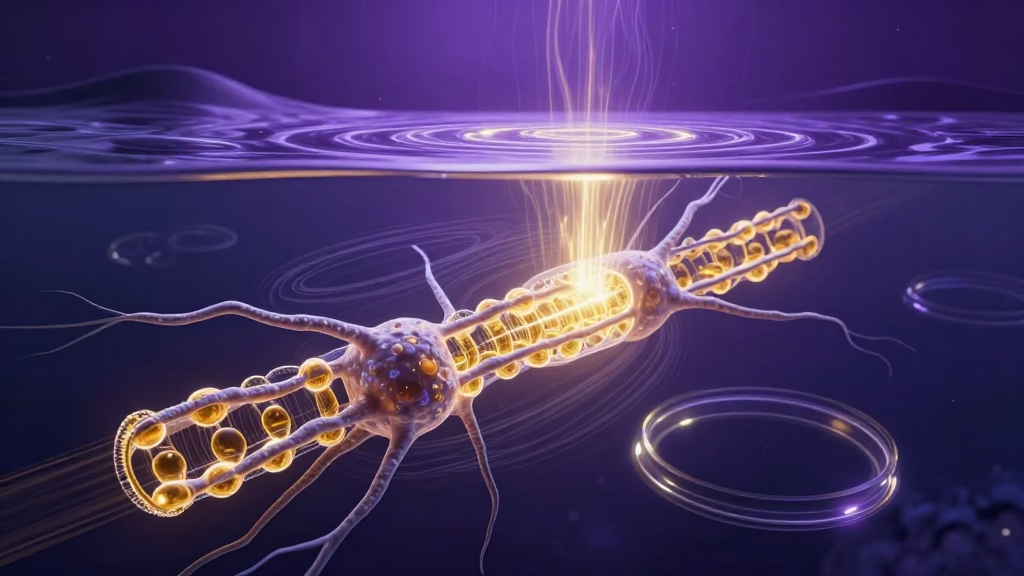
Hameroff added the crucial biological link: microtubules, proteinaceous cylinders inside neurons, are an ideal candidate for protecting quantum coherence long enough for OR to occur. In the Orch-OR picture, tubulin dimers within microtubules enter collective quantum coherence – like an ensemble of qubits – which is then orchestratedly reduced into discrete conscious moments.
It is important to emphasise that not every OR is conscious. Recent work explicitly distinguishes the two: OR is necessary but not sufficient for consciousness. A specific organisation of coherence, feedback loops, and information integration is also required.
🔬 Where does the experiment stand today?
Orch-OR has been controversial from the outset. The main objection is that the brain’s warmth (~310 K) should destroy any quantum coherence within femtoseconds. Yet recent years have brought findings that change this picture:
- Anaesthesia extinguishes coherence – Experiments show that anaesthetics act precisely on the hydrophobic pockets of tubulin, preventing the formation of coherent domains. When coherence vanishes, so does consciousness; when the anaesthetic dissipates, coherence returns.
- A terahertz signature of microtubules – Work from 2025–2026 demonstrates that microtubules exhibit characteristic resonances in the THz range, which can be detected and which change under anaesthesia. This may be the “quantum heartbeat” of consciousness.
- Surface code on microtubules – In 2025 a group of physicists showed that the Fibonacci helical geometry of microtubules naturally realises a surface code – the very same one used for quantum error correction in quantum computers. If this is correct, evolution “invented” a quantum code before we did.
- Self-organised criticality – A model from October 2025 shows that tubulin dimers, coupled by dipole-dipole interactions, can form coherent domains that behave as a system in a state of self-organised criticality – avalanches of wave-function collapse corresponding to sequences of conscious moments.
🌊 Orch-OR in the Dirac Sea: the gravitational wind inside the neuron
Now comes the crucial step – merging with the picture of the Dirac Sea.
Thus far we have imagined the gravitational wind as an external influence that smoothes the waves on the surface of the sea. But Orch-OR reveals that the same wind blows inside every neuron, inside every microtubule, inside every tubulin dimer. Every conscious moment – every now – is a local collapse of a superposition in the Dirac Sea, triggered by gravitational instability.
The brain, in this picture, is not merely a classical neuronal network that processes information. It is a resonant cavity in the sea, an instrument with billions of microtubular strings that vibrate in quantum coherence, waiting for the gravitational wind to tear them out of superposition and translate them into now.
This also explains why Orch-OR predicts discrete conscious moments: each collapse is one now. The sequence of collapses creates the stream of consciousness – the psychological arrow of time. As we saw in the Folman experiment, the phase of the wave function grows with ; a similar non-linear dependence may underlie the subjective feeling of duration.
🪞 The holographic principle and consciousness: the interior projected onto the surface
Here Orch-OR naturally ties into the holographic principle that we treated in the previous post.
If a black hole is a hologram – if all information about its interior is encoded on its horizon – what about consciousness?
The analogy is seductive: the brain is a volume, but perhaps consciousness is a holographic projection from its “surface”. Some researchers are already developing a “unified holographic framework for neural processing and consciousness”, in which lipid membranes, vicinal water, and cerebrospinal fluid form a coherent substrate capable of holographic encoding and coupling with electromagnetic fields.
In the context of the Dirac Sea this means the following: microtubules are not merely isolated quantum processors. They are local “antennae” that excite the Dirac Sea, creating coherent domains within it. When the gravitational wind triggers the collapse of those domains, the information is not lost – it is projected onto the holographic surface of the sea, where it remains permanently inscribed.
Every conscious moment is therefore a writing into eternity. Literally.
📜 Information preservation and the continuity of being
Here we arrive at the most sensitive point – one that touches the boundary of science, philosophy and religion.
If the Dirac Sea is a holographic film, and if all conscious moments are inscribed upon it, then the information that constitutes the I is indestructible. It is not stored in the brain as on a hard disk; it is woven into the very fabric of spacetime. The brain is an instrument that channels that information, but does not possess it.
This sheds new light on three major themes about which MilovanInnovation has already written:
- Gamma rhythm and “stage lighting” – Gamma oscillations (30–90 Hz) could be the external, EEG-visible trace of synchronisation of microtubular collapses. Each gamma wave carries one conscious “frame”, and their coherence depends on how well the scene is “lit” by quantum information.
- Anaesthesia as a break in continuity – As we wrote in the post on anaesthesia, the loss of quantum coherence in microtubules interrupts the continuity of consciousness, but does not erase it. When coherence returns, the
Icontinues – just as a wave on the sea “remembers” its phase. - Quantum archaeology – If the information about every conscious moment is inscribed on the holographic surface of the Dirac Sea, then the entire history of every being – every thought, every feeling, every epiphany – is preserved. Not as a story, but as an exact quantum configuration. Quantum archaeology thereby becomes a theoretically grounded possibility of reading the past from the sea.
🔮 Horizons: from the neuron to the cosmos – and back
Orch-OR, seen through the lens of the Dirac Sea, offers a picture in which consciousness is not an anomaly to be explained, but rather an expected consequence of the structure of reality:
- Consciousness is what the sea “feels” about itself.
- Every conscious moment is a collapse – a discrete
now– in an infinite sequence. - Every collapse is a writing onto the holographic film.
- Every film preserves the information forever.
The open questions remain enormous: does Orch-OR really require Planck-scale gravity, or is there an effective mechanism at lower energies? How can we experimentally prove that microtubules truly support quantum coherence at 310 K? And does the “surface” onto which information is projected really exist, or is it also emergent?
But one thing is certain: we are not accidental foamy waves on the surface of the sea. We are the sea that has become aware of itself – and that, with every new now, writes one more line in the infinite book of existence.
This post continues the series begun with “⚛️ Quantum Archaeology: Reading the Past from the Dirac Sea”, and continued through posts on the symphony of the Standard Model, the Big Ring, the Folman experiment, the Penrose-Hawking debate, Dirac monopoles, and the holographic principle.
Leave a Reply