
This post is dedicated to my father, Miloš Janićijević, who yesterday celebrated his 80th birthday and whom this topic particularly touches and inspires. Happy birthday, Dad!
This post continues our renewed series on Tesla, in which we now, with greater technical and scientific depth, re-examine his most important insights. Today we turn to one of the most mysterious phenomena in physics – ball lightning – and Tesla’s attempt not only to understand it, but to create it in his laboratory.
🔬 What Is Ball Lightning: A Plasmoid That Eludes Explanation
Ball lightning is a luminous spherical phenomenon that occurs during thunderstorms, usually near a lightning strike. It ranges in diameter from a few centimeters to several tens of centimeters, lasts from a few seconds to several minutes, and moves irregularly – sometimes hovering, sometimes following conductors, sometimes passing through windows or walls without causing damage.
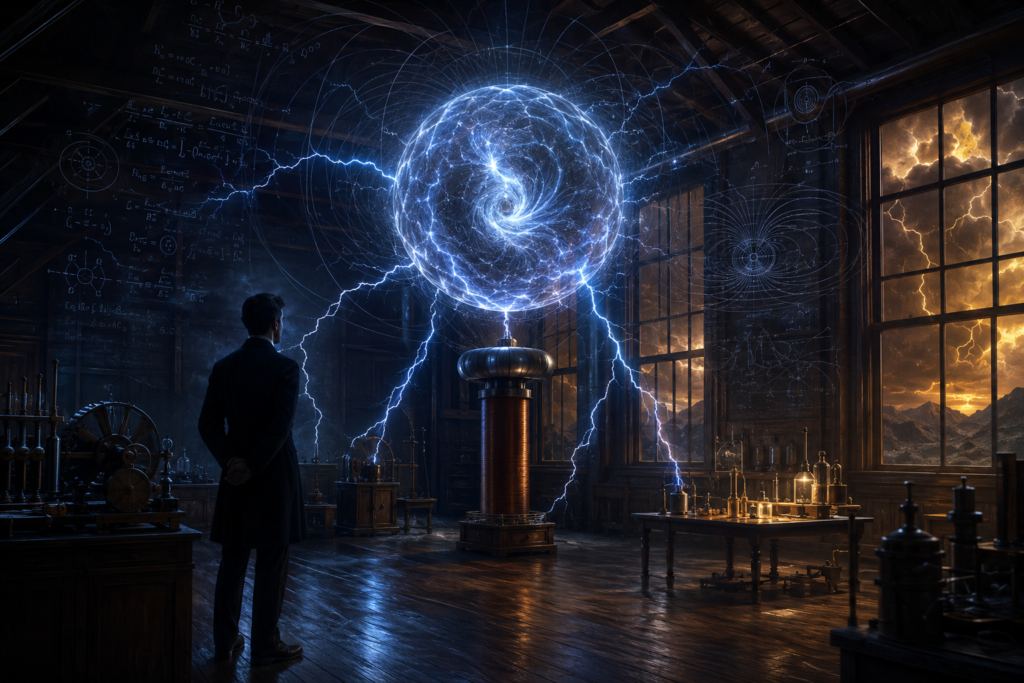
Tesla had already noted in Colorado Springs in 1899 that his high-voltage machines could create “fireballs” resembling natural ball lightning. In his notes, he described how electrical discharges from the tops of his coils produced “globules of plasma” that moved, persisted, and vanished in ways that varied from experiment to experiment.
Tesla quickly concluded that these were plasmoids – confined structures of plasma that survive independently thanks to the complex internal dynamics of electromagnetic fields. This was an extraordinary insight for a time when the word “plasma” did not even exist in the physicist’s vocabulary (the term would be introduced by Irving Langmuir only in 1928).
⚡ The Problem with the MHD Model: Why Standard Theory Fails
Today, the most widely accepted model of ball lightning is the MHD (magnetohydrodynamic) “hot plasma” model. This model assumes that ball lightning is plasma heated to several thousand degrees, shaped and stabilized by its own and external magnetic fields. However, when this model is tested quantitatively, a problem arises.
In one of the most cited review papers on the subject, researchers compared the predictions of the MHD model with observed characteristics of ball lightning. The result was devastating: the MHD model yields energy values for ball lightning that are 6 to 50 times smaller than those observed. In other words, the standard theory cannot explain how a ball lightning can contain so much energy and last so long.
This is a crucial insight. If the most accepted model fails by a factor of tens, it means that we are missing a fundamental understanding. Either more exotic mechanisms are at play – including nonlinear electrodynamics, resonant structures, or something beyond standard MHD – or conditions are needed that are not achieved in usual experiments. Tesla may have known something about the latter.
🔬 Tesla’s Voltages: The Difference That Changes Everything
Here we come to something we already wrote about in our analysis of Tesla’s magnifier and Wardenclyffe: Tesla worked with voltages that are still unattainable in laboratory replications today.
Modern record-holders among Tesla coils reach about 3 megavolts (MV). These are impressive machines, but Tesla was already routinely working with 12 MV in Colorado Springs in 1899, and there are indications that in his later experiments he aimed for values above 50 MV. These are not marginal differences – these are differences that qualitatively change the physical conditions.
The extreme electric fields that accompany such voltages can:
- Ionize air in unexpected ways, creating plasma with properties that do not occur at lower energies.
- Create nonlinear effects in the medium itself – effects not covered by the linear approximations of standard MHD.
- Induce extreme magnetic fields through discharge currents, which then confine the plasma and extend its lifetime.
Nowadays, the only way to achieve such electric fields is with lasers. In the focus of a laser beam, it is possible to create fields comparable to Tesla’s – but only in a volume comparable to the beam cross-section, thus micrometer or millimeter scale. And indeed, in such laser experiments, scientists have succeeded in creating miniature ball lightning. But they are tiny and short-lived – a shadow of what Tesla described.
Tesla, by contrast, created his plasmoids in a large space – the entire volume of his Colorado Springs laboratory, where enormous coils, long arcs, and wide distances allowed electric fields to act on a scale that is not merely millimeter but meter-scale. This is the difference between creating a spark and creating a stable plasmoid that can last long enough to be observed with the naked eye, studied, and described.
🧲 Magnetic Confinement and Plasmoid Lifetime
Another key factor is magnetic confinement. For a plasmoid to survive longer than a few milliseconds, it needs a strong magnetic field to hold it together and prevent it from dissipating into the surrounding air. Tesla’s transformers, with their enormous discharge currents, created precisely such fields – not just at the point of plasmoid formation, but throughout the entire surrounding space.
This may be the key to understanding why Tesla’s ball lightning lasted longer than today’s replications. Today’s experiments focus on a small space – between electrodes or inside a chamber. Tesla’s magnetic field filled the entire laboratory space, creating a three-dimensional “cage” for the plasmoid that allowed it to live and move.
🌐 Two Ways of Vanishing: What the Nature of the Plasmoids Tells Us
Tesla noted something that is still one of the enigmas of ball lightning: not all of them disappear in the same way. Some end with a small explosion – a sudden release of energy accompanied by a bang. Others simply extinguish – gradually fade and vanish, without any acoustic or thermal effect.
This difference in behavior suggests that we may not be dealing with one type of phenomenon, but with at least two:
- Explosive plasmoids likely contain a significant amount of internal energy that is released when the magnetic confinement weakens – similar to controlled fusion on a small scale.
- Non-explosive, “silent” plasmoids perhaps maintain a stable configuration until the energy dissipates sufficiently, and then they simply decay without a dramatic finale.
If Tesla indeed created both types in his laboratory, this means he had control over the parameters that determine which type will form – frequency, voltage, pulse shape, perhaps even electrode geometry. And that would mean we possess at least a rudimentary key to understanding these phenomena – a key that is still insufficiently explored.
🎯 Conclusion: Where Models Stop, Tesla Was Just Beginning
The problem of ball lightning reminds us of the limits of our knowledge. The best model we have – MHD “hot plasma” – fails by a factor of tens in predicting energy. This is not a small error – it is a sign that an entire dimension of understanding is missing.
Tesla may have already touched that dimension – not through theoretical models, but through engineering practice. His extreme voltages (12 MV and above), large laboratory spaces in which electric and magnetic fields acted on meter scales, and his careful observation of two types of plasmoid disappearance – all point to a man who was far ahead of not only his own time, but ours as well.
Today, when lasers can create miniature plasmoids in the focus of a beam, we are only just beginning to understand what Tesla was doing with his enormous coils over a century ago. His ball lightning were not mere laboratory curiosities – they were a window into physics we still do not fully comprehend.
What do you think? Will we ever succeed in modeling ball lightning with an accuracy that matches observations? And was Tesla, once again, ahead of us – not only in the power of his machines, but in the depth of his intuition about the nature of plasma?
#Tesla #BallLightning #Plasma #MHD #Plasmoid #ColoradoSprings #HighVoltage #Resonance #ElectricalEngineering #Innovation #MilovanInnovation

Leave a Reply