This post continues our renewed series on Tesla, in which we now, with greater technical and scientific depth, re-examine his most important insights. Today we turn to the most mysterious and most exploited aspect of Tesla’s legacy – his relationship with religion, spirituality, and phenomena we might today call “paranormal.”
⚠️ Fake Quotes: When the Internet Invents Tesla
Before we delve into what Tesla really said and believed, we must clear the ground of the most persistent falsifications.
The most famous fake quote circulating the internet reads: “Death does not exist… No man who has existed has died. They have turned into light…” This sentence, shared today across social media alongside Tesla’s photograph, has absolutely nothing to do with him. The Australian fact-checking organization AAP definitively established in 2020 that the quote is fabricated – it originates from a 1995 fictional drama about Tesla’s life, authored by Stevan Pešić. One gets the impression that this statement is deliberately attributed to Tesla in order to portray him as a mystic, while in reality it is pure fiction.
This is the best proof of how careful we must be. Tesla’s name is today used as a blank check for every kind of pseudoscientific and mystical claim – and the truth is, as always, more complex and more interesting.
📻 “Spirit Radio”: A Myth That Refuses to Die
Another persistent legend claims that Tesla constructed a so-called “Spirit Radio” – a device for communicating with the dead. The story goes that, after interpreting strange signals in his early radio experiments as paranormal, he began developing a dedicated apparatus for talking to the “other side.” This is often compared to Edison’s “ghost phone.”
What is the truth?
Tesla did indeed hear mysterious signals in his early radio apparatus. In 1899, in Colorado Springs, his receivers registered periodic, rhythmic impulses that he could not explain. Tesla himself wrote of this: “I felt as though I were present at the birth of a new knowledge, the revelation of a great truth… The changes I noted were taking place periodically and with such a clear suggestion of number and order that they were not traceable to any known cause.”
But – and this is crucial – Tesla never interpreted these signals as voices of the dead. His scientific explanation was that he was receiving signals from distant electrical discharges or cosmic radiation, not communication with spirits. In later statements, he even speculated that the signals might have originated from Mars or other planets – an extraterrestrial, not a spiritual, hypothesis.
There is no hard evidence – patents, blueprints, reliable testimonies – that Tesla ever built a device intended for communicating with the deceased. Most of these claims originate from paranormal literature, not from serious history of science. The “Spirit Radio” story likely arose from conflating Tesla’s admission that he heard unexplained signals, with his theories that thoughts and emotions could be transmitted via waves, and later sensationalization by popular culture.
🕉️ The Encounter That Changed Tesla’s Vocabulary: Vivekananda and Vedanta
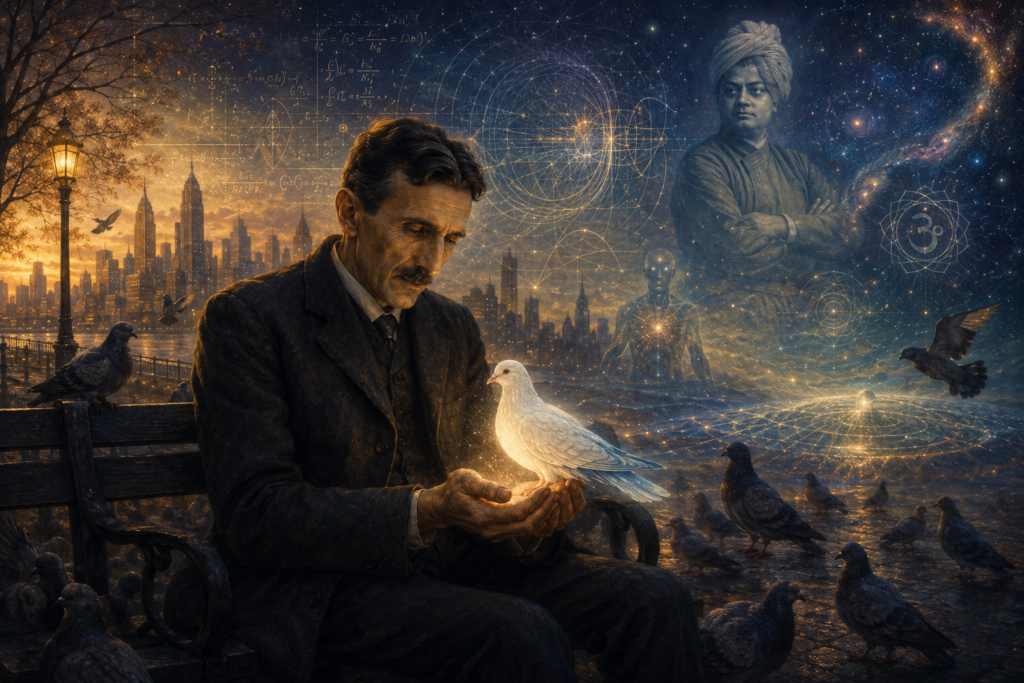
In contrast to fake quotes and myths, there are also authentic encounters that deeply shaped Tesla’s worldview. The most important of these is his meeting with Swami Vivekananda, the Indian spiritual teacher and philosopher.
In 1893, in Chicago, at a party hosted by actress Sarah Bernhardt, Tesla and Vivekananda met and began a conversation that would leave a mark on both of them. That same year, Vivekananda delivered his famous speech at the Parliament of the World’s Religions, which made him famous in the West. Tesla was already a recognized inventor at the time, but was just beginning his most ambitious theoretical work.
What did they talk about? Vivekananda introduced Tesla to two key concepts of Vedantic philosophy:
- Akasha: a subtle, all-pervading medium that represents the fundamental substance of the cosmos. In modern language, it is “space” filled with potential.
- Prana: the universal life force or energy that drives all processes in the universe.
Vivekananda wrote in a letter to his friend Alasinga Perumal: “Mr. Tesla was charmed to hear about the Vedantic Prana and Akasha and the Kalpas, which, according to him, are the only theories modern science can accept.” In another letter, he added: “Mr. Tesla thinks he can mathematically demonstrate that force and matter are reducible to potential energy.”
This is an exceptionally important detail because it shows that Tesla did not see Vedantic concepts as religion, but as a physical theory – a way to reduce forces and matter to a single, unified principle. Vivekananda hoped Tesla would find a mathematical proof for this idea, which was later partially realized through Einstein’s formula E=mc², but Tesla never demonstrated it in his lifetime.
Did they continue their collaboration? Although it is not known for certain whether they met again, Tesla used the Sanskrit terms Akasha and Prana in his writings for the rest of his life. In his 1930s article “Man’s Greatest Achievement”, Tesla explicitly writes about Akasha as a light-bearing ether. This encounter was not a passing inspiration – it shaped Tesla’s later language and conceptual framework.
🧘 Tesla and Christianity: Roots Never Uprooted
According to research by Oliver Subotić (Tesla: Spiritual Character, 2021), Tesla was an Orthodox Christian by birth, conviction, and ethics. His father Milutin was a priest, and although Tesla distanced himself from institutional religion, he never explicitly abandoned the Christian faith.
There are accounts that Tesla stated towards the end of his life: “I am amazed how the interpretation of reincarnation in Buddhism coincides with some insights I have reached in my experiments.” This quote is not confirmed by multiple independent sources, but it appears in the literature and is consistent with Tesla’s later interests. Nevertheless, it is important to emphasize: Tesla did not abandon Christianity. Like many great minds, he sought a synthesis between his own tradition and the universal truths he found in other philosophical systems.
🧲 Tesla, Schrödinger, and Vacuum Energy
It is interesting that Tesla was not the only great scientist who found inspiration in Indian philosophy. Erwin Schrödinger, one of the founders of quantum mechanics, was equally deeply inspired by Advaita Vedanta (non-duality). In his famous book What Is Life? (1944) and in numerous essays, Schrödinger writes about the unity of consciousness and matter, using terms almost identical to those Tesla conveyed from his conversations with Vivekananda.
This parallel is not accidental. Both Tesla and Schrödinger sought a unified theory of everything – and both found in Vedantic philosophy a conceptual framework closer to their intuition than the mechanistic materialism of Western science.
As for Tesla’s famous statement: “Throughout space there is energy. If that energy is static, our hopes are in vain; if it is kinetic – and we know it is – then it is merely a question of time when men will succeed in attaching their machinery to the very wheelwork of nature.” – these words from 1891 (before his meeting with Vivekananda) show that Tesla already had an intuitive notion of the ether as a source of energy. The encounter with Vedanta merely gave him the language to express it.
Modern physics acknowledges that the vacuum is not empty. The Casimir effect (1948) shows that two uncharged metal plates in a vacuum experience an attractive force due to vacuum fluctuations. This is experimental confirmation of something Tesla sensed. However, what we today call zero-point energy is not the same as Tesla’s “free energy” – the latter assumes the possibility of tapping unlimited energy, which quantum mechanics does not guarantee (except in a very limited, fluctuational form). It is important here too to draw a clear line between valid scientific intuition and claims that go beyond what physics can currently confirm.
🕊️ The White Dove: The Only Love of His Life
And finally, the most authentic and most intriguing part of Tesla’s spirituality – his white dove.
Tesla’s biographer John O’Neill, a New York Times journalist, recorded Tesla’s testimony a few years before his death. This is not legend, not an internet myth, not a falsification. These are words Tesla himself spoke:
“I have been feeding pigeons, thousands of them… But there was one, a beautiful bird, pure white with light grey tips on its wings. No matter where I was, that pigeon would find me. I loved that pigeon. Yes, I loved her as a man loves a woman, and she loved me. That pigeon was the joy of my life. As long as she was there, my life had meaning.
Then one night, she flew in through the open window. I knew she wanted to tell me she was dying. And then, as I received her message, there came a light from her eyes – powerful beams of light. Yes, it was a real light, a brilliant, blinding light, more intense than any light I had ever produced by the most powerful lamps in my laboratory.
When that pigeon died, something went out of my life. I felt that my work was finished.”
How to understand this confession?
Tesla lived in hotel rooms to the end of his life, without family, without friends. He fed hundreds of pigeons every day. This was his only ritual of love and belonging. O’Neill records that Tesla once engaged the best veterinarians for a sick pigeon and paid their bills even though he himself had no money.
For Tesla, light was always something more than a physical phenomenon. He repeatedly said: “Everything is light. In one of its rays is the destiny of nations.” When he says that a light shone from the dove’s eyes stronger than any he had ever created, he is not giving a literal physical description, but a poetic expression of emotional intensity. It is his way of saying: in that moment, I experienced something no machine can produce.
Numerous historians, including Dr. Branimir Jovanović, former director of the Nikola Tesla Museum, point out that Tesla exhibited traits we today recognize as obsessive-compulsive disorder: an obsession with the number 3, washing his hands three times, avoiding pearls. His attachment to the dove may not be mere eccentricity, but an extension of that pattern – but that does not make it any less sincere or any less profound.
🎯 Conclusion: A Scientist with a Holistic Worldview
Nikola Tesla, despite contemporary popular interpretations, was not a mystic. He was a scientist who held a holistic worldview. His “spirituality” was not a rejection of science, but its expansion. He believed that even the highest spiritual truths are, ultimately, expressed through the laws of physics and energy.
When Tesla spoke of Akasha and Prana, he was not reciting sacred texts – he was searching for a vocabulary for his intuition about the unity of the universe. When he wrote of light as the essence of everything, he was not a poet but a physicist who believed light to be primordial. When he wept for his dove, he was not a mystic – he was a man who had lost the only creature that gave him comfort.
The encounter with Vedanta gave him the language to describe what he already intuitively felt: that the universe is a single, dynamic, energetic field in which there is no void, no death in an absolute sense, only transformations. This is an idea that modern physics, from the Casimir effect to quantum entanglement, is only just beginning to confirm.
Tesla was not a prophet. He was a visionary whose intuition still seeks its final mathematical expression.
What do you think? Was Tesla’s search for the unity of matter and spirit ahead of his time, or was he simply a scientist who knew how to dream? And how much have today’s misuses of his name – from fake quotes to the “Spirit Radio” – distanced the public from the real Tesla?

Leave a Reply