
This post continues our renewed series on Tesla, in which we now, with greater technical and scientific depth, re-examine his most important insights. Today we turn to a device that entered legend as the “earthquake machine” – but whose true genius lies in something entirely different: solving one of the most stubborn problems in electrical power engineering.
🎭 The Legend: A Hammer, a Building, and Police at the Door
In 1935, Tesla told a story that would follow him for the rest of his life. While experimenting with his mechanical oscillator in his New York laboratory, the device allegedly hit the resonant frequency of the building he was in. The floor began to vibrate. The walls shook. Furniture danced. In neighboring buildings, people ran out into the street in panic, thinking it was an earthquake. The police knocked on the door. Tesla, unable to stop the oscillator any other way, grabbed a hammer and smashed the device. “I could have brought down the Brooklyn Bridge in less than an hour,” he later claimed.
How much of this story is truth, and how much is marketing genius at work? Probably both. Tesla was a master storyteller and knew the value of a good story for attracting investors’ attention. But what is indisputable is that he patented a device whose genius lies not in demolishing buildings, but in solving a fundamental engineering problem.
🔬 Patent US 514,169: The Oscillator That Changed the Game
In 1894, Tesla received patent number US 514,169 for a “Mechanical Oscillator.” The very name of the patent – “Reciprocating Engine” – suggests the essence: it is a reciprocating motor, designed to generate precise, stable oscillations.
But why did Tesla need such a device at all? The answer lies in one of the key technical problems of his time – and ours.
⚙️ The Problem: How to Maintain a Stable Frequency?
In a classic rotary alternating current generator, the frequency is directly tied to the angular velocity of the rotor. The rotor spins at a constant speed, and each of its revolutions generates one period of alternating voltage. In an ideal world, this is simple – set the rotation speed and you get the desired frequency.
But the world is not ideal. When a generator delivers a large current to consumers, that current creates a strong electromagnetic field in the stator windings. This field acts on the rotor with a counter-torque – a force that opposes rotation. The result is a slowing of the rotor. As the rotor slows, the frequency drops. And a frequency drop in a power system is a serious problem – from inaccurate clocks to the instability of the entire grid.
This problem was especially pronounced at a time when generators were smaller, regulation was cruder, and consumers were unpredictable. Tesla knew there had to be a better way.
🔧 Tesla’s Solution: A Piston, Channels, and an Air Spring
Instead of fighting the counter-torque on a rotary generator, Tesla changed the entire approach. His oscillator is not rotary – it is linear. It moves back and forth, like a piston in a cylinder.
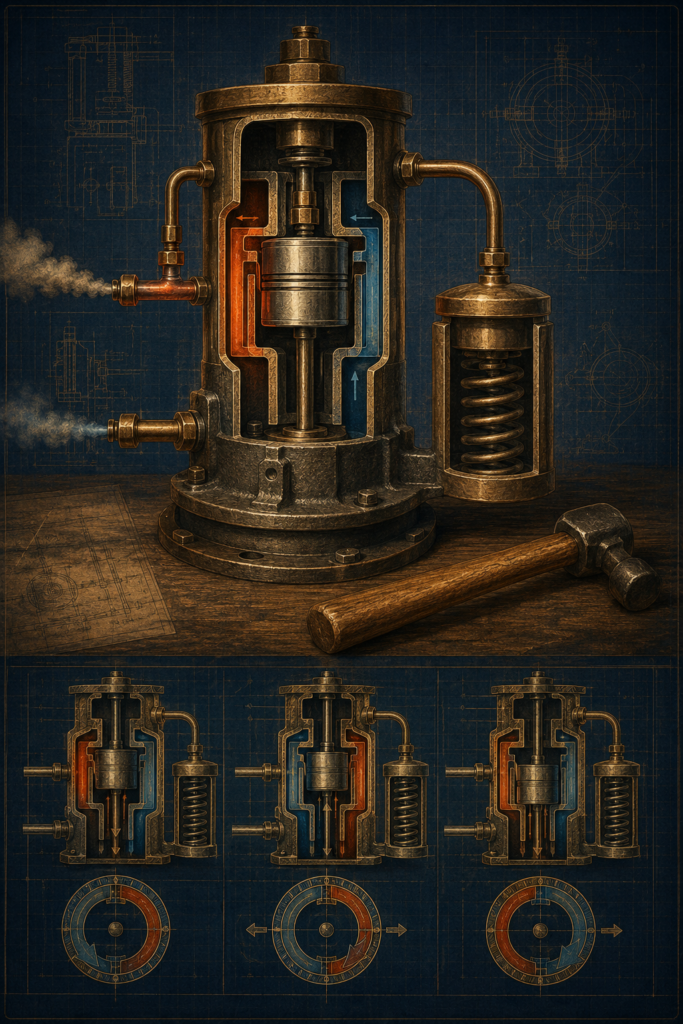
The heart of the system is a specially designed piston with two L-shaped channels carved into its body. When pressurized steam enters the cylinder, the L-channels direct it alternately into the upper and lower zones of the cylinder. This achieves the alternating back-and-forth movement of the piston – oscillation.
But the key element – what makes this device ingenious – is the air spring. The piston is connected to a chamber filled with air that acts like a spring: when the piston moves to one side, it compresses the air, which then pushes the piston back. This air spring gives the system its own resonant frequency – a frequency determined by its “stiffness” (the ratio of force to displacement), not by external factors such as steam pressure or electrical load.
The excitation of the piston is essentially impulsive. The steam does not push the piston continuously, but in short bursts, alternately in one direction and then the other. Between these impulses, the air spring takes over and determines the rhythm. That is why the frequency is stable over a wide range of operating conditions – regardless of variations in steam pressure or electrical load.
🌉 Resonance: A Real Force, Not Just a Legend
Although the story of the building’s collapse is probably exaggerated, the effect of mechanical resonance is real and well documented. The most famous example is the Tacoma Narrows Bridge, which collapsed in 1940 when the wind excited it at its resonant frequency – footage of the bridge twisting and breaking entered physics textbooks. Similarly, a bridge over the Maine River in France collapsed in 1850 when an army marched across it in lockstep – the rhythm of the steps matched the bridge’s resonant frequency.
These events confirm the basic physical principle Tesla was using: every object has its own resonant frequency. If that frequency is hit by an external force, the amplitudes of oscillation grow from cycle to cycle until the object fails. It is the same principle that shatters a glass with an opera singer’s voice – just on a larger scale.
It is likely that some manifestation of resonance did occur during Tesla’s experiments – enough to cause vibrations that could have alarmed the neighbors and brought out the police. But to actually bring a building down would have required a significantly larger oscillator – both in terms of dimensions and mass – than what Tesla had in his laboratory.
🎯 Conclusion: Genius That Outlives the Legend
Tesla’s mechanical oscillator is one of those inventions where the legend threatens to overshadow the substance. The story of the hammer and the police is entertaining, but what is truly important is the engineering problem Tesla solved: how to build a generator with a stable frequency independent of load.
His solution – impulsive excitation, L-shaped channels in the piston, and an air spring – represents a brilliant example of engineering thinking that steps outside conventional frameworks. Instead of improving the existing rotary generator, Tesla invented an entirely new approach. It is the same pattern we have seen in his work on the magnifier, teleautomatics, Teleforce: identify a fundamental limitation, discard the conventional solution, and offer something radically different.
Tesla’s oscillator may not have brought down any buildings. But it demonstrated how engineering genius can be applied to a problem that still troubles power engineers around the world today.
What do you think? Did Tesla really nearly bring down his laboratory, or was it just a masterfully told story? And do today’s challenges in stabilizing power grids call for the same kind of radical thinking?
Leave a Reply