Dear explorers,
When we sailed in previous posts through eigenstate thermalization and quantum complexity, we kept returning to a word that seemed familiar, yet mysterious: entropy. We said that entropy grows, that it reaches a plateau, that it is local unlike non-local complexity. But we did not pause to ask: what is entropy truly in the quantum world?
Today we dive precisely into that question. And in a way that will take us from the perfect crystals of zero entropy, through the very phenomenon of life, to black holes that contain almost all the entropy of the universe – and back, to the question of whether our Dirac Sea can freeze once again.
📐 Von Neumann Entropy: A Measure of Uncertainty, a Measure of Information
Quantum entropy is a measure of uncertainty, of chaos, in fact of the lack of information in a quantum system. Unlike classical thermodynamic entropy, which describes disorder in macroscopic systems, quantum entropy focuses on the probability of finding quantum particles in certain states.
The concept of quantum entropy arises from the inherently probabilistic nature of quantum states. Quantum entropy measures the amount of uncertainty or randomness associated with a quantum system. It provides insight into the information content and the degree of entanglement present in a quantum state.
Quantum entropy is usually quantified using von Neumann entropy, named after John von Neumann, one of the pioneers of quantum mechanics. For a quantum system described by a density matrix , von Neumann entropy is given by:
This formula conceals within it two extremes:
- Pure states: When a quantum system is in a perfectly defined, pure state, its entropy is 0. There is no uncertainty. No lack of information. Everything is known.
- Mixed states: If the system interacts with its environment and its information is scattered, entropy grows, indicating the degree of entanglement or uncertainty.
The process of wave function collapse leads to the loss of part of the information, is irreversible, and increases the entropy of the system.
🔐 Quantum Entropy, Qubits and Cryptography
If we return to our approach based on quantum information theory, quantum entropy refers to information encoded in quantum bits or qubits. This is important not only for quantum mechanics, but also for quantum cryptography.
Quantum entanglement, in this approach, refers to the strong correlation between the states of two or more qubits, even when they are physically separated. Quantum entropy measures precisely that entanglement present in a quantum state, providing a measure of non-classical correlations that can be exploited for cryptographic purposes.
In our picture of the Dirac Sea, quantum entropy is a measure of how intertwined the waves are, how much information is scattered through the sea, and how hard it is to decode the message the sea carries.
🧊 The Frozen Sea: Entropy Zero and the Impossibility of Life
Now we come to one of the most challenging places in our voyage: how to imagine the initial state of zero entropy?
In the picture of the Dirac Sea, the state of zero entropy is a frozen sea. A sea in which perfect crystals with perfectly defined states dominated. Every particle is in its place. Every wave is known. Nothing is left to chance.
But, just as we described the state of maximal entropy as a state of biological death, so too is zero entropy a state in which life is impossible. Life requires uncertainty. It requires gradients. It requires a difference between “here” and “there”, between “now” and “then”. In a perfect crystal of zero entropy, nothing happens. There is no time. No change. No life.
Physicist Jeremy England formulated this in a provocative way: life is an almost inevitable consequence of the second law of thermodynamics. Life is actually one of the most efficient processes for increasing the total entropy of the universe.
How does this work? Life on Earth itself exists by converting the low-entropy energy of the Sun into high-entropy thermal energy. For every high-energy photon in the visible and UV domain that arrives from the Sun, the Earth emits 20 thermal photons in the IR domain, significantly increasing the total entropy in the universe. Life is not a struggle against entropy. Life is an entropy engine – the most efficient way to convert the Sun’s energy into heat.
Life is thus a phenomenon of the “Goldilocks zone” – a zone of moderate entropy. Neither too little, nor too much. Just enough for gradients to exist, for waves to move, for information to flow. In the Dirac Sea, life is those parts where the sea is thawed enough for waves to exist, but not so turbulent that everything turns into thermal chaos.
🕳️ Black Holes and Bekenstein’s Revolution: Entropy on the Horizon
In 1972, physicist Jacob Bekenstein proposed a radical idea: the entropy of a black hole is proportional to the surface area of its event horizon. It was a shock for the physics community. Until then, entropy had always been associated with volume – with the number of possible microscopic states inside a system. And here, with a black hole, entropy depended on surface area, not volume.
This was one of the first hints of the holographic principle about which we have already written: information about what is inside is encoded on the surface.
Bekenstein’s idea was confirmed when Stephen Hawking discovered that black holes are not completely black – they emit radiation, Hawking radiation, and possess a temperature. If a black hole has a temperature, then it must also have entropy. Bekenstein was right.
The scale of black hole entropy is staggering. The supermassive black hole at the centre of our galaxy, the Milky Way, alone has 1,000 times more entropy than the entire early visible universe. But that is only the beginning. When all black holes are summed up, it turns out they contain almost all the entropy of the present-day universe.
According to some calculations, the early Universe had only about 0.000000000000003% of the entropy it has now. The rest? In black holes. On horizons. On surfaces that separate what we know from what we can never know.
In our picture of the Dirac Sea, black holes are the deepest vortices – places where entropy is so enormous it is almost incomprehensible. They are reservoirs of information, but information that is trapped on the horizon, inaccessible to an outside observer without the appropriate key.
🌌 Epilogue: Will the Sea Freeze Again?
And now we come to perhaps the boldest question of this voyage.
If black holes contain almost all the entropy of the universe, and if black holes eventually evaporate through Hawking radiation, what happens to that entropy? Is it lost forever? Does it mean the end of everything – the heat death of the universe, an infinitely diluted sea without a single wave?
Or is there a way for the sea to freeze again?
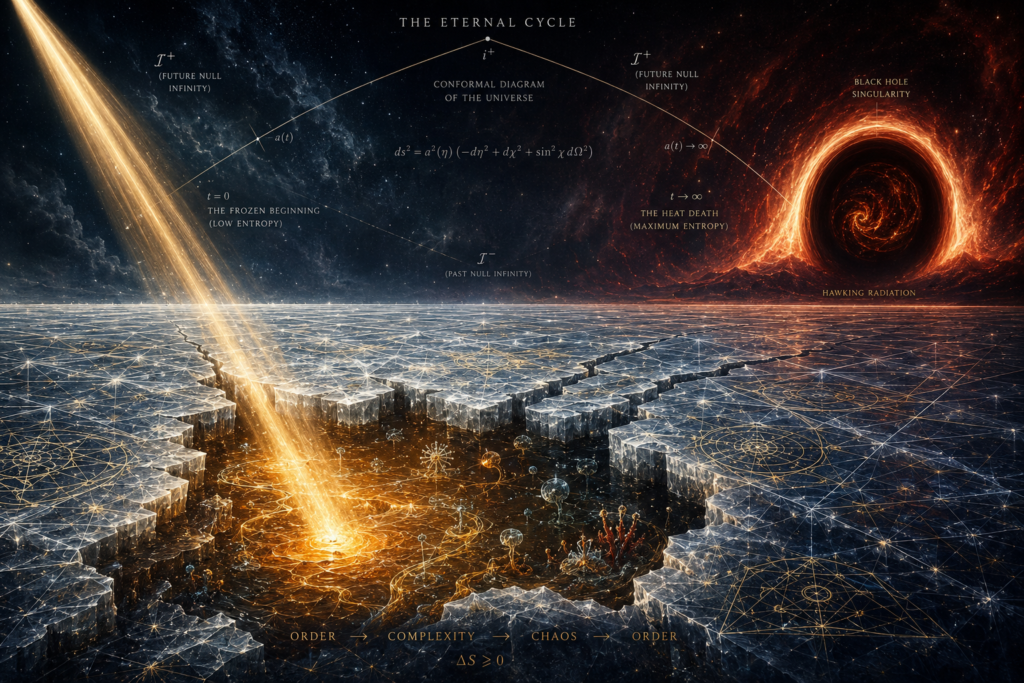
In Penrose’s Conformal Cyclic Cosmology (CCC), the answer is affirmative. At the end of each eon, all matter has either fallen into black holes or evaporated through Hawking radiation. All that remains is a sea of pure radiation – without structure, without gradients, without information. Entropy is at its maximum. But at that moment, something incredible happens: the conformal geometry of the old eon is smoothly mapped into the new eon. The Big Bang is not the beginning of everything – it is merely a transition.
And in the new eon, entropy is once again zero.
How is this possible? How can entropy be “reset”? Penrose’s answer lies in the very nature of entropy: entropy is a measure of information, and information is preserved on the conformal boundary between eons. What we see as a “loss” of entropy in the old eon is, in fact, a re-recording of information into the new eon. Just as a quantum computer after measurement resets its complexity to zero, so too does the universe at the end of an eon reset – not because information is destroyed, but because it is transferred to a new level of description.
In our picture of the Dirac Sea, this means the following: at the end of the eon, the sea is gripped by an unimaginable storm – entropy is at its maximum, black holes have swallowed almost everything, Hawking radiation is diluted to infinity. That storm lasts for an exponentially long time. But when everything calms, when all the waves are smoothed out, when complexity reaches its absolute maximum – the sea freezes. A new surface forms. New entropy is zero. A new eon begins.
And everything starts again.
⛵ Epilogue of the Epilogue: The Goldilocks Zone in Which We Sail
We do not live at the beginning of the eon, when the sea was frozen. And we do not live at the end of the eon, when everything will be swallowed by black holes. We live here and now – in the Goldilocks zone between zero and maximal entropy.
In this zone, the sea is thawed enough for waves to exist. Gradients are strong enough to drive life. Information flows, but is not entirely lost. Complexity grows, but has not yet reached its maximum.
And we, small waves on the surface of that sea, have the privilege of witnessing all of this. Of sailing. Of exploring. Of marvelling.
For one day, in some distant, unimaginably distant moment, the sea will freeze again. And everything will begin anew.
The sea is always clear. The horizon is always open. The voyage continues.
This post continues the series begun with “⚛️ Quantum Archaeology: Reading the Past from the Dirac Sea”, continued through the map of the quantum odyssey, posts on the observer paradox, Bohmian mechanics, quantum complexity, and eigenstate thermalization.
Leave a Reply