Dear explorers,
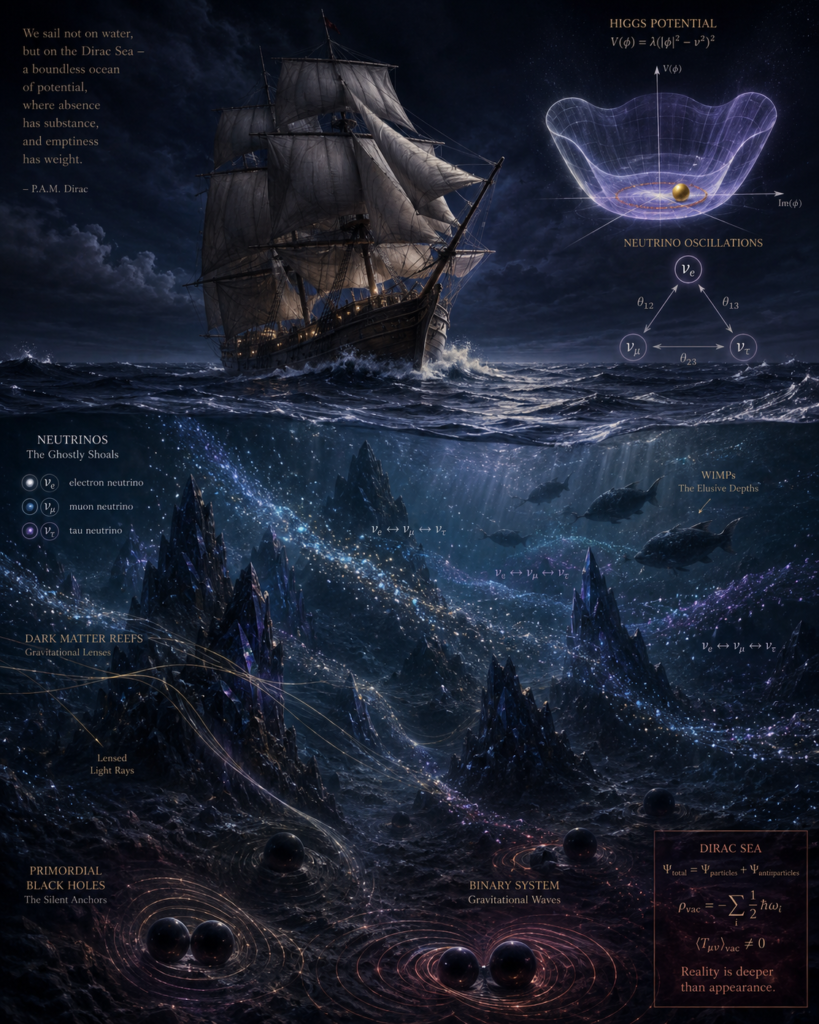
Imagine our ship in the middle of the night. The gravitational wind is blowing, but its strength is inexplicable. The sails are stretched far tighter than they should be given the visible clouds and waves. As if beneath the surface, in the depths, the sea hides vast, invisible reefs.
This is not fantasy. This is dark matter – the longest and most stubborn riddle in the history of astronomy. Today we dive into that mystery with all the precision it deserves.
🌬️ A Wind That Blows Too Strongly
When astronomers measure the rotation speed of spiral galaxies, they expect the outer parts to rotate more slowly than the inner parts – just as planets farther from the Sun have longer years. But that is not what we observe. The outer parts of galaxies rotate just as fast as the inner parts. At that speed, stars on the edges should be flung into intergalactic space. And yet, they hold.
The gravitational wind, which we feel as the consequence of all the mass in the universe, blows too strongly in those places. As if the visible matter – stars, gas, dust – is only the tip of an iceberg. Beneath it, in the shadows, hides something far more massive.
🔭 MOND: A Theory That Lost Its Breath
For a time it seemed that perhaps Einstein’s general theory of relativity might be modified on large scales. The theory known as MOND (Modified Newtonian Dynamics) proposed that gravitational laws deviate from Newton and Einstein at extremely small accelerations.
But the latest precise measurements – including observations of gravitational waves from the LIGO detector, pulsar binary systems, and the cosmic microwave background radiation from the Planck satellite – have confirmed that Einstein’s theory describes the universe perfectly even on the largest scales, without measurable deviations. The wind blows exactly as Einstein predicted. So the issue is not with the wind – it is with the mass we cannot see.
🦠 The Neutrino: Plankton of the Dirac Sea
Remember the story of the neutrino. That particle was proposed in 1930 by Wolfgang Pauli as a desperate move to save the law of energy conservation in beta decay. It was a mathematical object – a massless, chargeless particle that interacts only via the weak force. So weakly that it passes through the entire Earth without noticing.
It took twenty-six years for the neutrino to be experimentally detected. And then we realized it is one of the most abundant particles in the cosmos. Every second, trillions of neutrinos pass through every square centimetre of our bodies. They are like the plankton of the Dirac Sea – so numerous, yet so invisible.
🧬 Why the Neutrino Must Have Mass – and Why That Is a Problem
According to the Standard Model, all fermions (particles with half-integer spin) acquire mass through Yukawa coupling with the Higgs field. This holds for electrons, muons, tau particles, and quarks. But the neutrino is a special case.
In the Standard Model, the neutrino exists exclusively as a left-handed particle. Its spin is always opposite to its direction of motion. A right-handed neutrino has never been observed. And Yukawa coupling requires both a left-handed and a right-handed component to form a mass term. This means the neutrino cannot acquire mass in the same way as other fermions.
And yet, we know the neutrino has mass. How?
The neutrino comes in three flavours – electron, muon, and tau neutrino. Flavour is a property of elementary particles that is important for the weak interaction, just as electric charge is important for the electromagnetic interaction. And what is crucial: neutrinos oscillate – they transition from one flavour to another as they travel through space. A neutrino created as an electron neutrino in the Sun can arrive on Earth as a muon or tau neutrino.
These oscillations are possible only if neutrinos have mass. This is direct evidence that the Standard Model is not the complete story.
👥 Majorana vs. Dirac: The Neutrino as Its Own Antiparticle?
There are two fundamentally different ways for the neutrino to acquire mass, and both lead toward new physics.
Dirac mass would require the existence of right-handed neutrinos – particles that have never been observed to date. They would be “sterile” – interacting only gravitationally, making them excellent candidates for dark matter.
Majorana mass is even more intriguing. Ettore Majorana proposed in 1937 that fermions could be their own antiparticles. If the neutrino is a Majorana particle, then there is no difference between a neutrino and an antineutrino. This would be a unique case among fermions and would explain the exceptionally small mass of neutrinos through the seesaw mechanism: the lighter one type of neutrino is, the heavier the other. And that heavy Majorana neutrino would be a perfect candidate for a WIMP – a weakly interacting massive particle.
💪 WIMPs and a Fruitless Haul
WIMPs were for decades the leading candidate for dark matter. Unlike neutrinos, which are light, WIMPs would have a significant mass – from a few GeV to a few TeV. Their existence naturally follows from supersymmetry, a theory that predicts every particle of the Standard Model has a supersymmetric partner.
Ever larger and more sensitive detectors have been built, buried deep underground – in abandoned mines, beneath mountains – to shield them from cosmic radiation. Particle colliders, including the Large Hadron Collider (LHC), have scoured their data in search of traces of WIMPs.
And… nothing. So far, all experiments have fallen short. WIMPs, if they exist, skilfully evade our nets. That does not mean they do not exist – but their window of possible masses and interactions is narrowing ever further.
🧲 Dirac Magnetic Monopoles: Scars from the Beginning of Time
We return to one of the most exciting themes of our voyage. Dirac magnetic monopoles – topological defects in the fabric of spacetime – were created in the first moments after the Big Bang, when the fundamental symmetries were breaking.
Monopoles are incredibly massive (they could be as heavy as 10¹⁶ GeV – a billion times heavier than the heaviest particles at the LHC) and perfectly stable. Once created, they cannot vanish except by annihilation with an anti-monopole. If they were created in sufficient numbers in the early universe, they would today be cold dark matter – massive, slow, and visible only through gravity.
The search for them is still underway. The ATLAS and CMS detectors at the LHC are hunting for a monopole signal, and ever more restrictive limits have been placed on their mass and magnetic charge. But as with WIMPs, we have not yet found them.
🕳️ Primordial Black Holes: Shadows from the First Billionth of a Second
And now we come to perhaps the most intriguing candidate.
Primordial black holes were not born from dying stars. They formed directly from the collapse of overdense regions in the hot, dense plasma of the early universe – in the first billionth of a second after the Big Bang. Their mass can range from microscopic (less than the mass of a mountain) to supermassive (millions of solar masses).
Why are they such a good candidate for dark matter? First of all, they would not be concentrated at the centres of galaxies like supermassive black holes. They would be evenly distributed throughout the entire universe – including the voids between galaxies, where dark matter is most noticeably “missing”.
How would they move and cluster? Primordial black holes would behave as cold dark matter – they would move slowly and their clustering would follow gravitational potentials. They could form binary systems, and their collisions and mergers would generate gravitational waves that LIGO and Virgo detectors can register. Moreover, some of the events LIGO has already detected could be precisely mergers of primordial black holes.
If we were to succeed in creating some of these tiny black holes in our great colliders, it would be an immense indirect proof of this theory. It would be a moment when our laboratory becomes a micro-cosmos, creating the very same objects the Big Bang itself created.
🧩 Synthesis: Assembling the Mosaic, Tile by Tile
And so, slowly, we assemble, tile by tile, the mosaic that represents the answer to the question of what dark matter is:
- Neutrinos are the plankton of the Dirac Sea – numerous, but too light to account for all the missing mass. Yet their mass, oscillations, and possible Majorana nature open the door to new physics.
- WIMPs are perhaps the greatest hope – but also the greatest disappointment. Decades of searching have yielded no result, but the window of possibility is not yet closed.
- Dirac magnetic monopoles are ancient scars on the fabric of spacetime. If they exist, they are almost perfect candidates for cold dark matter.
- Primordial black holes are shadows from the first billionth of a second – and perhaps the missing key. Evenly distributed, invisible except through gravity and the occasional flash of gravitational waves.
And the truth is, almost certainly, more complex than any single story. Dark matter is perhaps a combination of all these phenomena – and something else we have not yet even glimpsed.
⛵ Epilogue: The Sea Is Vast
Dear explorers, our journey in search of dark matter is perhaps the most humbling voyage so far. It teaches us that, despite all our mathematics, despite all our detectors and colliders, we still do not know what makes up 85% of the matter in the universe. The Dirac Sea is vast, and we have only just scratched its surface.
But precisely in that uncertainty lies the excitement. Many voyages lie ahead of us, with many discoveries – but also new questions. For every time we find an answer, the sea reveals itself to be even deeper and more mysterious than we thought.
The sea is always clear. The horizon is always open. And the search for the shadows in the sea – it continues.
This post continues the series begun with “⚛️ Quantum Archaeology: Reading the Past from the Dirac Sea”, continued through the map of the quantum odyssey, posts on the observer paradox, Bohmian mechanics, quantum complexity, eigenstate thermalization, entropy, infinities, and broken symmetries.
Leave a Reply