Dear explorers,
In our previous voyages we encountered the most mysterious properties of the Dirac Sea. We saw that at its bottom time knows no direction, that negative frequencies become antiparticles, and that consciousness, according to Penrose, perhaps plays a role in breaking the symmetry of the block universe. We also saw how Jung and Pauli, each from their own perspective, searched for a psychoid background – that Hintergrund which precedes the division into mental and physical.
All these questions lead toward one, even deeper question: how does a stable, classical world that we all share emerge from an infinitely rich quantum reality, full of superpositions and indeterminacy? How is it that we all see the same chair, the same star, the same wave function collapsed into the same outcome?
Today we sail toward one of the most elegant theories that offers an answer to this question – a theory whose logic and depth have earned it a place in our great story. This is Quantum Darwinism, the fruit of decades of work by the physicist Wojciech Zurek, whose book Decoherence and Quantum Darwinism was published last year and is still as fresh as a morning breeze on the open sea.
🧬 Natural Selection of Quantum States: Why “Darwinism”?
Zurek began from a seemingly simple question: in quantum mechanics, a system can be in a superposition of countless states. The world ought to be a chaotic mixture of all possibilities. Why do we, instead, perceive only one, well-defined, classical state?
His answer was brilliant in its simplicity: information about the state of a system is not only subject to decoherence – it is also copied, spread, and competes for “survival” in the environment.
Just as in biological evolution only those organisms survive that are best adapted to their surroundings, so too in the quantum world only those states “survive” – that is, are detected and become part of objective reality – whose information is most efficiently copied and spread through the environment.
Zurek elevated this analogy to the level of a precise physical theory. What we call the “objective state” of a system is, for him, the state that has won the evolutionary race for the reproduction of information.
In our picture of the Dirac Sea, this means the following: the sea is full of waves – countless possible states, superpositions, potentials. But only some of those waves manage to “multiply” – to leave their trace in the surrounding particles, photons, air molecules. Only those waves become visible. Only they become reality.
💧 Ink Falling Into the Sea: Decoherence as the Mechanism of Selection
What does this process look like exactly? Zurek offers an image that fits perfectly into our metaphor.
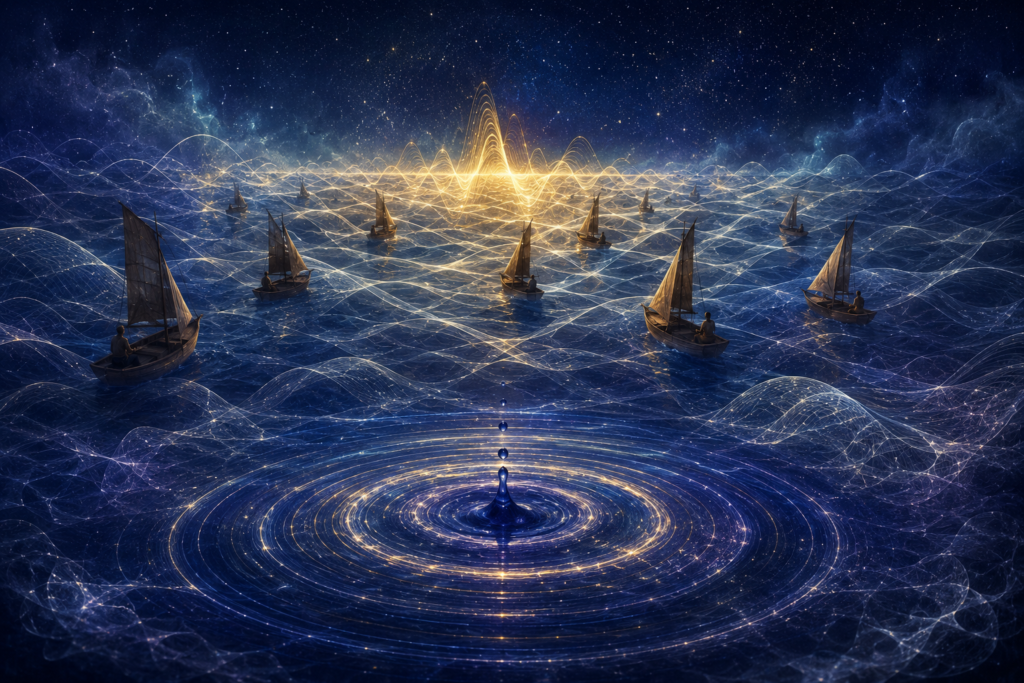
Imagine a drop of ink falling into the Dirac Sea. The moment it touches the surface, its information – shape, colour, density – begins to spread at incredible speed. The ink particles collide with water molecules, photons scatter, and in an astonishingly short time, the original drop is completely lost in the vast mass of the ocean. The information about its original form is humanly impossible to reconstruct.
This is decoherence – the process by which a system, interacting with its environment, loses its quantum properties and becomes classical.
Zurek’s calculations are staggering: for a grain of dust floating in the air, collisions with photons and gas molecules cause decoherence in just 10⁻³¹ seconds. That is a billionth of a billionth of a billionth of a second. So fast is the process by which quantum indeterminacy vanishes and the world becomes “solid”.
In the Dirac Sea, this means that any attempt to capture the superposition of a macroscopic object is doomed to fail – not because superpositions are “forbidden”, but because the environment simply smears them out faster than any instrument can detect them.
🏛️ The Epiontic View: A Synthesis of Copenhagen and Many-Worlds
Quantum Darwinism is especially valuable because it offers a bridge between the two most orthodox interpretations of quantum mechanics.
The Copenhagen school (Bohr, Heisenberg) approaches the wave function from an epistemological side – it is a reflection of our knowledge about the system. The collapse of the wave function is the moment we update our information.
Everett’s Many-Worlds Interpretation (MWI) approaches the wave function from an ontological side – it is reality itself. There is no collapse; the universe simply branches into all possible outcomes.
Quantum Darwinism occupies what we might call an epiontic view (a term combining epistemological and ontological). The wave function is real (ontology), but what we see as “collapse” and “objective state” is the result of the selection of that information which has succeeded in being copied and spread through the environment (epistemology).
In this picture, there is no mysterious “collapse”. There is only a process in which some states become so well “inscribed” in the environment that they can no longer be ignored. They have become facts. The other states have not disappeared – they are still there, in the wave function – but they have become irrelevant for any macroscopic observer. They did not manage to “reproduce” in our environment.
Just as in nature it is not the strongest that survive, but those best adapted, so too in the quantum world not all states “win”, but only those that are most suitable for copying.
🤝 The Role of Consensus: The Objective as Intersubjective
Zurek introduces another extremely important concept – consensus.
What does it mean for something to be “objective”? In everyday language, objective is that upon which we all agree – that which is independent of any individual observer. Zurek claims that this is precisely the mechanism nature uses: a state becomes objective when multiple independent observers, who have access to different parts of the environment, can agree about it.
Imagine thousands of small boats on the Dirac Sea. Each boat sees only a small part of the sea – the part in its immediate surroundings. But if a particular wave (information) is so strongly imprinted on the sea that all boats, from their different perspectives, can detect it – then they agree: “Yes, this wave exists.” That wave has won. It has become part of objective, intersubjective reality.
This consensus is not the result of an agreement among captains. It is the result of the fact that the information about that wave has been so efficiently copied into the environment that it is impossible for any observer not to see it. Objectivity, in Quantum Darwinism, is a physical consequence of the efficient reproduction of information, not a philosophical postulate.
🔮 What Does Quantum Darwinism Leave Open?
And here we come to the most exciting point – and the reason why our voyage cannot stop here.
Quantum Darwinism offers a logical, complete, and astonishingly elegant explanation of how the Dirac Sea shapes our objective, classical reality. It tells us that information evolves, copies itself, competes, and that only those states that win this race become part of our world. It even gives incredibly precise predictions about the speed of this process (decoherence in 10⁻³¹ seconds).
But there is one question to which Quantum Darwinism gives no answer: What is the quantum substrate itself? What is that Dirac Sea from which everything emerges?
Zurek gives us the “rules of the game” – how information behaves, how it is copied, how it is selected. But he does not delve into the ontology of the sea itself. Is it made of strings? Of loops of quantum gravity? Of Pauli’s Hintergrund? Of something we have not yet even glimpsed?
That question remains open. And that is precisely why our voyage does not end.
⛵ Epilogue: The Dirac Sea – Stage and Protagonist Alike
In Quantum Darwinism, the Dirac Sea is simultaneously both stage and medium. It is the space in which information is born, copied, competes, and dies. But it is also the actor itself – because its structure, its “viscosity”, its capacity to receive and transmit information, directly determines which states will survive.
Do you remember our story of the frozen sea at the beginning of the eon? Then entropy was zero, information could not be copied, and life was impossible. Now we can add: there was no objective reality in Zurek’s sense either. Because there was not a sufficiently complex environment that could “choose” a single state and declare it real.
Only when the sea thawed, when it became sufficiently rich and complex, did the evolution of information begin. Quantum Darwinism began. And our reality began.
The sea is always clear. The horizon is always open. And information – information is a wave that never tires of competing for its place in reality.
This post continues the series begun with “⚛️ Quantum Archaeology: Reading the Past from the Dirac Sea”, continued through the map of the quantum odyssey, posts on the observer paradox, Bohmian mechanics, quantum complexity, eigenstate thermalization, entropy, infinities, broken symmetries, dark matter, the Andromeda paradox, negative frequencies, and the Jung–Pauli synchronicity.
Leave a Reply