Dear explorers,
In our previous voyages we dove into negative frequencies and discovered that at the bottom of the Dirac Sea, time knows no direction. Today we sail even deeper – into waters where physics meets not only mathematics, but the psyche itself. Our course leads toward one of the most fascinating intellectual collaborations of the twentieth century: the dialogue between Carl Gustav Jung, the founder of depth psychology, and Wolfgang Pauli, one of the fathers of quantum mechanics.
This is no ordinary voyage. We are not moving here on the terrain of experimentally confirmed science, but on terrain where science and metaphysics are in dialogue – and where our Dirac Sea becomes not only an ocean of fields, but also a mirror of the psyche.
🕯️ Two Minds in Crisis: How the Bridge Began
Carl Gustav Jung spent decades developing the concepts of the collective unconscious, archetypes, and synchronicity. Wolfgang Pauli – one of the founders of quantum mechanics, creator of the Pauli exclusion principle, and Nobel laureate – went through a severe life crisis in the late 1920s and early 1930s. Divorce, alcoholism, and psychosomatic problems brought him to Jung’s clinic.
What began as therapy grew into a twenty-year intellectual collaboration. For Jung, Pauli became the embodiment of the archetype of the “psychoid bridge”: a man who lived in a world of mathematical symbols and was simultaneously deeply immersed in the irrational processes of the psyche. Their correspondence, published in Atom and Archetype, is a fascinating testimony to a bridge between fundamental science, psychology, and metaphysics.
In the language of our voyage, Jung was a mariner of the inner ocean – the psyche, dreams, symbols. Pauli was a mariner of the outer ocean – equations, particles, symmetry. And the Dirac Sea, in which both of them unconsciously sailed, became the point of their meeting.
🪲 Synchronicity: An Acausal Connecting Principle
Jung defined synchronicity as an “acausal connecting principle” – a temporal coincidence of two or more events that are not causally connected, yet carry the same or similar meaning for the observer.
A classic example: a patient recounts a dream in which she receives a golden scarab beetle, and at that very moment a house beetle appears at the window, whose species (Cetonia aurata) is the closest European relative of the scarab. There is no physical mechanism linking the dream and the beetle. And yet, for the patient and Jung, that coincidence carried an enormous semantic charge – it was a turning point in the therapy.
The key components of synchronicity are:
- Acausality: there is no physical mechanism of transmission.
- Semantic parallelism: the connection is meaningful, not energetic.
- Constellation of an archetype: synchronicity occurs when an archetypal content is activated in the psyche of the observer – due to high emotional charge, crisis, or a life turning point.
Jung insisted that synchronicity is not a replacement for causality where causality is present, but a complementary principle, just as the particle and wave descriptions are complementary in Bohr’s interpretation of quantum mechanics.
⚛️ Pauli’s Contribution: The Physics Behind Acausality
Pauli was not merely a patient receiving psychological insights. He actively participated in shaping the concept, bringing his understanding of quantum mechanics to bear.
The Measurement Problem and the Collapse of the Wave Function
Pauli was deeply dissatisfied with the standard Copenhagen cut – Heisenberg’s cut between the quantum and the classical. If collapse occurs at the moment of measurement, and measurement involves the consciousness of the observer, then the boundary between the physical and the mental is fundamentally blurred. In his letters to Jung, Pauli suggested that archetypes might play a role analogous to the “observer” in quantum mechanics – they are what select one experientially realized state from an ensemble of possible ones.
Complementarity Extended to the Psychophysical Problem
Bohr’s complementarity held that the wave and particle pictures are mutually exclusive, yet both are necessary for a complete description of a quantum phenomenon. Pauli believed the same pattern could be applied to the relationship between psyche and matter: they are mutually exclusive “languages” for describing the same deeper reality. Synchronicity would be a phenomenon that appears precisely at the boundary where both descriptions individually fail, just as quantum paradoxes emerge at the boundary of classical concepts.
Psychoid Reality – Pauli’s Hintergrund
In the later phase of their collaboration, Pauli proposed a model in which there exists a level of reality that precedes the division into mental and physical. He called it the “background” (Hintergrund) which is neutral – neither mental nor material, but psychoid. At that level, meaning and causality are not separated. Synchronicity is a “breakthrough” from that background into both domains simultaneously.
This is the point where Pauli’s thought most deeply touches our Dirac Sea. For what is that psychoid background if not the Dirac Sea itself – an ocean that precedes the division into particles and waves, into matter and consciousness, into past and future? A sea in which meaning has not yet separated from fact, and every wave carries both?
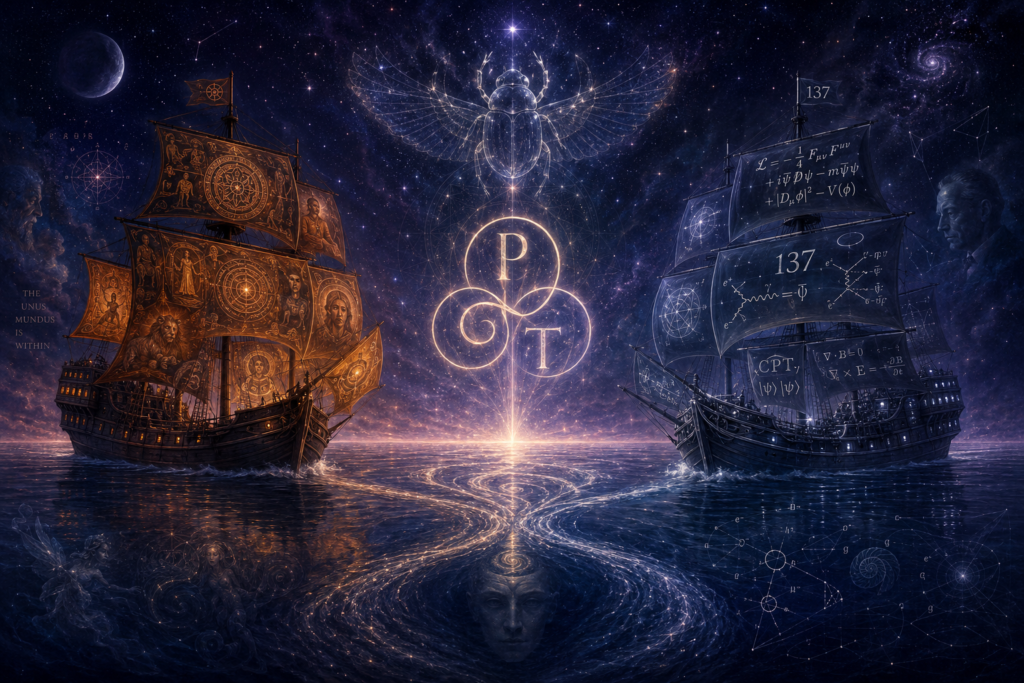
Pauli went even further. Searching for deeper symmetries in quantum mechanics, in 1954 he formulated the CPT theorem, which establishes the invariance of physical laws under the simultaneous transformation of charge (C), spatial parity (P), and time reversal (T). He received the inspiration for this theorem in his dreams. As part of his therapy with Jung, Pauli recorded his dreams, and Jung interpreted them as manifestations of the unconscious mind and concrete archetypes. The dreams were filled with geometric shapes, mandalas, and symmetrical symbols – and they encouraged Pauli to believe in a universal harmony and symmetry. He claimed that every relativistic quantum theory must be symmetric at its core. That is preserved in the Dirac Sea as the basis of its existence and of everything that is the manifestation we know as our universe and the spacetime in which we exist.
🔢 137: The Number That Haunted Pauli
Pauli’s obsession with the fine-structure constant is well known. He saw in it not only a physical constant, but a symbol of the unity of physics and psychology – a number that could express the “wholeness” (Jung’s Self archetype) of the universe.
As an example of the synchronicity in which Pauli so deeply believed, it is often noted that Pauli died in hospital room number 137. This proves nothing physically, but it is a striking illustration of the rootedness of the idea that numbers and archetypes share the same ontological background. In the Dirac Sea, numbers are not merely human inventions – they are waves, patterns, structures that emerge from the same ocean from which dreams also emerge.
🔗 The Connection to Our Previous Voyages
All of this is not merely of historical interest. Our previous voyages – through the paradox of Wigner’s friend, Penrose’s theory, quantum information theory, and the Andromeda paradox – now gain a new dimension through the Jung–Pauli lens.
Non-locality and Bell’s Inequalities: Bell’s experiment showed that nature is non-local – two distant systems can be correlated in a way that admits no causal explanation. That non-locality is acausal in Jung’s sense: correlation exists, but there is no mechanism of transmission. However, that similarity remains superficial – quantum non-locality carries no meaning; it is statistical and anonymous. Synchronicity, for Jung, always has a semantic dimension for the concrete observer.
Wigner’s Friend and the Role of Consciousness: The Frauchiger-Renner experiment, which we have written about, shows that if we assume agents can be in superposition and measurement results are treated as absolute, a contradiction arises. Pauli would likely have said: what breaks is precisely the assumption of the separation of psyche (the agent) and physics. His psychoid level anticipated the need for an ontology in which facts are relational and consciousness is not an epiphenomenon.
Penrose and Objective Reduction: Penrose’s Orch-OR proposes that consciousness is not outside physics, but that the very act of objective reduction is a proto-conscious event. If so, then every reduction – every “now” that arises in the universe – is a kind of synchronistic event: it simultaneously generates a physical fact and a mental experience. The challenge of fitting this approach into the Jung–Pauli framework is that Penrose does not see the need for meaning as a category; his mechanism is purely physical.
🔭 Modern Continuators: Atmanspacher and Formalization
Harald Atmanspacher, a physicist and philosopher of science, is seriously engaged in formalizing Jung–Pauli ideas in the context of quantum information theory. He suggests that synchronicity could be modeled as a kind of “non-selective measurement” – a situation in which the mental and the physical are brought into correspondence without the mediation of a local causal chain.
This is, of course, speculative. But it is not empty rhetoric – it is an attempt to establish a mathematical framework for what Jung and Pauli intuited. In our picture of the Dirac Sea, Atmanspacher’s attempt is like someone trying to draw a map of those parts of the sea where waves carry both energy and meaning simultaneously.
⚠️ Boundaries: Why Synchronicity Is Not a Scientific Category
Despite all its intellectual appeal, synchronicity remains outside the domain of scientific methodology for two reasons:
Unfalsifiability in Jung’s form. Meaning is inherently subjective and contextual. There is no way to independently measure whether two events are connected by meaning without relying on the experience of a concrete individual. This makes impossible the verification independent of subjective experience that is a pillar of science.
The absence of a mechanism. Even if we accept that quantum non-locality opens the door to acausality, there is no known physical mechanism for meaning (semantic information) to be transmitted or paired between the mental and physical domains. Pauli was aware of this and hoped that future physics would find a more neutral language – but to this day it has not found one.
⛵ Epilogue: A Horizon That Waits
The Jung–Pauli synchronicity can be understood precisely as a manifestation of an unfixed past and a non-local present. If the past is not fixed until it is “measured” by decoherence (or conscious reduction), then synchronicity represents that rare moment when, in the present, a physical fact and its meaning are simultaneously “chosen” so that they coincide in a way that feels as though someone has “arranged” the world.
In Penrose’s picture, that would be the moment when two OR events (one in the brain, one outside) share the same spacetime geometry because they are connected via quantum gravity. In relational quantum mechanics, it would be the moment when two systems enter into interaction such that, for their relation, information about meaning and information about physical state become one and the same correlation.
But for now, the horizon remains a horizon. Synchronicity is not a bridge that has been completed – it is a bridge whose foundations have been laid, but whose arch has not yet been joined. Perhaps future physics, especially quantum information theory and the theory of consciousness, will find a way to complete that arch. Or perhaps it will remain an eternal reminder that there are questions science cannot yet even pose, let alone answer.
And the Dirac Sea? It continues to ripple. Within it are both dreams and equations. Both archetypes and particles. Both Jung and Pauli. Two minds, one sea.
The sea is always clear. The horizon is always open. And the questions – the questions are waves that never cease to come.
This post continues the series begun with “⚛️ Quantum Archaeology: Reading the Past from the Dirac Sea”, continued through the map of the quantum odyssey, posts on the observer paradox, Bohmian mechanics, quantum complexity, eigenstate thermalization, entropy, infinities, broken symmetries, dark matter, the Andromeda paradox, and negative frequencies.
Leave a Reply