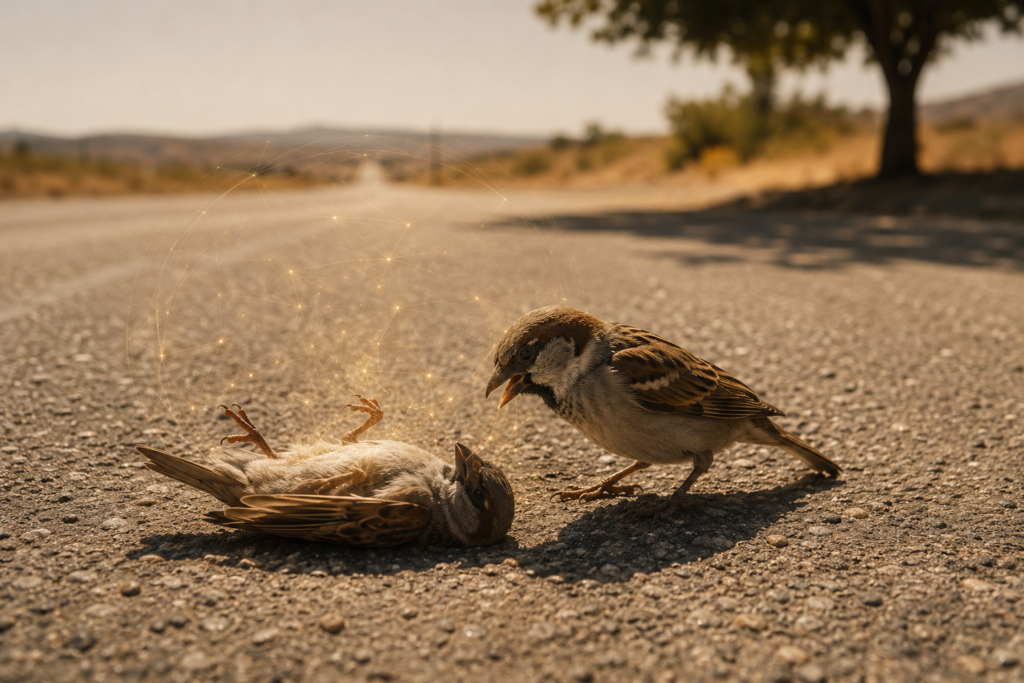
It was a hot, sultry day. I was driving home from work. Near my house, in the middle of the road, I spotted two sparrows. I saw them in time to avoid running them over – I slowed down.
One was lying on its back, motionless. The other stood beside it, as if trying to help it get up. Then it flew off. Briefly – and then returned. It tried again. Flew off again. Returned again.
I parked the car and approached. The little sparrow lying on the scorching asphalt was no longer breathing. I tried to gently massage its heart with my finger – but it was no use. I carried it to the shade of a tree by the roadside. It had no visible injuries. It seemed like heatstroke. Or dehydration.
But what stayed with me was not so much its end, but the attempt of its friend to revive it. That small scene – two beings weighing barely twenty grams, on hot asphalt, one of them on an impossible mission to bring life back to the other.
It was touching. And in some way, instructive.
How is this possible? How can such a small creature, with such a small brain, show something that we humans often forget? Something we call empathy – the ability to recognise another’s suffering and to respond to it.
🧬 The Biological Basis: Instinct or Something More?
Science offers us a simple explanation. Sparrows are social birds. They form strong pair bonds and group ties. When one member of a flock dies or is injured, another often stays with it, tries to “wake” it by pecking, or encourages it to get up.
This is not a conscious “understanding of death” in the human sense. It is, above all, an instinctive reaction to an immobile member of the flock – an attempt to restore normality, to get the other to move and return to the group. In their small world, immobility means danger. The response is urgent mobilisation.
But – and this is important – is it only instinct? And where does instinct end, and something else begin?
Because, precisely in that instinctive reaction lies something that strikes us, as humans, at our very core. It is the biological foundation of what we call empathy. Empathy cannot be reduced to a single neuron – it emerges at the group level, from interaction, from the need to connect with another. It is an emergent property that arises whenever living beings live together.
In humans, this ability is developed to incredible heights – but also to tragic depths. We have seen how the same empathy can turn into hatred, how care for “our own” can turn into cruelty towards “others.” And then, in an ordinary scene on hot asphalt, a small sparrow reminds us of something fundamental:
Caring for another is not a human invention. It is a legacy we share with many living beings.
🌌 The First Bridge: Jung, Pauli and the Hintergrund
But let us step further. If empathy is merely an emergent property – why does this scene touch us so deeply? Why do I remember that little sparrow that tried to revive its companion, more than many other, “more important” things we have seen?
Perhaps because that scene opens a door to something that Carl Gustav Jung and Wolfgang Pauli called the “Hintergrund” – the background.
Pauli, in his famous discussions with Jung, spoke of the Hintergrund as a level of reality that precedes the division into mental and physical. It is neither matter nor consciousness – but something third, which he called “psychoid”. It is the background from which both physical events and psychic states emerge. Jung linked this to his concepts of the collective unconscious and synchronicity – meaningful coincidences that cannot be explained by cause and effect.
Now imagine that scene on the road. Two small beings. One motionless. The other trying to bring it back to life. In that moment, something happened that goes beyond mere biology. That small sparrow did not “calculate” whether its attempt would help. It did not assess the risk. It simply – reacted. From some depth older than its small brain, older than instinct.
Perhaps that was one of those moments when something from the Hintergrund “breaks through” the surface and becomes visible in the physical world. Not as a grand, dramatic synchronicity – but as a quiet, everyday care. As a reminder that we are, on some level, all connected. Connected not only biologically, but on that level that precedes biology.
⚛️ The Second Bridge: Dirac’s Sea and Entanglement at the Macro Level
Dirac’s sea is a frequent theme in our posts. That quantum-informational substrate on whose surface our deepest insights about the world around us – and the inner world within us – are reflected, is indispensable even in a theme like this. From that sea emerge not only particles, but also all manifestations of existence, and into it they return. That abstract sea has become the foundation of all foundations and the background of all backgrounds. Through the theme of quantum complexity, we have seen that correlations between certain parts of that sea intensify over time, increasing the number of entangled states.
What we saw on the road – two small sparrows connected in a moment of crisis – may be a manifestation of that same entanglement, but on a macro level. Not as literal quantum entanglement between particles, but as archetypal entanglement – a pattern that repeats at all levels, from quarks to birds to us.
In Dirac’s sea, everything is connected. The boundaries between “I” and “you”, between “here” and “there”, between “now” and “then” – all are temporary, surface divisions. Beneath them, in the sea, everything is one. And when one sparrow tries to revive another, perhaps it is not just instinct. Perhaps it is an echo of that deeper connectedness – a reminder that care for another is embedded in the very structure of reality.
🌉 Conclusion: The Bridge Is Not Yet Completed
As we wrote at the end of the post about Jung and Pauli – synchronicity is not a completed bridge. It is a bridge whose foundations have been laid, but whose arch has not yet been joined. The same applies to our understanding of empathy, consciousness and connectedness.
But this small scene from the road shows us that the bridge exists – even if we do not yet fully know how to describe it.
Because if one small bird of twenty grams is capable of showing care for its companion, if it is capable of responding to suffering – then empathy is something older than human culture. Older than religion. Older than philosophy. Perhaps it is one of the fundamental principles of existence itself – a principle that manifests at all levels, from quarks to birds to us.
The next time you see a sparrow on the pavement, remember this story. And remember – you are looking at a being that carries within it the same spark that moves us. Only that in them, it is pure. Unburdened by ideology. Uncorrupted by hatred.
Perhaps these small beings could teach us something we have forgotten.
Leave a Reply