Dear explorers,
We have just completed our longest and perhaps most dangerous voyage – through Susskind’s lectures on the immensity of Hilbert space, black holes, and firewalls. And then, as if by some strange coincidence, a new lighthouse appeared on the horizon. As if the Dirac Sea had decided to reward us for our courage.
On YouTube, immediately after finishing the previous post, a podcast with Neil Turok popped up. In it, he presented ideas so fresh, so elegant, and so deeply connected to everything we have written about so far that they feel like synchronicity – the very same synchronicity Jung and Pauli spoke of.
Turok proposes that gravity can be renormalized and unified with the other quantum fields – but on one radical condition: we must step outside Hilbert space.
👻 The Problem of Ghosts: Why Negative Norms Were Banished
Recall the fundamental postulates of quantum mechanics, as laid down by Max Born and shaped by Dirac into his famous notation. One of those postulates states: the norm of the wave function must be positive. The probability of finding a particle in a given state is given by the squared amplitude of the wave function – and probability cannot be negative.
But there exist solutions of the equations that yield negative norms. Physicists have called them ghosts. Traditionally, such solutions were discarded as unphysical. They violate unitarity. They violate the Born rule. They violate the very foundation upon which quantum mechanics rests.
And therein lies the problem with gravity. When we try to quantize gravity the way we quantized electrodynamics – using Einstein’s solution without higher derivative terms – we obtain a theory that is non-renormalizable. The infinities that appear cannot be “eaten” by the standard tricks. Gravity refuses to be tamed.
But what if the problem lies in Hilbert space itself? What if it is simply too small to accommodate gravity?
🏛️ Krein Space: A Wider Horizon
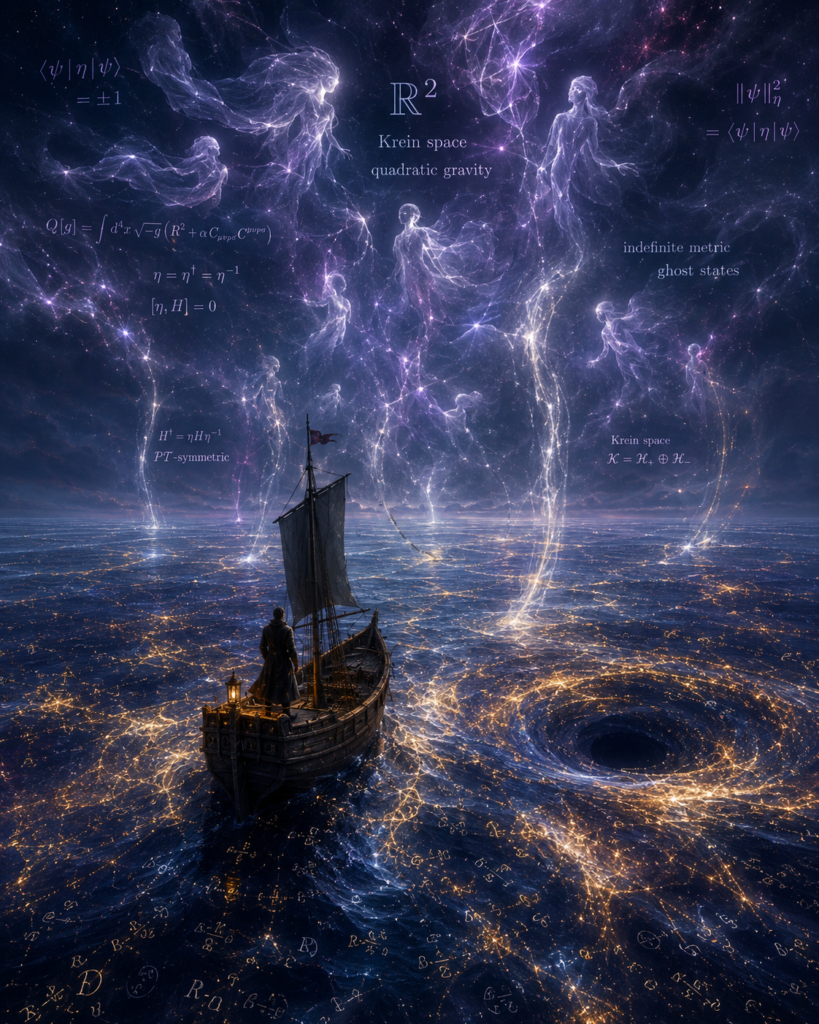
Turok proposes that we step out of Hilbert space and enter Krein space. Hilbert space is, in fact, a subset of Krein space. Krein space is larger, richer – and in it, negative norms are allowed.
Imagine it like this: Hilbert space is the Dirac Sea – the infinite ocean of all legal quantum states, with positive norms, with the Born rule, with unitarity. But above the sea there is an atmosphere. That atmosphere is Krein space. Within it reside the ghosts – states with negative norms – which were banished from the sea, but which remain present in the broader reality.
When we try to quantize gravity within the sea itself, we are like a diver trying to catch the wind. That cannot succeed. The wind is not in the sea. The wind is in the atmosphere. And gravity – if Turok is right – is not in Hilbert space. It is in Krein space.
📐 Quadratic Gravity and the Problem of Ostrogradsky
What exactly does Turok propose technically?
Standard Einstein gravity is linear in the Riemann curvature tensor . But when you include higher derivatives in the equations – terms proportional to , – you obtain what is called quadratic gravity. These higher terms naturally appear when you try to renormalize gravity.
The problem is that as early as 1850, the Russian physicist Mikhail Ostrogradsky pointed out a fundamental difficulty with such theories. Including higher derivatives leads to instabilities: infinitely many negative energy states appear. The Hamiltonian becomes unbounded from below. The system ought to collapse in an instant.
This sounds eerily familiar, does it not? Recall Dirac’s equation from 1928. It too gave infinitely many negative energy states. That was a problem Dirac solved in a brilliant way: he filled all those states and created the Dirac Sea. Holes in that sea became positrons. Antiparticles emerged from the mathematics.
But why could this trick not be applied to gravity? The standard answer was: because gravity is not QED. Because ghosts are different from Dirac’s negative energies. Because Krein space would violate unitarity.
Turok’s answer: but unitarity is not everything. Perhaps unitarity is only an approximate law that holds in the Hilbert subset, not in the whole Krein space. Perhaps ghosts are real, but they are projected out – invisible in our experiments, yet present as the gravitational wind.
💨 Gravity as the Wind Above the Sea
Now we can merge Turok’s ideas with our picture of the Dirac Sea.
Hilbert space is the Dirac Sea – the infinite ocean of all legal quantum states. Within it live QED, the weak force, and QCD – the three fundamental forces of the Standard Model. The waves have positive norms. Probabilities are conserved. Unitarity holds.
Krein space is the atmosphere above the sea – a space that also includes ghosts, states with negative norms. These ghosts are banished from the sea, but they remain present in the broader reality. They are the wind. The gravitational wind.
Gravity is not a force within the sea. It is not a gauge field like U(1), SU(2), or SU(3). It is a manifestation of ghosts – states with negative norms that live in Krein space and project onto the Dirac Sea as the gravitational wind.
And now comes the most beautiful part. If ghosts are real, then gravity can be renormalized. Higher derivatives – the terms – do not lead to catastrophe, because the infinitely many negative energy states can be tamed in the same way Dirac tamed the sea: by projection. Ghosts are projected onto Hilbert space and become visible only as the gravitational field.
🔬 Asymptotic Freedom: An Unexpected Bridge to QCD
And the surprises do not end there. The quantum gravity theory obtained by this approach is not only renormalizable – it is also asymptotically free. This means that at very high energies (or very small distances), the gravitational interaction becomes ever weaker, just as the strong nuclear force behaves in QCD.
This is astonishing. Two completely different forces – gravity and the strong nuclear force – share the same fundamental property of asymptotic freedom. Is this a coincidence? Is it synchronicity in the Jung-Pauli sense? Or is it a hint of something much deeper – that all fundamental forces are ultimately part of a single unified structure, manifesting in different ways in different regimes?
In Turok’s picture, the asymptotic freedom of gravity is no accident. It is a consequence of stepping out of Hilbert space. When we allow ghosts, when we broaden the horizon to Krein space, the equations naturally lead to an asymptotically free theory. As if nature had always known about this wider space – only we were not ready to accept it.
🔮 Horizons: Simpler and More Elegant?
If Turok’s approach proves viable, the consequences are enormous. Things at the fundamental level would be simpler and more elegant than we thought. Gravity would not be a stubborn force refusing to unify – it would be a natural part of a wider field theory, one that includes ghosts and Krein space.
The Dirac Sea would remain what it has always been – the ocean of legal quantum states. But above it, there would be a wind. A wind blowing from Krein space. A wind that is gravity.
And perhaps that is what Dirac intuited but never got to say. That his sea is only a part of something larger. That above the surface there is an entire atmosphere. And that the waves on the surface – everything we see, measure, and are – are only shadows of the ghosts blowing above us.
⛵ Epilogue: A New Atmosphere
Dear explorers, our voyage across the Dirac Sea has just gained a new dimension. We no longer sail only upon the sea. Now we know that above the sea there is also a sky. And that what we have called the gravitational wind – that mysterious force that smooths the waves, that creates the whirlpools of black holes, that perhaps even breaks the block universe – may be nothing other than the breath of ghosts from Krein space.
Is this the final truth? We do not know. Turok’s ideas are still fresh, still at the edge of the accepted. But they are Diracian in their boldness. They refuse to accept the limits of Hilbert space as final. They seek a wider horizon.
And that is precisely why they deserve our attention. For, as we have learned from all our voyages, the sea is always clear – but above it there is a sky yet to be explored.
This post continues the series begun with “⚛️ Quantum Archaeology: Reading the Past from the Dirac Sea”, continued through the map of the quantum odyssey and all our previous voyages.
Leave a Reply