Dear explorers,
In our previous voyage we passed through the mirror of the Dirac Sea and discovered that behind it lies an entire hidden world – mirror matter, born from the pens of Kobzarev, Okun, and Pomeranchuk in 1966. But why did this idea languish in obscurity for decades? And why today, right now, is it emerging as one of the most elegant and comprehensive theories explaining the anomalies that trouble the Standard Model?
Today we sail deeper. Not only shall we compare mirror matter with M-theory and supersymmetry, but we shall pass through a whole series of concrete phenomena – from the muon’s magnetic moment to the proton radius paradox – where mirror particles offer explanations that are at once simple and testable. And we shall show that discovering the hidden world requires no Planck-scale energy. It is enough to listen carefully to the whisper in the wind.
📜 Why Was Mirror Matter in the Background?
There are several reasons. The first is historical: Kobzarev, Okun, and Pomeranchuk published their paper in a Soviet journal in Russian, at a time when the Iron Curtain seriously limited the flow of ideas. While Western physicists feverishly searched for the Higgs boson and developed the Standard Model, the idea of an entire parallel sector remained trapped behind a linguistic and political barrier.
The second reason is conceptual: the idea of doubling the entire world of particles seemed too radical, almost metaphysical. Physicists preferred minimal extensions of the Standard Model – add a single particle, a single interaction, a single mechanism. An entire parallel sector? That sounded like science fiction.
The third reason is experimental: there simply were not sufficiently precise measurements to point to anomalies that mirror matter naturally explains. Without data, the theory remained a mathematical exercise.
Today the situation has fundamentally changed. The precision of measurements has reached a level where deviations from the Standard Model are no longer statistical fluctuations, but stubborn signals. And mirror matter, unlike many competing theories, offers unified explanations for multiple anomalies at once – without the need to introduce an entire imaginary zoo of new particles on arbitrary energy scales.
🏛️ Comparison with M-Theory: Elegance vs. the Infinite Landscape
M-theory is a supreme mathematical achievement. It unifies five consistent string theories into a single framework, offers 11-dimensional geometry, membranes, and dualities. But its problem lies precisely in what we have previously mentioned – the infinite landscape of possible vacua, in which nearly everything imaginable and unimaginable is simultaneously possible. M-theory, for now, does not yield unique, concrete, testable predictions at low energies. It is a magnificent cathedral – but in it we do not yet know to which God we are praying.
Mirror matter, by contrast, starts from a much more modest, but for that reason more verifiable, stake: it extends the Standard Model with its own reflection. It introduces no new fundamental forces, requires no additional dimensions, but simply postulates that the symmetry group is actually (where is the gauge group of the Standard Model), with very weak mutual mixing. The mathematical structure is clear and the predictions are concrete. While M-theory seeks answers in 11 dimensions, at energies beyond our reach, mirror matter offers them in four – merely doubled and at accessible energies.
🧲 The Muon Magnetic Moment (g-2 Anomaly)
The Muon g-2 experiment at Fermilab confirmed in 2021 that the measured value of the muon’s magnetic moment deviates from the Standard Model prediction by about 4.2 sigma. That is enough to be considered a serious anomaly, but not enough to declare a discovery.
Mirror models with kinetic photon mixing predict that mirror fermions can contribute to the muon’s magnetic moment through loops with virtual mirror particles. Since the mixing is extremely weak (on the order of to ), the contribution is small, but sufficient to explain the anomaly without introducing supersymmetric particles at TeV scales.
Moreover, Tan’s model with oscillations of neutral hadrons (neutrons) indirectly affects electroweak loops as well, opening the possibility that the g-2 anomaly and the neutron anomaly are explained by the same mechanism. One mirror particle sector, two anomalies, one solution.
🪟 The Casimir Force at Scales of 100 nm
The Casimir force between two neutral plates in a vacuum is a direct manifestation of quantum fluctuations of the electromagnetic field. Precise measurements at distances of 100 to 1000 nm have shown small but systematic deviations from theoretical predictions.
If kinetic mixing exists between ordinary and mirror photons (dark photons), mirror virtual particles can give an additional contribution to the Casimir force. At distances on the order of hundreds of nanometres, the effect would be measurable and potentially explains the observed deviations. This is yet another low-energy window into the mirror sector – a window that requires no colliders, only precise engineering at the nanometre scale.
⚛️ The Fine-Structure Constant and Its Varieties
Different methods of measuring the fine-structure constant – atomic interferometry, the quantum Hall effect, the electron magnetic moment – yield values that differ from one another at the level of several standard deviations.
If mirror particles contribute to vacuum polarization through kinetic mixing, the effective value of depends on the energy scale and on which process is used for the measurement. This offers a natural explanation for why different methods give slightly different results – not because the measurements are wrong, but because we are actually measuring different manifestations of the same quantity in the presence of a mirror sector.
🔴 The Proton Radius Paradox
Measurements of the proton radius using muonic hydrogen (where the electron orbiting the nucleus is replaced by a muon) give a value about 4% smaller than measurements using ordinary hydrogen and electron scattering. This anomaly, known as the proton radius puzzle, defied explanation for a decade.
Mirror models with weak mixing between sectors predict that the muon, because of its greater mass and greater probability of virtual transitions into the mirror sector, “feels” a slightly different charge distribution than the electron. The difference is minuscule, but sufficient to explain why muonic measurements yield a smaller radius. Again, the same mechanism – kinetic mixing – offers a solution to an apparently unrelated problem.
🧬 Supersymmetric Particles vs. Mirror Particles: Low-Energy Elegance
Supersymmetry (SUSY) predicts partners for every particle of the Standard Model – selectrons, squarks, sneutrinos – but places them at high energy scales (TeV and above). The problem is that the LHC, despite years of searching, has found not a single supersymmetric trace. The longer this search continues, the more the allowed SUSY scales are pushed upward toward Planck energy, and the theory becomes ever less convincing as a solution to the hierarchy problem and dark matter.
Mirror particles, by contrast, are a low-energy phenomenon. They require no new interactions at TeV scales; their mixing with the ordinary sector is extremely weak and manifests itself at energies from eV to MeV – precisely where precision experimental physics is today uncovering anomalies. A mirror electron, proton, or neutron is not an exotic superparticle; it is nearly identical to ours, only invisible to our photons. Its “hiddenness” is not a consequence of large mass, but of extremely weak interaction.
In that sense, mirror matter is supersymmetry without high energies – a symmetry that doubles the number of degrees of freedom, but in a way that is experimentally accessible today, in precise low-energy measurements, and not only in the colliders of the future.
🌊 The Dirac Sea as a Low-Energy Window into the Mirror
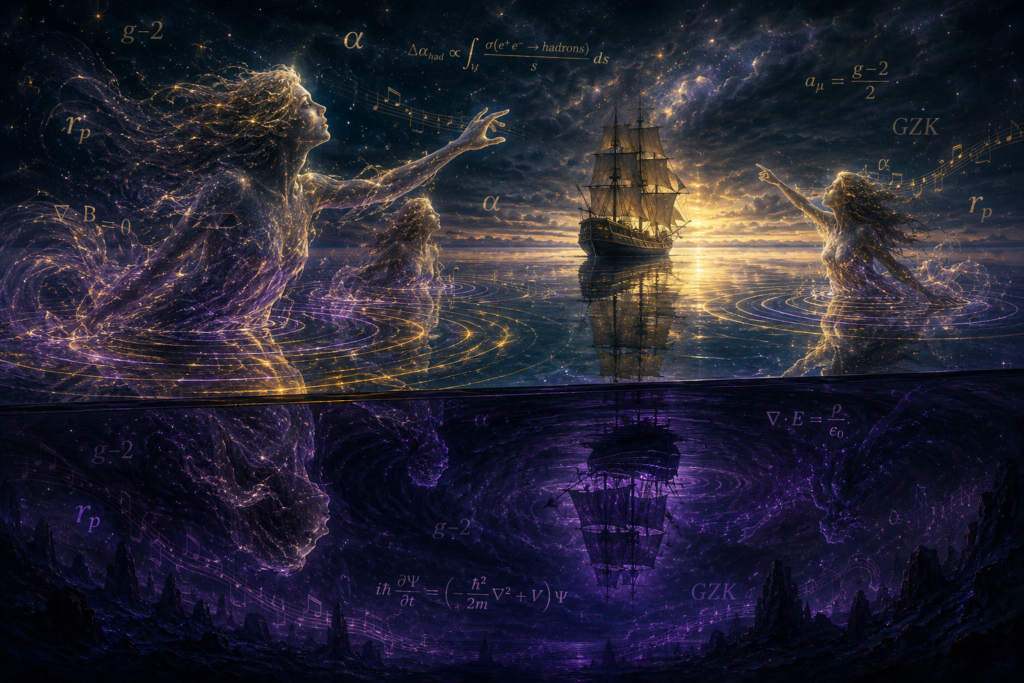
We return to our central image. If our reality is a voyage across the surface of the Dirac Sea – a surface on which virtual fluctuations become real particles through interactions with our detectors – the mirror sector is the other side. A hidden world behind the reflection, in the sea foam. No Planck-scale energy is needed to reach it; it is enough to examine carefully the tiny cracks in our picture of the world.
Precisely those cracks – the muon magnetic moment, the Casimir force at 100 nm, the divergence of the fine-structure constant, the proton radius paradox, the neutron anomaly – are not accidental errors. They are a whisper in the wind. Or perhaps the seductive song of sirens, luring us off course.
Are they sirens or heralds of truth? To find out, we must continue our voyage and face many more mysteries.
⛵ Epilogue: A Whisper That Becomes a Voice
When Kobzarev, Okun, and Pomeranchuk proposed mirror matter in 1966, their voice was barely audible – muffled by the Iron Curtain, drowned out by scepticism, deafened by a lack of data. Today, nearly six decades later, that whisper is growing louder. Every new anomaly, every new precise measurement, adds another voice to the chorus asking: what if the universe is twofold?
Mirror matter requires no leap into 11 dimensions. It requires no particles at Planck energies. It is here, just below the surface, waiting to be recognised in the tiny deviations from what we thought we knew.
And as we sail on, let us listen to that whisper. For perhaps what we today call an anomaly – tomorrow becomes a discovery.
The sea is always clear. The horizon is always open. And the whisper in the wind – the whisper is what precedes the storm. 🪞🌊🔬
This post continues the series begun with “⚛️ Quantum Archaeology: Reading the Past from the Dirac Sea”, continued through the map of the quantum odyssey and all our previous voyages, especially the previous post on mirror matter.
Leave a Reply