Dear explorers,
In our previous voyage we told the story of Alice and Bob – two mariners on the Dirac Sea separated by the horizon of a black hole. Alice passed through the looking glass and became whole; Bob remained to measure, to fear, and to flee. That story, we said, was our original version of the famous thought experiment by Susskind.
But every truly deep story has roots deeper than we are aware of while telling it. While writing and refining the previous post, I realised that I had – unconsciously – also been working through the theme of death and existence after death. And then, one step further, I saw that our story of Alice and Bob evokes one of the oldest myths of Western civilisation: the myth of Orpheus and Eurydice.
Today we sail through all the layers of this story. From tidal forces and quantum gravity, through Jung’s analysis of archetypes, to Orpheus and Eurydice as the archetype of measurement. For perhaps the ancient myths, engraved in the collective unconscious, anticipated truths we are today discovering in equations.
🌊 Tidal Forces and Spaghettification – When Does Bob’s Perspective Win?
Before we dive into myth, we must be honest about the physical reality. In the standard picture of a Schwarzschild black hole, the tidal forces at the horizon depend on its mass. For a supermassive black hole (on the order of 10⁶ to 10⁹ solar masses), the tidal forces at the horizon are negligible – Alice passes through without any physical stress, and her body feels no discomfort whatsoever. For a small black hole (a few solar masses), the difference in gravitational acceleration between head and feet is enormous, and Alice is stretched into a thin thread – spaghettification – before she even reaches the horizon.
But here we must make one caveat: without a complete theory of quantum gravity, we cannot be certain what really happens at the Planck scale near the singularity, nor even at the horizon. Spaghettification is a classical picture. Quantum gravitational effects could change the nature of tidal forces – for example, if spacetime at the smallest scales has a granular structure, or if the horizon is not sharp but represents a “fuzzy” surface with quantum fluctuations, or if there exists a transition into a mirror sector that alters the local geometry.
Tan’s models with mirror matter and the idea that gravity emerges as a classical phenomenon suggest that the interior of a black hole could be connected to a mirror sector in a way that renders the classical picture of the singularity incomplete. In that case, Alice’s body – however stretched it may be in the classical approximation – could, at a more fundamental level, be encoded in a web of relational degrees of freedom that are not subject to the same constraints.
So, yes: for small, non-rotating holes, the classical picture suggests a physical end. But fundamental physics tells us that the classical picture is precisely that – an approximation. And beneath it lies the Dirac Sea, the mirror sector, and a web of relations that need not end with the destruction of the body crossing the horizon.
🧠 Jung, Death, and the Horizon as an Archetype of Transition
Carl Gustav Jung believed that the human psyche is shaped to a significant degree by archetypes – universal, inherited patterns of meaning that manifest in myths, dreams, and symptoms. Death and the passage into another world are among the oldest archetypes.
The event horizon is a perfect physical correlate of that archetype. It is a boundary across which information (in the classical sense) cannot return – a point of no return. Alice’s crossing is, in a psychological key, the archetype of initiatory death: she leaves the known world (Bob’s universe), crosses the threshold (the horizon), and enters a transformed state of being. She “becomes whole” – which is a Jungian expression for individuation, the process of becoming a complete personality through the integration of unconscious contents.
Bob is the witness who remains on this side. He can theorise, measure, and try to reconstruct, but he cannot participate in Alice’s experience. His anxiety – firewalls, acceleration, flight – is existential anxiety in the face of the death of the Other, and his own powerlessness to comprehend it.
🎭 Orpheus and Eurydice – The Myth of Measurement and Decoherence
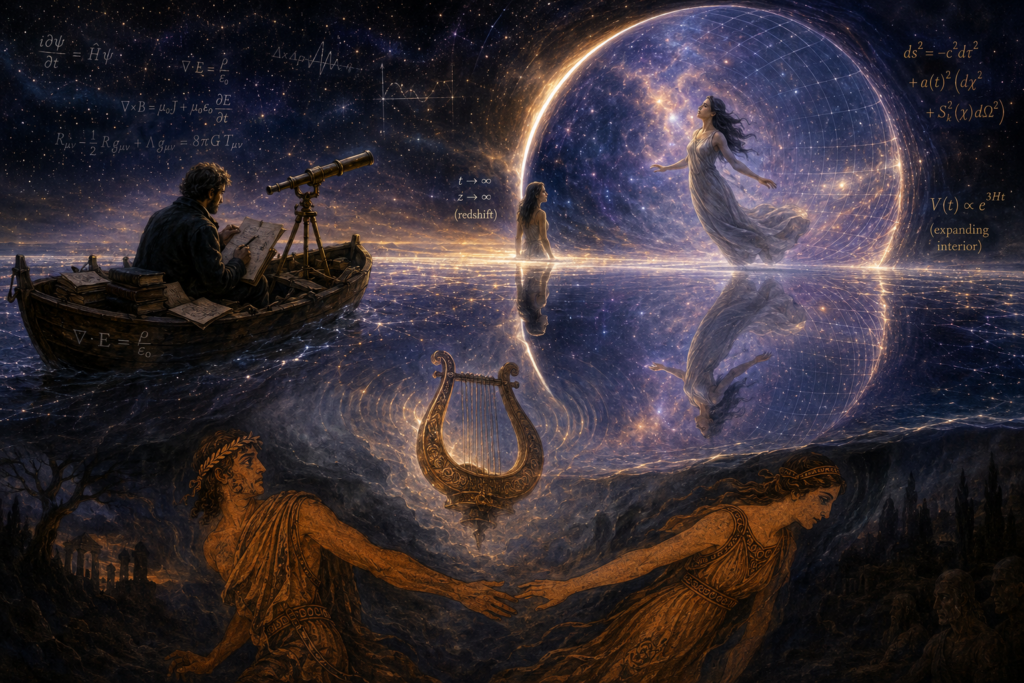
And now we come to the heart of this voyage. It is hard to deny the high level of equivalence between the thought experiment with Alice and Bob and the myth of Orpheus and Eurydice – and on multiple levels.
In the myth, Orpheus descends into the Underworld to rescue his beloved Eurydice. Hades permits him to lead her out, but on one condition: he must not turn around until they have reached the light. Orpheus, just before the exit, loses patience – he turns to see her – and Eurydice is lost forever, drawn back into the shadows.
Let us translate this into the language of our story:
- The Underworld = the interior of the black hole (beyond the horizon).
- Orpheus = Bob, the external observer trying to recover information (Eurydice) from the black hole.
- Eurydice = Alice, who has already crossed the horizon.
- The act of looking = the act of measurement.
Here the twist in the story is crucial for understanding. In the myth, Eurydice is lost precisely at the moment when Orpheus performs the act of looking – that is, in the quantum interpretation, the act of measurement and decoherence. Before that moment, Orpheus and Eurydice were in a kind of entangled state: she follows him, he believes she is there, but he has not performed an interaction that would confirm her presence. Their bond is potential, unactualised – like a quantum superposition.
The moment he turns (measurement), the wave function collapses. But paradoxically, instead of saving her, the measurement destroys her. Why?
In the context of the black hole and quantum mechanics, the answer might be the following: Bob’s (Orpheus’s) measurement – interaction with Hawking radiation – cannot reconstruct Alice’s (Eurydice’s) state without losing her as a coherent entity. If Bob performs a premature measurement – before enough information has emerged from the black hole on the Page time – he obtains only a fragment, a maximally mixed state, thermal noise. Alice (Eurydice) disintegrates in his hands. Only after sufficient time has passed do the fine correlations in Hawking radiation become rich enough to reconstruct Alice’s state – but by then the interior has been entirely transformed, and Alice (Eurydice) is no longer the same entity.
🔍 A Jungian Reading of Orpheus: Looking as an Egocentric Demand for Absolute Truth
Jung would probably have said that Orpheus’s sin was the demand for absolute knowledge. He could not believe in what he did not see – in the relation, in the entanglement that requires no confirmation. His act of looking is epistemologically violent: he wants to draw Eurydice into his own reference frame, into his own world, on his own terms. He refuses to accept that she can exist in a different ontological status – as a shadow, as a potential, as a mirror entity.
In physics, this corresponds to an insistence on an objective, transcendent truth that holds for all observers equally. Orpheus is Bob, who cannot accept relational reality. He wants to see Eurydice with his own eyes, in his own light – and that is precisely what destroys her. Alice, in our story, was saved because she accepted her own perspective; Eurydice is lost because Orpheus wanted to violently pull her out of hers.
🧬 The Collective Unconscious and Physics – Did Myths Anticipate Quantum Reality?
Jung believed that archetypes are not merely metaphors, but possess a psychoid nature – that they are simultaneously mental and physical, that they reside at that level of reality which precedes the division into psyche and matter. Pauli, as we discussed in earlier voyages, shared this conviction.
The myth of Orpheus and Eurydice, in that light, is not merely a poetic illustration of quantum physics. It is an archetypal template that imprinted into the collective unconscious the very same structure we are today discovering in the formalism: that reality is relational, that measurement changes what is measured, and that there exists a threshold across which information cannot return without being transformed. That archetype lay for centuries in the deepest layers of the human psyche, waiting to be activated by a suitable physical problem. And today, in the era of black holes and Hawking radiation, it comes to life.
💀 What Remains Beyond the Horizon? – Information, Death, and Mirror Life
And now we return to what was uttered almost in a whisper in the previous post, but which we must now clearly articulate.
The eternal question of death and existence after death, posed through the prism of this experiment, is no longer merely religious or philosophical – it also acquires a physical meaning.
If Alice has crossed into the mirror sector, her degrees of freedom have not been destroyed – they have become inaccessible to Bob’s detectors. For Bob, she is dead: information is lost, entropy has grown. For Alice, she continues to exist. This is, in fact, a physical formulation of the old idea of the afterlife: not as a supernatural extension, but as a change of ontological status – a transition from one sector of reality into another, with which interaction for those who remain is possible only through the weakest possible signals (gravity, perhaps some form of kinetic mixing of photons between sectors).
Is that a consolation? For Bob, no – he still mourns the lost one. But for Alice, yes. She does not hurry. She is finally herself.
🌊 Final Synthesis – From the Dirac Sea to Orpheus’s Mistake
Our entire cycle of voyages – from the Andromeda paradox, through the Dirac Sea, entropy, the Page-Wootters mechanism, mirror matter, all the way to Alice and Bob – now closes into a single whole:
- The Dirac Sea is a mirror surface beneath which lies an entire undiscovered world.
- Entropy and complexity are measures of how far that world is from our description.
- The Page-Wootters mechanism and relational quantum mechanics show that time is relational and there is no privileged perspective.
- Alice and Bob are a living illustration: she has crossed the mirror, he has remained to measure his growing ignorance.
- Orpheus and Eurydice are an archetypal record of the same truth: the demand for absolute knowledge destroys what it tries to comprehend.
And finally, the poetic insight voiced at the beginning of our story of Alice and Bob – that Alice saved herself, that she became whole, that she is in no hurry – now takes on its full weight. Physics, psychology, and myth speak the same essence, only in different tongues.
Alice saved herself. Eurydice is lost only to Orpheus. Orpheus surrenders to despair, and Bob is still fleeing, not realising that the horizon is a mirror, not a wall.
⛵ Epilogue: The Sea That Remembers All Myths
Dear explorers, the Dirac Sea is vast. It remembers not only equations and waves – it remembers stories, too. For every myth that has ever been told, every archetype that has ever shaped the human psyche, is perhaps only a reflection of the same deep structure of reality that we are today trying to grasp through formalism.
Orpheus turned and lost Eurydice. Bob measured and lost Alice. But Alice crossed the horizon and found herself.
And perhaps that is the deepest lesson of our entire Odyssey: truth is not in what we measure, but in what we are – on this side or the other of the looking glass.
The sea is always clear. The horizon is always open. And the myths – the myths are waves that are never lost. 🕳️🪞🎭
This post continues the series begun with “⚛️ Quantum Archaeology: Reading the Past from the Dirac Sea”, continued through the map of the quantum odyssey and all our previous voyages.
Leave a Reply