
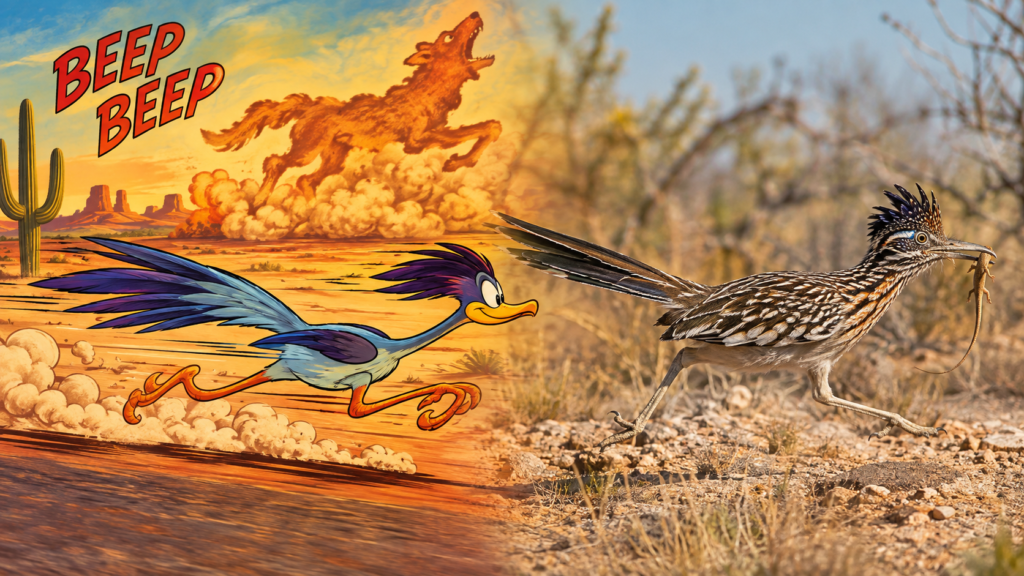
When we think of the roadrunner, most of us first picture the cartoon – that fast, clever bird that always outsmarts the coyote with its famous “beep-beep.” But what the cartoon didn’t show is that the roadrunner is one of the most fascinating and successful creatures of the American Southwest. And no, it doesn’t go “beep-beep” – its real story is far more interesting than any cartoon.
Recently, I came across a YouTube channel – a woman from Texas managed to tame a roadrunner. I didn’t even know that was possible. And truly, that bird is a phenomenal hunter of mice and snakes, with its unique appearance and demeanor. That story inspired me to dive deeper into the world of this extraordinary bird.
🧬 Taxonomy and Basic Characteristics
The roadrunner (Geococcyx californianus) is not closely related to ostriches or emus, as one might think, but belongs to a completely different family – the cuckoo family (Cuculidae). There are two species: the greater roadrunner and the lesser roadrunner, with the larger species ranging from Texas to California.
These are birds adapted to life on the ground, measuring 50-62 cm in length, with a long tail that serves as a rudder while running and legs specialized for fast movement. Their wings are small and they fly rarely and briefly, mostly downhill or in escape. They have a characteristic crest on their head and bare skin behind the eye that changes color – from blue to red, depending on their mood.
🏃♂️ Behavior and Diet: An Unmatched Hunter
What makes them exceptional is their way of life. They have perfected ground hunting, developing speed and cunning.
- Speed and hunting: They run up to 32 km/h, with their tail serving as a rudder for sharp turns. They feed on snakes (including venomous rattlesnakes), lizards, scorpions, rodents, and even other birds.
- Cooperative hunting: They often hunt in pairs – one distracts the prey while the other attacks.
- Monogamy and parenting: They mate for life. The male and female build the nest together from twigs and snake skin, and both parents incubate the eggs. The male takes over night incubation because the female’s body temperature drops. Young leave the nest after about a month.
🧬 Evolutionary History: From Ancient Times to Today
The evolutionary story of the roadrunner is incredible and reaches deep into the past.
- The first “runners” from the Cretaceous: Fossil footprints in China, dating back 110 million years, belong to birds that occupied the same ecological niche as today’s roadrunners. Their zygodactyl feet (two toes forward, two backward) testify to an ancient lineage.
- From forests to deserts: Fossils up to 8,000 years old have been found in caves in New Mexico, California, and Texas. Interestingly, they then inhabited sparse forests, and only later adapted to arid desert regions.
- Place in the cuckoo family: Within the cuckoo family, the genus Geococcyx is most closely related to the genus Neomorphus (ground-dwelling cuckoos of the forests). This connection shows how one branch of cuckoos left the trees and adapted to life on the ground.
🏠 Is It Really Possible to Tame a Roadrunner?
Although there are exceptions, roadrunners are generally not kept as pets.
- Why they’re not for households: They are fierce and opportunistic predators that see prey as food. Moreover, in the US they are protected wild species – keeping them is illegal.
- What can enable taming?: Exceptions are possible when a bird is found in unusual circumstances, but this is rare and extremely difficult. Although curious, they are wild animals that live best in their natural environment.
🌟 Interesting Facts That Depart from the Cartoon
- Doesn’t go “beep-beep”: They make a soft, dove-like cooing sound and a bill-rattling sound.
- “Sunbathing”: To warm up after cold desert nights, they spread their feathers and expose the skin behind their eye to the sun.
- “Punk” hairdo: The crest on their head, which they raise and lower in communication.
- Resistant to natural poisons: Their immunity allows them to safely eat venomous snakes and scorpions.
🦊 Natural Predators and Human Impact
Although in the cartoon they are always a step ahead of the coyote, in reality things are different. Coyotes are, unfortunately, one of their key natural predators. Along with them, the main enemies are hawks (which attack from the air) and raccoons (which are dangerous to their nests and young). The list of predators is longer: domestic cats, skunks, snakes, and bobcats are also on the list of those that threaten this bird.
However, the greatest danger to it comes from humans:
- Roads and traffic: Birds often end up under wheels, as they move along roads in search of food.
- Hunting and persecution: There are irresponsible hunters who target them – illegally, but also legally in some US states in the past. Some states even offered bounties for roadrunners, as farmers mistakenly considered them predators of quail – which they are not.
- Habitat loss: Urbanization and city expansion fragment their territories and destroy food sources.
- Poisoning: As predators, they are exposed to pesticides that accumulate in their prey.
💫 Conclusion: More Than a Cartoon Character
The roadrunner is not just a cartoon hero – it is a living fossil, a master of survival, and one of the most successful predators of the American deserts. Its story is a story of adaptation, evolution, and the struggle for survival in one of the harshest habitats on the planet.
The next time you see a cartoon with the “beep-beep” bird, remember that the real roadrunner is far more fascinating. And remember that, despite all its speed and cunning, its greatest enemy – unfortunately – is man.
Perhaps it’s time we stop seeing it as a cartoon character, and start seeing it for what it truly is – one of the most remarkable inhabitants of our planet.
Leave a Reply