
Dear explorers,
In our previous voyage we visited the desert island of Julian Schwinger, the man who built the cathedral of QED and was then banished from it for daring to think differently. Today we continue along that path, but we sail toward far wider waters – toward the triumph and the shadows of quantum chromodynamics (QCD) , the theory that was supposed to be the crown of the Standard Model.
The standard story is magnificent: Yang and Mills laid the foundations, Gell-Mann brought SU(3) colour, and Gross, Politzer, and Wilczek discovered asymptotic freedom – and thus QCD was born. But in the shadow of that triumphal story stand two giants – Schwinger and Feynman – who remained deeply sceptical to the end of their lives. Their scepticism was not the conservatism of old men; it was a principled critique that still echoes today.
Today we sail through that shadow. For, as in every true Odyssey, beneath the celebration lies a restlessness.
🧵 Yang-Mills and the Massless Trouble
In 1954, Chen Ning Yang and Robert Mills published a paper that generalised gauge symmetry. Instead of the simple U(1) symmetry of QED, they considered SU(2) – the symmetry of isospin. The mathematical structure was elegant: they introduced gauge fields as the carriers of the interaction, their number corresponding to the number of group generators (three for SU(2)).
But there was a catch. For gauge invariance to be preserved, these fields had to be massless. In QED this is no problem – the photon is indeed massless. But the strong force is short-ranged; its carriers cannot be massless, for then the force would be felt over infinite distances. Yang and Mills were aware of this and admitted in their paper that they did not know how to generate mass for these particles.
The problem remained open until the Higgs mechanism (1964), but for the strong interactions the solution came from an entirely different direction – not by giving mass to the gluons, but through confinement. It was so radical that even Yang and Mills could not have imagined it in their original formulation.
🎨 Gell-Mann and SU(3) – from Flavour to Colour
During the 1960s, Murray Gell-Mann, together with Ne’eman, introduced SU(3) flavour to classify hadrons – the famous “Eightfold Way”. But this was only a phenomenological symmetry, similar to Mendeleev’s table – it described regularities but did not explain them.
When quarks became serious candidates for fundamental particles, the question arose: what binds them? Gell-Mann postulated that there exists an SU(3) colour – a new, exact symmetry, distinct from SU(3) flavour. Gluons were introduced as the gauge bosons of this symmetry. But they were still massless, and the force still had to be short-ranged.
The solution – asymptotic freedom and confinement – came in 1973. At high energies, gluons behave as though they were free (asymptotic freedom); at low energies, the force grows and the quarks are trapped (confinement). It was a triumph – but not for everyone.
😠 Feynman’s “Whatever the Hell That Is”
Richard Feynman, despite his genius for perturbative QCD (he also introduced “partons” – the forerunners of quarks in deep inelastic scattering), was deeply sceptical of the whole SU(3) colour construction. His famous remark, delivered with his characteristic mixture of humour and contempt, went something like:
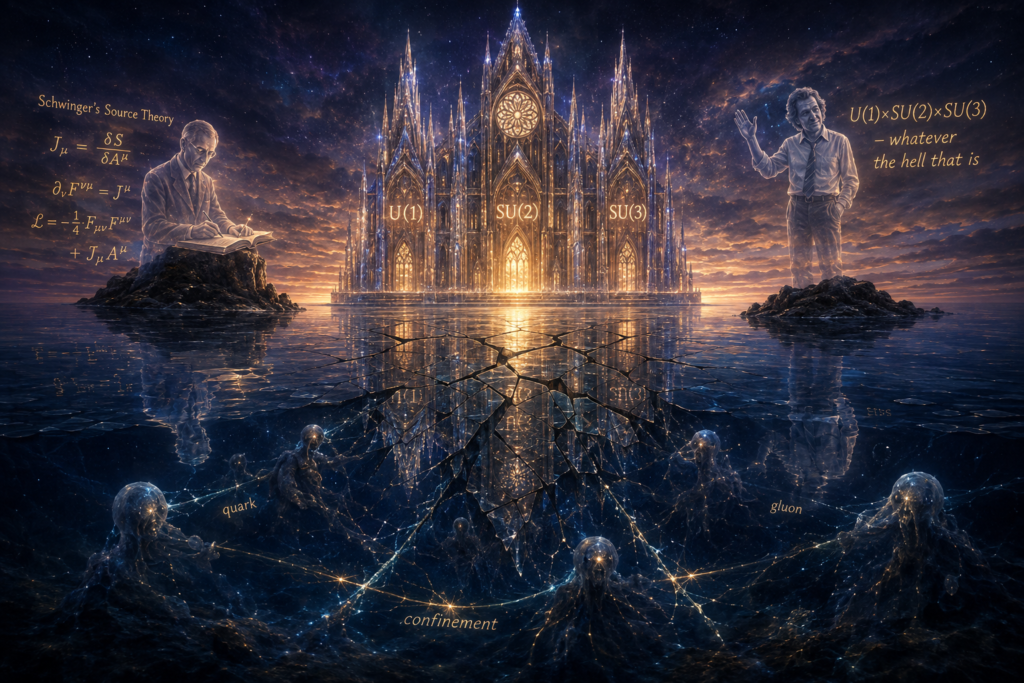
“U(1)×SU(2)×SU(3) – whatever the hell that is.”
What did Feynman object to? Several things.
The arbitrariness of the symmetry group. Why precisely U(1)×SU(2)×SU(3)? Why not SU(4) or Sp(6) or something entirely different? The choice was driven purely by phenomenology – it matched the data – but there existed no principle that singled it out. Feynman loved theories that were inevitable, that followed from deep logical constraints, not ones merely “fitted” to data.
The multitude of free parameters. The Standard Model has 19 (or more, depending on how one counts) free parameters – masses, coupling constants, mixing angles. Feynman considered this too many. A truly fundamental theory, he believed, ought to have few or no free parameters.
The problem of confinement was not solved. Although asymptotic freedom had been proved, no one had analytically demonstrated that SU(3) truly confines quarks. This remains a problem even today – we know confinement exists (from numerical lattice simulations), but we do not know why at a fundamental level. Feynman saw this as an intellectual hole, not a settled matter.
🏝️ Schwinger’s Critique – Deeper and More Principled
If Feynman was sceptical, Schwinger was openly hostile to QCD. His reasons were deeper and concerned the very philosophy of physics.
Fields are not fundamental – neither gluonic nor quark fields. Recall Schwinger’s Source theory: sources are fundamental, and fields are merely auxiliary mathematical constructs. From that perspective, QCD is yet another example of a mistaken focus on fields. Introducing eight gluon fields and three coloured quark fields is not an explanation – it is only shifting the problem to a more abstract level. Instead of asking “what are hadrons?”, we now ask “what are gluons and quarks?” – but that question remains unanswered because gluons and quarks have never been seen as free particles. For Schwinger, this was a sign that the theory had not gone deep enough.
Confinement is an ad hoc assumption, not a derived property. Schwinger did not deny that quarks are a useful concept. But he insisted that confinement had been introduced “by hand” – we believe quarks exist, but since we do not see them, we say they are “trapped”. For him, this was too convenient. A true theory, he believed, ought to derive the invisibility of quarks from first principles, not declare it an axiom.
SU(5) and grand unification – escape into even greater abstraction. In the 1970s, when Georgi and Glashow proposed SU(5) as the grand unified group (GUT), Schwinger was even more sceptical. SU(5) predicts new heavy bosons (X and Y bosons), proton decay, and the unification of coupling constants at enormous energies (~10¹⁵ GeV). For Schwinger, this was a step in the wrong direction: still more fields, still more symmetries, still less contact with experiment.
💎 The Phenomenological Approach and Chiral Dynamics
Schwinger held that the physics of the strong interactions must be strictly phenomenological and based exclusively on particles we actually detect in the laboratory. Using Source theory, he successfully described the chiral dynamics of pions and their interactions with nucleons. He demonstrated that important mathematical relations and hadron masses can be computed directly via the effective action of pions and nucleons, without any need to introduce quarks and gluons.
However, although Source theory was consistent and elegant, Schwinger remained alone in this approach. During the 1970s, the triumph of QCD came through the discovery of asymptotic freedom, and deep inelastic scattering experiments (which proved the existence of point-like constituents inside the proton) gave wind to the sails of the dominant community of physicists advocating QCD.
🌊 Schwinger’s Alternative: Sources Instead of Fields
Schwinger’s alternative was not “fix QCD” – it was a radically different starting point. If, instead of fields as fundamental entities, we take sources – real, measurable sources (hadrons, nuclei, currents) – and ask how they affect one another through the Dirac Sea, the whole picture changes.
In that picture:
- Gluons are not particles flying between quarks. They are correlations in the sea, excitations that arise in response to the presence of coloured sources. Their “confinement” is no mystery – they simply do not exist as free entities because they are bound to the sources that generate them.
- Quarks are not prisoners. What we detect are always “white” combinations – hadrons – which is a direct consequence of the structure of the sources, not an additional assumption.
- SU(3) symmetry is not fundamental. It is only a language for describing how sources behave. If mirror sources exist, they may have their own SU(3) symmetry. If we start from sources, then SU(3) is emergent.
⛪ Epilogue: The Cathedral and Its Shadows
Dear explorers, QCD is a triumph of the Standard Model. It is beautiful, precise, and experimentally confirmed in countless ways. But it is also a shadow hanging over the cathedral – a reminder that the cathedral, however magnificent, was still built by human hands.
Feynman and Schwinger, the two geniuses who built QED, disagreed in their approaches, but both were rebels against dogma. Feynman was a pragmatic sceptic – he did not reject QCD entirely, but he refused to accept it as the final truth. Schwinger was a principled revolutionary – he believed that the whole direction from Yang-Mills to GUT had missed the essence, because it had not returned to first principles.
Both, in one thing, were right: the Standard Model is not the end of the story. Its symmetries are beautiful, but they are not sacred. Its particles are useful concepts, but they need not be fundamental. And its success, paradoxically, becomes the greatest obstacle to progress – for who would dare to touch something that the great community of established physicists has been building for decades?
Our voyage continues. For as long as there are desert islands where exiles write their theories, and as long as there are mariners ready to visit them – truth, however unpleasant, cannot remain banished forever.
The sea is always clear. The horizon is always open. And the shadows in the cathedral – the shadows are what drive us to sail on. 🎨🧲🔬
This post continues the series begun with “⚛️ Quantum Archaeology: Reading the Past from the Dirac Sea”, continued through the map of the quantum odyssey and all our previous voyages, especially the previous post on Schwinger.
Leave a Reply