
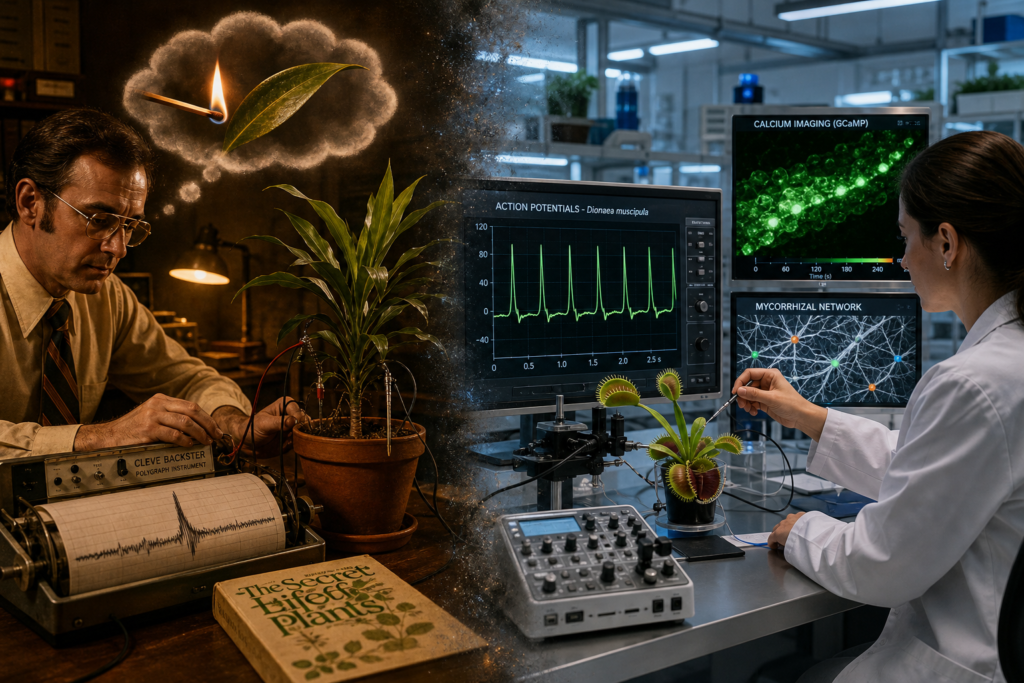
The book by Peter Tompkins and Christopher Bird (1973) popularised the idea that plants feel, communicate, and even “read minds.” Many experiments from the book, such as those by Cleve Backster with a polygraph, did not pass scientific verification. To remind you, Backster connected polygraph electrodes to the leaf of a Dracaena plant. When he thought about setting the leaf on fire, the device suddenly recorded a strong stress reaction. He concluded that plants feel human thoughts and intentions. Many of the experiments cited in the book were not well controlled, were not replicable, and confused causation with correlation. This led academic biology to place the entire field under an embargo.
Rejecting the book does not mean rejecting the phenomena. In the meantime, a serious scientific discipline has developed: plant electrophysiology and plant neurobiology (although the term “plant neurobiology” itself still meets resistance). Today we know that plants are not passive objects; they are active, sensitive, information-rich organisms.
⚡ Plants as Electrical Systems – Signals Without Nerves
Plants do not have neurons, but they do have action potentials – the same electrical impulses we measure in our nerves. The most famous example is the Venus flytrap (Dionaea muscipula):
- When an insect touches a hair on the leaf, a mechanically sensitive ion channel opens.
- Calcium ions enter the cell and generate a receptor potential.
- If a second touch occurs within ~20 seconds, an action potential is generated. The leaf closes in less than 100 milliseconds.
This is a real electrical logic circuit: the plant counts stimuli (two touches) and makes a decision to close the trap. This is a simple form of memory and information processing, without a single neuron.
Similar electrical signals exist in ordinary plants: Arabidopsis, mimosa, cucumber, tomato – all of them generate propagating waves of depolarisation when injured, when facing cold, drought or herbivores.
🌿 Plant Communication – Chemical Language and the “Wood Wide Web”
Plants communicate chemically, and in an exceptionally sophisticated way:
- Volatile organic compounds (VOCs): When a caterpillar attacks a leaf, the plant emits a specific cocktail of scents that warns neighbouring plants. Before the attack reaches them, they increase the production of toxins or defensive proteins.
- Mycorrhizal networks: These are underground systems in which fungi and plant roots connect for mutual benefit. Fungi give the plant water and nutrients from the soil, and the plant gives them food from the leaves. Through these networks, not only nutrients but also warning signals are transmitted (the so-called Wood Wide Web). The forest behaves like a distributed network, similar to a neural network without a central processor.
- Root-root signalling: Plants recognise relatives, compete for resources, and even change their growth strategy depending on whether they are surrounded by relatives or foreign species.
These are not “blind mechanisms” in the sense of simple reflexes; they are flexible, context-dependent responses that involve memory and learning. Famous experiments show that mimosa, after repeated harmless stimulations, habituates – it stops closing its leaves. If the stimulus changes, the response returns. This is an elementary form of learning, similar to that in animals.
🪤 Carnivorous Plants – Predators with Strategy
The Venus flytrap is only the most famous. We will mention a few more examples:
- Sundew (Drosera): Has sticky hairs that slowly curl around the prey, secreting enzymes and digesting trapped insects.
- Nepenthes (pitcher plants): An entire genus of plants with 90 species. They have slippery rims that use physical laws to draw prey in, after which they digest them with digestive fluid.
- Utricularia (bladderworts): A genus of aquatic plants with bladders that create a vacuum and suck in small organisms with incredible speed.
These plants do not hunt “blindly.” As we have already described with the Venus flytrap, they distinguish live prey from non-living matter: multiple touches are needed to close the trap, and then additional stimuli to trigger enzyme secretion. If the “prey” is a pebble or a raindrop, the trap does not activate (or opens quickly). This is sensory decision-making – information processing in the service of survival.
🧠 Is Consciousness Necessarily Neuronal?
Here we come to a deeper question. If we define consciousness as the ability for integrated information processing, response to the environment, memory, and decision-making, then plants meet some of these criteria – but in a fundamentally different way from animals.
There are several scientific and philosophical frameworks for studying consciousness:
- Reductionism: Consciousness is exclusively a product of complex neural networks. According to this view, plants, without a brain, cannot be conscious. But this position is increasingly difficult to defend under the weight of new findings.
- Panpsychism: Consciousness is a fundamental property of matter, present to varying degrees. Plants would have a rudimentary form of consciousness.
- Integrated Information Theory (IIT): Consciousness is a measure of integrated information in a system. According to this theory, both plants and fungal networks could have some degree of “proto-consciousness.”
- The Penrose-Hameroff Orch-OR theory, which we have covered in our posts about Dirac’s sea: Consciousness depends on quantum processes in microtubules. Since plant cells also have microtubules, they could, through the same mechanism, possess proto-conscious processes, although to a far lesser degree than animals.
In the context of quantum physics, plants are observers – systems that interact with their environment, measure it and respond to it. In relational quantum mechanics, every interaction is a “measurement.” Plants perform measurements of light, gravity, chemical gradients, touch. They are, in this sense, active participants in the weaving of relational reality, not passive objects.
🔬 Diagnostic Capabilities – What Tools Do We Have for Deeper Insights?
After the writing of the book “The Secret Life of Plants,” many advanced techniques have emerged that give us the ability to delve deeper into the world of plants while meeting strict scientific criteria. We will list the most used ones:
- Plant electrophysiology: microelectrodes, microelectrode arrays (MEA), surface sensors – measuring action potentials, ion gradients, wave propagation.
- Calcium imaging: genetically encoded calcium sensors (GCaMP) enable visualisation of calcium ion movement within living plant tissue cells in real time.
- Gas chromatography-mass spectrometry (GC-MS): enables analysis of volatile chemical signals, the “chemical language” of plants.
- Mycorrhizal network analysis: mapping carbon and signal flows through fungal and plant root networks using radioisotopes and fluorescent markers.
- Wearable electronics for plants: flexible sensors, “plant fitness trackers” that monitor electrical activity, transpiration and stress.
All of this is legitimate scientific methodology, far more scientifically recognised than Kirlian photography and polygraphs, but open to phenomena that older biology ignored. This has driven the rapid development of quantum biology. Particularly significant is research into the role of quantum coherence in photosynthesis as an explanation for the high degree of energy efficiency of this key process for converting sunlight into energy, which eluded classical biology.
🌱 Conclusion – Openness Without Dogmatism
We can approach this issue as true researchers, without prejudice or preconceptions. We do not have to a priori choose between “plants are automata” and “plants are thinking beings like us.” It asks us to expand our framework of understanding – to acknowledge that consciousness may be a continuum, not a binary category.
Plants do not need to have human-like consciousness to be sensitive, intelligent, communicative and adaptable. Their intelligence is distributed, slow, chemical-electrical – but it is real.
From the standpoint of understanding life through information theory – where patterns of information and energy flow are tracked – plants are complex information systems with the capacity for self-organisation, which measure their environment and respond to it. Their consciousness, if it exists, is not neuronal; it is ecological, relational, rooted in the weaving of life.
When many experimental data points accumulate, we cannot turn our heads away. We can be critical of bad experiments, but we must remain open to the possibility that the world of plants is far more wondrous than the reductionist paradigm allowed us to believe.
Leave a Reply