
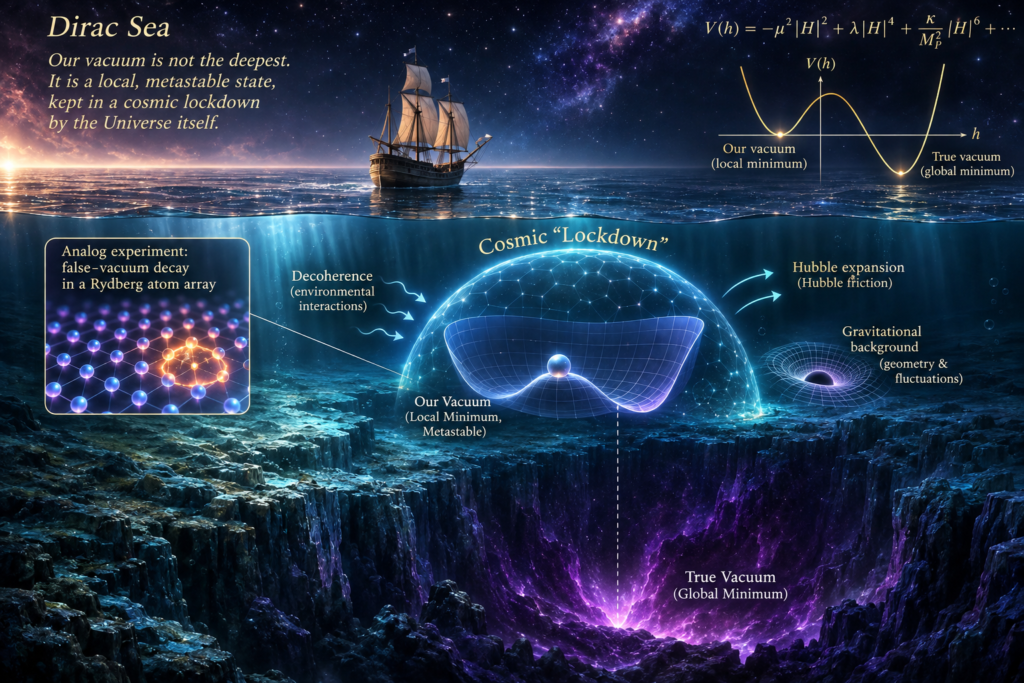
In quantum field theory, the vacuum is not emptiness. It is the ground state, the lowest-energy state of a field. But the energy landscape does not have to contain only one bottom. There may be a local minimum in which a field remains for an extremely long time, even though somewhere in a “deeper valley” an even lower-energy state exists.
Such a state is called a false vacuum.
The term is slightly misleading, because there is nothing “false” about it. It is a real, metastable state that can be extraordinarily long-lived. The problem arises only if there is a quantum possibility for the field to leave that local minimum through tunneling and transition into a deeper, more stable state — the true vacuum.
In the most dramatic popular version of this story, a microscopic bubble of true vacuum could form somewhere in the Universe. If it reached a critical size at which further expansion became energetically more favorable than contraction, it would begin to grow, changing the state of the field throughout space. In such a scenario, what we call the laws of physics, particle masses, and the stability of matter would no longer necessarily remain the same.
In other words, there would not be much time left to philosophize about what had happened.
We have already discussed the possibility of a metastable Higgs vacuum, the energy landscape of quantum fields, and the “fissure” that might exist beneath our present vacuum state in an earlier part of the Dirac Sea series: The Chasm at the Bottom of the Sea: Landau, Higgs, and the Metastability of the Dirac Sea
This time, we will not repeat the same question. We are interested in something else:
If such a fissure exists, what in the real Universe prevents it from opening?
A Local Minimum Is Not the Same as Instability
Imagine an energy landscape with two valleys. One is shallower, the other deeper. Classically, a ball resting at the bottom of the shallower valley will not cross the hill that separates them by itself. In quantum physics, however, there is a finite amplitude for the system to end up on the other side of the barrier by tunneling.
This is where the idea of false-vacuum decay begins.
In quantum field theory, the transition does not have to occur everywhere in space at the same time. Instead, a localized region may form — a bubble of true vacuum. If such a bubble is too small, the energy concentrated in the wall separating the two phases makes the configuration unstable and the bubble collapses. If it exceeds a critical size, the reduction of energy in its interior can outweigh the energy of the wall, and expansion becomes more favorable than contraction.
This is an elegant theoretical picture, developed in the work of Sidney Coleman and later extended to include gravity.
But one major question remains:
How isolated is a real quantum system, really?
Tunneling Likes Isolation
A quantum system preserves superposition best when it is isolated from its environment. As soon as it begins to exchange information with external degrees of freedom, the phase relations between different quantum possibilities begin to disappear.
This is what we call decoherence.
In laboratory quantum systems, decoherence is one of the greatest enemies of quantum computing. If we want a qubit to remain in a coherent superposition, we must protect it from thermal vibrations, electromagnetic noise, collisions with atoms, and practically everything that might “learn” which state the system is in.
But a cosmological field is not a qubit sealed inside a carefully isolated chamber.
It exists in a Universe full of other fields, particles, fluctuations, gravity, and the constant dynamics of spacetime.
And this is where the new story begins.
Cosmic “Lockdown”
A 2026 paper titled Cosmic lockdown: when decoherence saves the universe from tunneling, by Robson Christie, Jaewoo Joo, Greg Kaplanek, Vincent Vennin, and David Wands, investigates what happens when a quantum field in a cosmological setting is not ideally isolated, but coupled to an environment.
The authors analyze a scalar field in a potential with two minima during an inflationary phase of the Universe and include external degrees of freedom that produce decoherence. The result is highly interesting: once the system decoheres sufficiently, tunneling between vacuum states can be strongly suppressed.
The system then remains, figuratively speaking, “locked” in the local minimum it has selected.
The authors connect this effect with the quantum Zeno effect. In its standard quantum-mechanical form, sufficiently frequent measurements can strongly slow the evolution of a system away from its initial state. Here, of course, there is no laboratory experimenter repeatedly performing measurements. The environment itself takes on the role of a constant observer, because interactions with external degrees of freedom continuously carry away information about the state of the system.
The more information about the system leaks into the environment, the harder it becomes to maintain coherence between the quantum alternatives involved in the transition.
That is the basic idea behind cosmic “lockdown.”
Decoherence Is Not a Magical Shield
Here we have to be careful.
This result does not mean that we have proved that a false vacuum cannot decay. The study uses a specific cosmological model, a particular structure of the potential, and a definite form of coupling between the system and its environment.
Even more interestingly, the behavior also depends on the characteristic mass of the field relative to the Hubble scale. In some regimes, decoherence can significantly increase the probability that the system remains in a metastable state, while in other regimes the behavior can be different.
So the message is not that decoherence saves every possible Universe.
A more precise statement is that vacuum decay does not depend only on the shape of the potential, but also on how open the quantum field is as a system and how it interacts with its environment.
That is an important shift in perspective.
A False Vacuum in the Laboratory
Of course, we cannot create a cosmological vacuum in the laboratory and wait to see whether our Universe collapses. But we can create quantum systems with related mathematical structures.
In recent years, this is precisely what experiments with ultracold atoms, superfluids, Rydberg arrays, and quantum simulators have been doing. In such systems, it is possible to prepare a metastable state that plays the role of a false vacuum and then observe how regions of a more stable state emerge — analogues of true-vacuum bubbles.
Experiments with coherently coupled atomic systems have shown that the nucleation and evolution of such bubbles can be observed under controlled conditions. Even more intriguing results have been obtained in Rydberg systems, where the initial metastable state can be prepared with great precision and its quantum dynamics followed in detail.
One particularly important result is that even relatively small deviations from an ideally prepared initial state can strongly change both the rate and the character of decay.
That is an important lesson for the cosmological analogy. A real quantum system does not know our idealized sketch of a potential drawn on a blackboard. It knows its initial conditions, its coupling to the environment, fluctuations, inhomogeneities, and the way in which it was prepared.
The Bubble That Changes Everything
In a classical phase transition, a region of the more stable phase can form through thermal fluctuations or local inhomogeneities. In quantum-vacuum decay, we speak of quantum nucleation, but the basic competition between two tendencies is similar.
The interior of a true-vacuum bubble is in a lower-energy state than the surrounding false vacuum, so increasing its volume lowers the total energy of the system. By contrast, the boundary between the two phases — the bubble wall — contains additional energy and therefore favors contraction. For small bubbles, the wall energy dominates and they disappear; once a critical size is reached, the contribution from the interior becomes dominant and expansion can become self-sustaining.
For a cosmological vacuum, the consequences of such a transition would be more fundamental than those of an ordinary phase transition between two forms of matter. A change in a field’s vacuum expectation value could alter particle masses, the structure of interactions, and the stability of the forms of matter we know.
That is why the metaphor of a “fissure at the bottom of the Dirac Sea” is not merely a literary ornament. If a sufficiently large region of deeper vacuum opened, the physical “sea” on the other side of that boundary would no longer be the same.
Higgs: We Already Know the Fissure — Now We Ask What Keeps It Closed
In the previous article, The Chasm at the Bottom of the Sea, we examined the Higgs vacuum in more detail, its possible metastability, and the fact that quantum corrections at very high energies can change the shape of the effective Higgs potential.
There, the central question was:
Does an even deeper minimum exist below our present vacuum?
Here we are interested in the next step.
Even if we assume that our Higgs vacuum is metastable, it does not follow that a transition into a deeper state will occur easily or soon. Standard estimates of the lifetime of such a vacuum are already vastly longer than the current age of the Universe. But new questions about decoherence suggest that the potential itself may not contain enough information for a complete understanding of the decay dynamics.
Previously, therefore, we were studying the geography of the bottom of the Dirac Sea.
Now we are studying the dynamics of the fissure.
What matters is no longer only how deep the second minimum lies or how high the potential barrier is between it and our present vacuum. It also matters whether a real quantum field, immersed in the rest of the Universe, can preserve the quantum coherence required for the transition to develop in the way predicted by an idealized isolated model.
So the same topic returns at a higher level: we are not changing the question of Higgs-vacuum metastability, but adding the physics of an open quantum system.
Hubble Friction: Expansion That Slows the Rolling
There is another important element in cosmology — the expansion of the Universe itself.
The equation of motion for a homogeneous scalar field in an expanding spacetime contains a term that behaves like friction. It is commonly called Hubble friction.
This is not friction in the classical sense. There are no molecules slowing the field down. The expansion of space, however, damps the time evolution of the field and can slow its motion across the potential. During inflation, precisely this type of dynamics is one of the key ingredients behind the slow evolution of the inflaton field.
It is therefore intuitively appealing to say that cosmic expansion can help keep a field in a certain region of its potential. Still, two processes must be distinguished here. Hubble friction directly affects the classical evolution of the field, whereas vacuum tunneling is a quantum, nonperturbative process. The expansion of spacetime also affects quantum fluctuations and nucleation itself, but its influence cannot be reduced to a simple classical brake that “prevents” tunneling.
The cosmos is a more complicated regulator than that.
Gravity Can Protect — but It Can Also Catalyze
If we have so far gained the impression that the environment and gravity only stabilize the false vacuum, another complication must be added immediately.
In some regimes, gravity can modify the rate of vacuum decay in ways that are not stabilizing. Inhomogeneities, spacetime curvature, and compact objects can alter the conditions for nucleation.
Theoretical models have long considered the possibility that black holes may act as catalysts for vacuum decay, because strong spacetime curvature changes the dynamics of forming a critical bubble.
There is therefore no simple equation:
gravity = stability.
The same gravitational sector that may contribute to stabilization in one regime can, in another, change the probability of transition in the opposite direction.
This brings us to perhaps the most important lesson of the entire subject:
vacuum stability is not merely a property of the vacuum potential. It also depends on the vacuum in its cosmological environment.
The Quantum Zeno Effect on a Cosmic Scale
Here we can return to the idea of cosmic “lockdown.”
The quantum Zeno effect is interesting precisely because it violates our everyday intuition about observation. In the macroscopic world, observing a process does not prevent it from happening. In a quantum system, however, frequent interactions that carry information about the system’s state can change its dynamics.
If the vacuum field is not isolated but continuously leaves traces in other degrees of freedom, decoherence can suppress coherent quantum processes that, in an isolated system, would allow a different transition dynamics.
On a macroscopic scale, this sounds almost like cosmic irony:
the complexity of the Universe itself may contribute to its stability.
Particles, fields, gravity, and the expansion of spacetime are not merely the content of the Universe placed “above” the vacuum. They may be part of the environment that determines how the vacuum state evolves quantum mechanically.
Can Analog Experiments Tell Us What the Universe Will Do?
Here, scientific discipline is essential.
When we observe false-vacuum decay in a superfluid, a Rydberg system, or another quantum simulator, we are not observing the Higgs field.
We are not building a miniature Universe, nor are we directly measuring the probability of its end.
What we are testing is the mathematical and dynamical structure of the problem: metastability, tunneling, bubble nucleation, critical configurations, and many-body evolution.
This is one of the great strengths of modern experimental physics. A phenomenon we cannot control on a cosmological scale can be mapped onto a system whose dynamics we can follow in the laboratory.
The experiment therefore does not tell us:
“This is how the Universe will end.”
It tells us something much more useful:
“This is how this type of quantum dynamics behaves when we are able to control and observe it.”
Theory must then determine very carefully how far those lessons can be transferred to cosmology.
The False Vacuum May Not Be So Lonely
The classical picture of vacuum tunneling almost encourages us to imagine a field alone in its potential.
But the real Universe is not like that.
Every field is part of a larger structure. There are other fields, fluctuations, particles, spacetime curvature, thermal history, and cosmic expansion.
In other words, the vacuum is not an isolated ball sitting in a double well.
It is part of an open quantum system embedded in the entire Universe.
If this perspective turns out to be fundamentally important, the question will no longer be only:
“How high is the barrier between the false and true vacuum?”
We will also have to ask:
“How much quantum coherence does the environment allow the field to preserve for the transition to occur?”
That is a different and perhaps deeper question.
The Dirac Sea Is Restless
In our earlier voyages across the Dirac Sea, we often used it as a metaphor for the quantum vacuum — not as emptiness, but as a deep physical structure from which particles, fluctuations, and the entire visible world can emerge.
Now we can add another detail to that picture.
The bottom of the sea may not be the absolute bottom. We may be sitting in one deep depression while, somewhere in the mathematical landscape, an even lower state exists.
But the sea is not calm.
It is full of waves, particles, fields, gravitational disturbances, and constant interactions. That very restlessness may, in some regimes, not increase the probability of transition, but do the opposite — destroy the quantum coherence required for it.
The bottom of the Dirac Sea is still quiet, and the Universe still exists. Perhaps the reason is that the Dirac Sea is constantly foaming and restless. In the language of quantum theory, decoherence at the macroscopic level is continuous. And yet, perhaps one bubble could still change everything.
Leave a Reply