
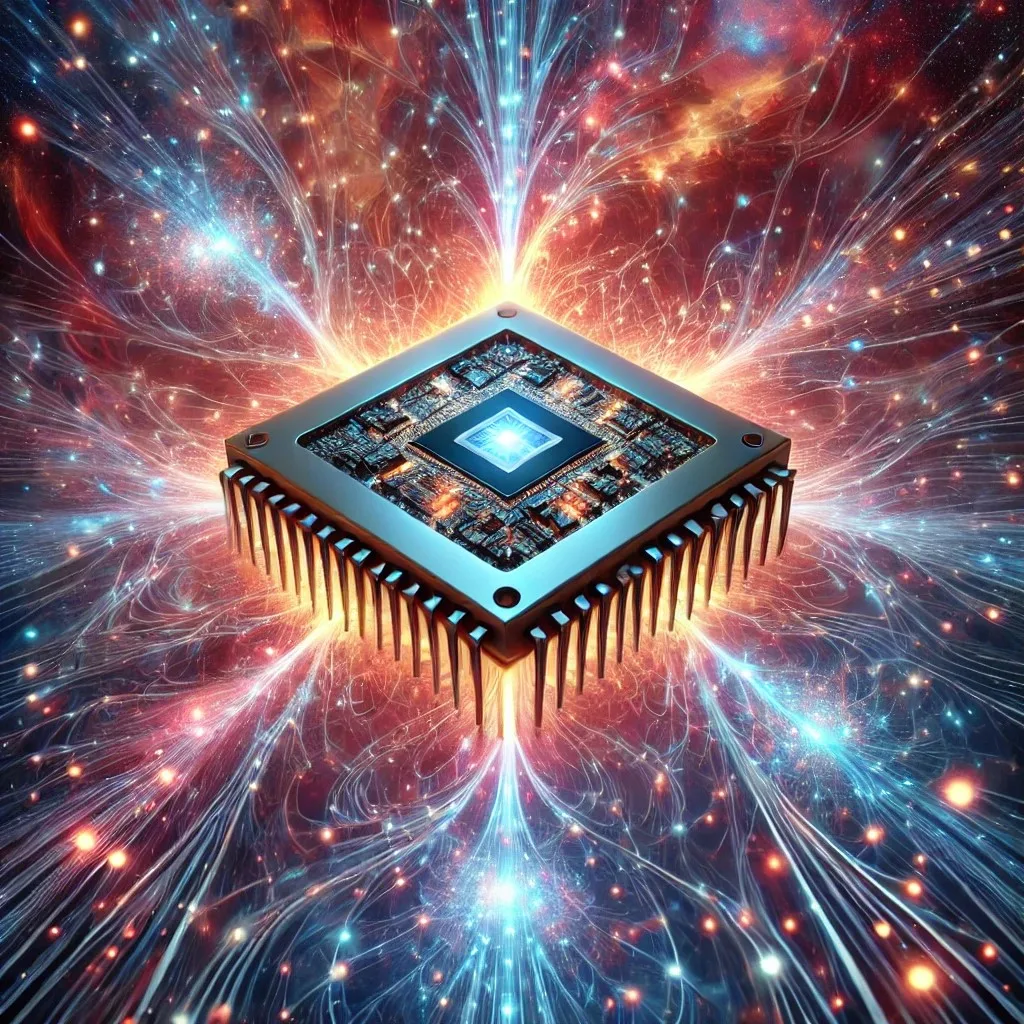
In a groundbreaking announcement, Google has unveiled its latest and most powerful quantum computing chip, dubbed Willow. While the remarkable speed and reliability of this chip have captured the tech world’s attention, an extraordinary claim from Hartmut Neven, the head of Google Quantum AI, has stirred significant debate. Neven speculated that Willow’s unprecedented performance might involve computational borrowing from parallel universes, reigniting discussions about the multiverse and its connection to quantum mechanics.
Quantum Mechanics and Parallel Universes
Quantum physics has long flirted with the idea of parallel universes, a concept popularized by the Many-Worlds Interpretation of quantum mechanics. According to this theory, every quantum decision leads to the creation of new, parallel realities. While these ideas remain speculative, Neven’s claim has brought renewed attention to the intersection of quantum computing and the multiverse. MilovanInnovation has previously elaborated on this theory in its earlier post, delving into its implications for science, spirituality, and philosophy.
Critics have been quick to point out the lack of direct scientific evidence supporting such a hypothesis. Nonetheless, others have found Neven’s statement intriguing, viewing it as a potential spark for deeper exploration into the philosophical and scientific implications of quantum phenomena.
What Sets Willow Apart?
The Willow chip represents a significant leap in quantum computing. Unlike classical computers that rely on binary bits (0 or 1), quantum computers use qubits, which can exist in multiple states simultaneously thanks to quantum superposition. Furthermore, qubits exploit entanglement—a phenomenon where particles remain interconnected regardless of distance—to perform complex calculations far beyond the reach of classical systems.
One of Willow’s most notable advancements is its ability to minimize errors in quantum calculations. Previous quantum chips have struggled with instability, as the accumulation of errors increases with the number of qubits in operation. Google claims that Willow’s architecture addresses these challenges, bringing quantum systems closer to practical application. If true, this advancement could make quantum computing a feasible tool for solving previously intractable problems.
Neven says quantum technology will be “indispensable” for collecting AI training data, eventually helping to “discover new medicines, designing more efficient batteries for electric cars, and accelerating progress in fusion and new energy alternatives.” Google claims these advancements bring quantum computing closer to practical use.
Skepticism and Scrutiny
Despite Willow’s promise, skepticism remains regarding Google’s performance claims. Critics highlight that the benchmarks used to evaluate the chip’s capabilities were developed internally by Google, raising questions about their objectivity. The hypothesis that Willow draws computational power from parallel universes has also been met with considerable doubt, given its speculative nature and lack of empirical support.
The Potential of Quantum Computing
Regardless of the controversies, Willow’s advancements underscore the transformative potential of quantum computing. With improved reliability and error correction, quantum computers could revolutionize industries such as medicine, logistics, climate modeling, and artificial intelligence. Problems considered unsolvable today—from discovering new drugs to optimizing global supply chains—could become manageable with quantum solutions.
However, the journey to fully operational and stable quantum computers is far from over. While Willow is a significant step forward, the field faces numerous technical and theoretical challenges. The idea of tapping into parallel universes for computational power might remain in the realm of fantasy for now, but the implications of quantum computing are already reshaping our understanding of technology and reality.
Conclusion
Google’s Willow chip marks an exciting milestone in the evolution of quantum computing. Whether or not it taps into parallel universes, its breakthroughs in speed and reliability push the boundaries of what’s possible. As the technology matures, it holds the potential to address some of humanity’s most pressing challenges and even alter our perception of existence itself. MilovanInnovation will continue to explore the latest developments in quantum computing and their broader implications for science, technology, and society.
Leave a Reply