How did a 16th-century doctor survive the Inquisition, and what does his case tell us about the link between the heavens, fate, and science? 🔮📜⚖️
At a time when science was still in its infancy and the Inquisition was in full force, Michel de Nostredame – Nostradamus – walked a fine line between genius and heresy. He was a man deeply marked by personal tragedy – the loss of his first wife and two children to the plague – which convinced him of the shortcomings of contemporary medicine and spurred him to seek different paths of healing and understanding the world.
His historical image, however, is flooded with later interpretations, pseudo-history, and cults of personality. Where does the man from the archives end, and the projection of our desire for predictability begin?
The Faces of One Man: Tragedy, Knowledge, and Survival
A Physician Forged by Tragedy: Nostradamus’s personal pain became the driving force of his professional work. When the plague struck Provence again, he did not flee. He treated the sick, replacing common practices like bloodletting with a new approach: he emphasized hygiene, fresh air, herbal remedies, and strengthening natural resistance. He was a practitioner who looked directly into the eyes of the disease that had taken his family.
Astrologer and Cipher Master: To publish his observations and “prophecies,” Nostradamus used quatrains – four-line verses written in an intentionally obscure, metaphorical language, a mix of tongues and allusions. This was not merely poetic refinement; it was necessary protection. In an era when the Inquisition mercilessly punished “sorcery” and heresy, coded language was his shield.
Cultural Icon and the Forer Effect: After his death, every major historical event – from the French Revolution to 9/11 – was “found” in his verses. This phenomenon lies in the Forer effect, the human psychological tendency to recognize specific and personal truths in vague, universal descriptions. This is how the legend was fed and grew.
Celestial Mechanics and Earthly Questions: From Astrology to Astronomy
Nostradamus worked within a tradition that considered celestial movements the language of the divine. Today we know that the position of celestial bodies does not determine personal destiny, but their cyclical nature undeniably influences life on Earth in a profound way.
Milankovitch cycles (changes in Earth’s orbit and axial tilt) directly determine long-term climatic cycles and ice ages, showing how cosmic mechanics shape our planet.
Conjunctions, oppositions, and eclipses demonstrate a mathematical regularity that enabled the development of celestial mechanics.
The question remains: is this cosmic rhythm merely a physical backdrop, or is it part of a broader pattern reflected in human history? Science still has no definitive answer, but the very fact that we ask it connects the inquiring mind of the Renaissance astrologer with the modern scientist.
Mirrors of Time: From Nostradamus to Kozyrev
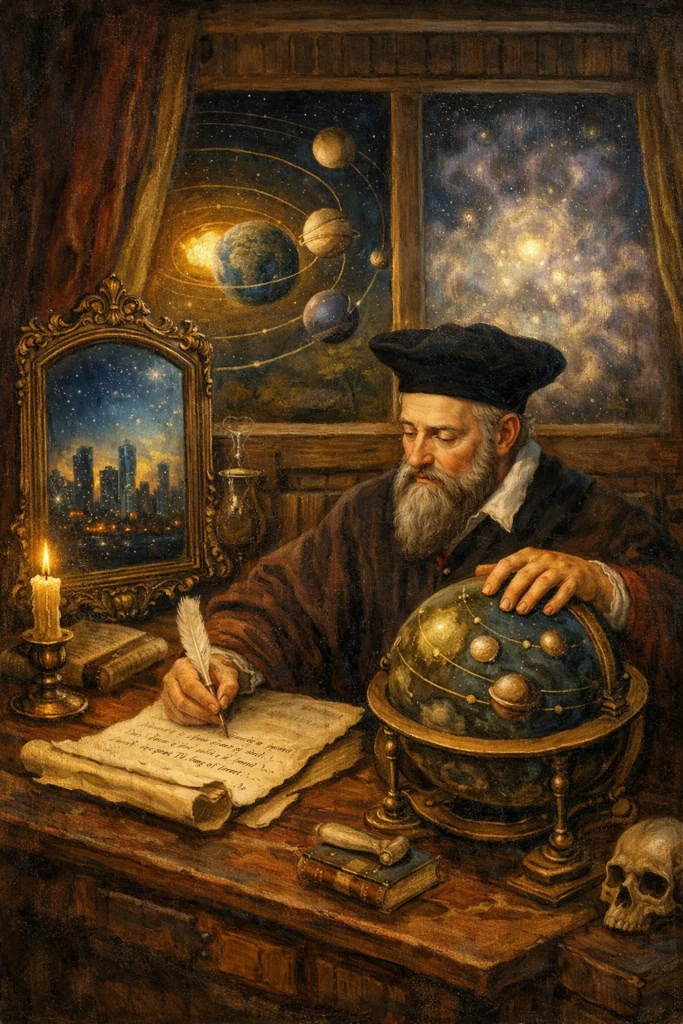
One of the most persistent legends speaks of Nostradamus’s “seeing mirrors” – devices made of polished bronze or other materials with which he allegedly gazed into the future. This story so fascinated the Soviet astrophysicist Nikolai Kozyrev (1908–1983) that he attempted to investigate it on a scientific basis.
Kozyrev developed a controversial theory that time is not merely an abstract concept, but a physical substance with properties such as density, flow rate, and quality. He believed that with the help of specially shaped convex mirrors, this “energy of time” or flows of causality could be concentrated, enabling the observation of distant events in space and time. Although his work remains outside the scientific mainstream, it represents an interesting bridge between ancient legend and modern scientific speculation.
The Core Question: Is the Future Already Written? Determinism vs. Freedom
At the foundation of the desire for prophecy lies a scientific and philosophical question of epochal importance.
Strict determinism (dominant in classical physics) claims that the future is predetermined by the state of the universe. If we knew all parameters, we could calculate it. In that world, Nostradamus would merely be a man who managed to “read” an already written book.
Modern physics (quantum mechanics, chaos theory) introduces fundamental indeterminacy. The future is not a written book, but an open field of possibilities. Our choices, like quantum fluctuations, carry real weight.
If the future is an open field of possibilities – then our endeavors, efforts, and struggles are not an illusion. They are what give meaning and shape to tomorrow. This is perhaps the deepest message of Nostradamus’s story: it doesn’t matter whether he accurately foresaw the Great Fire of London; what matters is that, faced with the terrible uncertainty of life and death, he continued to search for order, meaning, and the possibility of helping others.
Conclusion: A Cipher in Search of Humanity
Nostradamus was not a prophet in an apocalyptic sense. He was a product of the Renaissance mind – a mind that, having lost everything, tried to reconcile rational medicine with astrological tradition, to protect himself with ciphers from authority, and in celestial cycles to find meaning for human fragility.
His true value lies not in accurate dates, but in how he confronts us with eternal questions: How much are we determined by the cosmos? How free are we? And is the yearning to understand what is to come – even in ciphers and metaphors – precisely what makes us human?
Question for you: Was Nostradamus an early scientist who used astrology as a language or a master of ambiguity whose reputation was created posthumously? Is the desire for prediction a sign of fear of uncertainty or a quest for a deeper order?
Leave a Reply