Introduction: The Problem with Disappearing 🔥
Imagine throwing a family photo album into a fire. The paper burns, the images vanish, the smoke rises into the sky. The information about your memories – irretrievably lost.
Now imagine that same album, but instead of fire – a black hole.
For a hundred years, physics told us that the fate of information in a black hole is the same as in that fire. In 1974, Stephen Hawking calculated that black holes aren’t eternal – they evaporate, radiate, shrink, and eventually disappear. And with them, everything that ever fell in disappears too.
The problem? The law of conservation of information in quantum mechanics states that information cannot simply vanish. Just as a torn piece of paper can (at least theoretically) be reassembled, the quantum state of a particle must remain preserved somewhere – even after it crosses the event horizon.
Hawking argued for years that information is lost. Most physicists were horrified. If Hawking was right, quantum mechanics was in serious trouble.
And then Leonard Susskind stepped into the ring. 🥊
Bekenstein’s Bound: When Size Ceases to Matter 📐
To understand Susskind’s idea, we need to go back a few years.
In the 1970s, Jacob Bekenstein asked a seemingly simple question: How much information can fit into one cubic centimeter of space?
Intuitively, the answer is: Infinite. Divide space into smaller and smaller cubes, put one bit in each – can this iteration continue indefinitely?
Bekenstein discovered something strange. When you add too much energy (and therefore too much information) to a system, space collapses into a black hole. And a black hole, it turns out, has a rule: its entropy – meaning the amount of information it can store – is not proportional to its volume, but to the surface area of its horizon.
Mathematically: S = A/4 (in Planck units).
Translated into understandable language: A 1cm³ black hole cannot store as much as you might expect – only as much as fits on its two-dimensional skin. As if the interior is literally hollow. 🎭
Susskind’s Leap of Faith: What If It’s Not Just Black Holes? 🤯
In 1994, Susskind added two and two.
If a black hole – the densest possible storage unit in the universe – can only store as many bits as fit on its surface (not its volume), perhaps this is a universal law of nature.
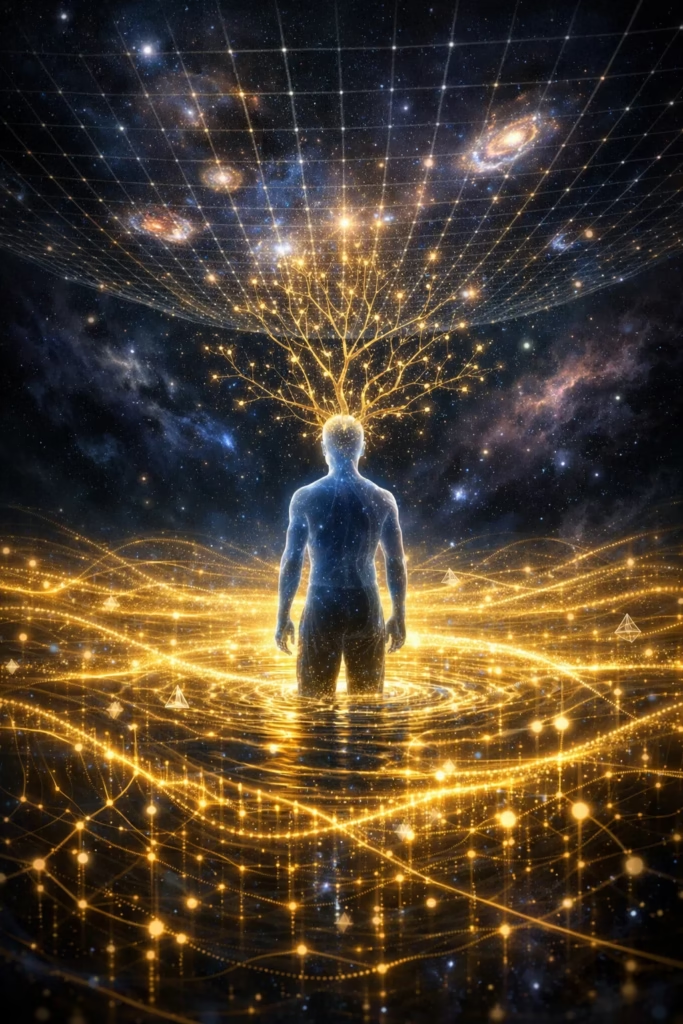
Perhaps our entire three-dimensional world is nothing more than a holographic projection of information inscribed on some distant, two-dimensional surface.
This wasn’t poetic imagery. Susskind meant it literally: Volume is an illusion. Space is an illusion. The depth we see around us – just an interpretation of data encoded on the boundary of the cosmos.
Gerard ‘t Hooft independently arrived at a similar idea. Susskind integrated it into string theory and gave it a name: the Holographic Principle.
Alice and Bob: The Thought Experiment That Changes Everything 👩🚀👨🚀
Now we come to the most beautiful part.
Imagine Alice, an astronaut free-falling toward a black hole. She carries a quantum bit – a single piece of information, say “I love you” meant for Bob.
Bob hovers far from the horizon, at a safe distance, watching Alice through a telescope.
According to Einstein’s general theory of relativity:
- Alice crosses the horizon without any dramatic event. For her, time flows normally. At one moment, she’s no longer connected to the outside world – she’s sucked in.
- Bob sees something entirely different. Due to time dilation caused by strong gravity as described by General Relativity, Alice appears to him slower and slower. Her clock ticks ever more slowly. Her fall decelerates. She turns, smiles at him, and waves – and freezes at the horizon. If Bob waits long enough, he will see her farewell smile forever.
Two observers. Two completely different truths.
Who is right? Both. And that’s the point.
Black Hole Complementarity: Like Wave and Particle ⚛️
Susskind, together with Lárus Thorlacius and others, introduced the principle of black hole complementarity.
It echoes quantum mechanics: an electron is both a wave and a particle, depending on how you measure it. You can’t say it’s “really” one or the other – both descriptions are correct, but they never appear simultaneously.
The same applies to Alice:
- From Alice’s perspective: She crossed the horizon, continued her journey, and eventually combined her quantum bit with the Hawking radiation that Bob later collected.
- From Bob’s perspective: Alice never crossed the horizon. Her quantum bit is imprinted onto the particles the black hole radiates. Bob can collect those particles and reconstruct the message.
The problem: If Bob reconstructs Alice’s bit from Hawking radiation and then jumps into the black hole to meet Alice, who personally hands him the same bit – this would result in quantum information cloning, which quantum mechanics forbids.
The solution? Time. For Bob to collect enough Hawking photons to reconstruct the message, he needs an enormous amount of time – on the order of M³ (in Planck units). By that time, the black hole has long evaporated, or Bob has hit the singularity and vanished.
In other words: You can never perform both measurements. Nature has arranged things so that the two pictures never meet.
A More Radical Susskind: What If the Interior Doesn’t Exist? 🚫🕳️
But here’s what’s fascinating – and where Susskind goes further than classical complementarity.
If all the information about Alice, her smile, her message, and every particle that ever fell into the black hole – peacefully resides on the horizon, imprinted on a two-dimensional layer of Planck thickness…
… then why have an interior at all?
Perhaps the interior of a black hole does not exist as a physical object. Perhaps it’s just an illusion, a projection, an interpretation that the brain (or mathematical apparatus) constructs from information available at the boundary.
Susskind puts it this way:
“The three-dimensional world of everyday experience – the universe full of galaxies, stars, planets, houses, rocks, and people – is a hologram, an image of reality encoded on a distant, two-dimensional surface.”
Translated: You, reading this text, physically exist both as a 3D person and as 2D code on the boundary of the cosmos. Both versions are equally real. One is not an “illusion” and the other “truth.” They are two complementary representations of the same reality.
Maldacena’s Confirmation: The AdS/CFT Bridge 🌉
In 1998, Juan Maldacena gave Susskind’s intuition mathematical foundation through the AdS/CFT correspondence.
He showed that one theory of gravity in five-dimensional space can be completely described by a quantum field theory on the four-dimensional boundary of that space – without a single extra degree of freedom.
Every calculation on one side perfectly matches a calculation on the other. Two theories, two languages, one ontology.
This isn’t proof that our universe is a hologram – but it’s proof that one mathematically consistent universe can be. And if it’s possible in one, why not in another?
Conclusion: The Boundaries of Reality 🧠
The holographic principle confronts us with a question once reserved for philosophers:
What is actually “real”?
Is it what we perceive with our senses? What we measure with instruments? What’s written in mathematical equations?
Susskind’s answer is unexpectedly practical:
“The question isn’t what’s really out there. The question is which language best serves you to describe what you see.”
For Bob, the language of the horizon and imprinted information is correct. For Alice, the language of free fall and interior is correct. Both are true. Both are necessary. Neither is final.
And perhaps that’s the greatest lesson of the holographic principle: reality isn’t what we think it is – but it’s also not what we fear it might be. It’s simply what it is, and our job is to find the language that describes it most faithfully.
Leave a Reply