
How we traveled from error correction to quantum consciousness through seven posts, and what lies around the corner 🧠⚛️🔮
This is the eighth and final part of our series on quantum computers.
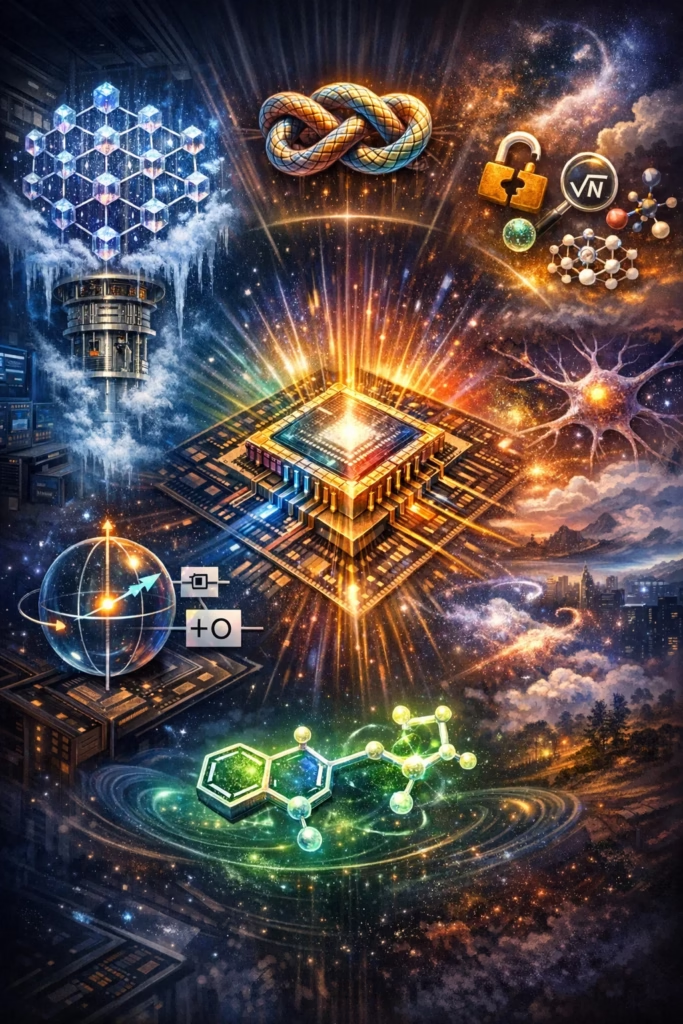
In the previous seven posts we traveled a long road: from error correction through physical implementations (superconductivity, ions, topological qubits) and logic gates, through quantum consciousness (Orch OR) to algorithms and practical applications.
Now, at the end of this journey, we look back to connect all the pieces into one whole – and to look forward. Where are we today? What lies around the corner? And will quantum computing truly change the world – or remain another fascinating but distant technology?
Brief Summary of the Series: Seven Steps into the Quantum World
Part 1: Error Correction – BB Codes
We started at the foundation: without error correction there is no scalable quantum computer. BB codes (bivariate bicycle codes) showed that we can achieve 10 times greater efficiency than the surface code, reducing the hardware overhead from hundreds to tens of physical qubits per logical qubit. Key takeaway: clever coding can compensate for imperfect hardware.
Part 2: Physical Implementation – Colder Than Space
We descended into reality: quantum computers operate at 10–100 millikelvin, colder than any natural place in the universe. Dilution refrigerators cost millions, consume as much electricity as 4–8 households, while the actual quantum chip is the size of a postage stamp. Conclusion: quantum computing is an expensive sport, but the cost is slowly decreasing.
Part 3: Topological Qubits – Majorana’s Dream
We met Ettore Majorana, the genius who mysteriously disappeared in 1938. His equations now live in topological qubits – quasiparticles that are their own antiparticles. Microsoft’s Majorana 1 chip with 8 qubits is the first step toward qubits that are inherently error‑resistant. Conclusion: topology may be the key to scalability.
Part 4: Trapped Ions – Laser Harps
Trapped ions are the oldest and most stable quantum technology. Held in electric fields, cooled by lasers, they levitate in vacuum and achieve coherence times of several minutes – far longer than superconducting qubits. Their drawback: slowness and scaling complexity. Conclusion: ion qubits are ideal for quantum memories and networks.
Part 5: Logic Gates – From NAND to Rotations
We explained the fundamental difference: classical gates are irreversible (they lose information), quantum gates are reversible and act as rotations of the state vector. Instead of NAND we have X, Hadamard, CNOT. Conclusion: quantum gates are not just faster – they are fundamentally different in nature.
Part 6: Is the Brain a Quantum Computer? – Orch OR
We ventured into the most controversial topic: Penrose’s Orch OR theory. Microtubules in our neurons may sustain quantum coherence at room temperature, and wavefunction collapse may create moments of consciousness. New research (Bandyopadhyay, 2014) showed that microtubules indeed exhibit quantum effects. Conclusion: nature may have solved the quantum computing problem before us.
Part 7: Quantum Algorithms – From Shor to Machine Learning
We concluded with the practical side: Shor’s algorithm (factoring), Grover’s algorithm (search), VQE and QPE (molecular simulation), and quantum machine learning. Software tools like Qiskit, Cirq, and PennyLane already allow programmers to write quantum algorithms. Conclusion: algorithms are the bridge between theory and application.
Where Are We Today? Quantum Computers Emerge from Labs 📍🔬
Today we have quantum computers with over 100 physical qubits (IBM, Google, IonQ, Quantinuum). These systems are available via the cloud, and thousands of researchers around the world are already writing and executing quantum programs.
But qubit count isn’t everything. The key challenges remain:
- Error correction: Although BB codes are promising, practical implementation of error correction on a large number of qubits is still in its infancy.
- Coherence: Superconducting qubits still have short coherence times (tens of microseconds). Trapped ions are more stable but slower.
- Scalability: Moving from 100 to 1,000,000 qubits requires solutions that haven’t been built yet.
Still, progress is undeniable. Just ten years ago, quantum computers with 10 qubits were state of the art. Today 100 qubits is standard, and 1,000 qubits is on the horizon.
A New Clue: Tryptophan and Quantum Effects in Living Systems 🧬🔬
As we write this concluding post, news arrives of research that connects our series in an unexpected way. Scientists have discovered that the amino acid tryptophan – a building block of many proteins in our cells – exhibits quantum properties at room temperature.
Tryptophan is an aromatic amino acid that absorbs ultraviolet radiation and plays a key role in protein biosynthesis and in the function of serotonin (the happiness hormone). Research has shown that tryptophan molecules can sustain quantum coherence during electron transfer – in the wet, warm environment of a cell.
This is direct confirmation of the idea we explored in Part 6: nature has indeed found a way to maintain quantum effects at room temperature. If tryptophan – one of the 20 standard amino acids – can be quantum coherent, it is likely that many other biological molecules (including the tubulins in microtubules) have evolved to exploit quantum effects.
This discovery has profound implications:
- Quantum biology ceases to be speculation and becomes experimental science.
- Natural quantum computers (our brains, but also basic cellular processes) may be far more widespread than we thought.
- The path to practical quantum computers may lead not only through laboratories, but also through imitating nature.
What Lies Around the Corner? Challenges and Opportunities 🔮🚀
1. Post‑Quantum Cryptography
The first major wave of practical quantum computing will be – paradoxically – defensive. When Shor’s algorithm becomes practical, today’s RSA encryption becomes vulnerable. That is why post‑quantum cryptographic algorithms – resistant to quantum attacks – are already being developed. We expect the transition to begin in the next 5–10 years.
2. Quantum Chemistry and Pharmaceuticals
VQE and QPE are already delivering initial results in simulating small molecules. In the next decade, we expect quantum computers to enable simulation of complex biological molecules – proteins, enzymes, catalysts – which will revolutionize drug discovery and materials science.
3. Hybrid Computing
The future is not about replacing classical computers with quantum ones, but about hybrid systems. Classical computers will continue to dominate everyday tasks, while quantum processors will serve as accelerators for specific problems – much like today’s GPUs.
4. Quantum Machine Learning and Artificial Intelligence
The combination of quantum computing and AI opens the door to a new paradigm. Quantum neural networks could solve problems that classical networks cannot – from pattern recognition in massive datasets to simulating human consciousness (if Orch OR is correct).
5. Room‑Temperature Quantum Computers
The discovery of quantum effects in tryptophan at room temperature gives hope that one day we may have quantum computers that don’t require dilution refrigerators. That would drastically reduce costs and enable widespread deployment.
Conclusion: Quantum Computing Is Not Just a Technology – It Is a Paradigm Shift
Through this series of eight posts, we have tried to show that quantum computing is more than faster computers. It is a fundamentally different way of computing, based on principles that govern the deepest level of reality.
We started with error correction, aware that qubits are fragile. We walked through physical implementations, seeing how hard it is to isolate a quantum system from the chaos of the everyday world. We met topological qubits and trapped ions, different philosophies aiming at the same goal. We learned that logic gates are not just faster – they are reversible and operate on vectors, not bits.
Then we asked: is our own brain a quantum computer? Penrose’s Orch OR theory and the new discoveries about tryptophan suggest that nature may already be solving quantum problems at room temperature, in the wet, chaotic environment of our cells.
Finally, we looked at the algorithms that will turn this technology into practical applications – from breaking encryption to developing new drugs.
Quantum computing is not a destination – it is a beginning. The beginning of an era in which computers will not be mere tools, but partners in understanding nature. An era in which we may finally understand how consciousness works, how life arises, and what reality is at its deepest level.
Question for you: After this journey through eight posts – which topic stayed with you the most? Have you changed your mind about quantum computers? And do you think quantum technology will truly change the world in the next decade?
📖 Read the entire series on our website:
- “Quantum Computers: From Lab to Reality – Why the New BB Code Is a Giant Leap Forward”
- “Quantum Computers: Colder Than Space – What the Machine That Changes the World Actually Looks Like”
- “Quantum Computers: Topological Qubits – Microsoft’s Leap into the Unknown”
- “Quantum Computers: Trapped Ions – How Laser Harps and Electric Wells Hold Quantum Machines Together”
- “Quantum Computers: Logic Gates – From NAND Gates to Rotations in Quantum Space”
- “Quantum Computers: Is the Brain a Quantum Machine – Penrose’s Orch OR and the Mystery of Consciousness”
- “Quantum Computers: Quantum Supremacy and Algorithms – From Feynman’s Insight to Practical Applications”
Leave a Reply