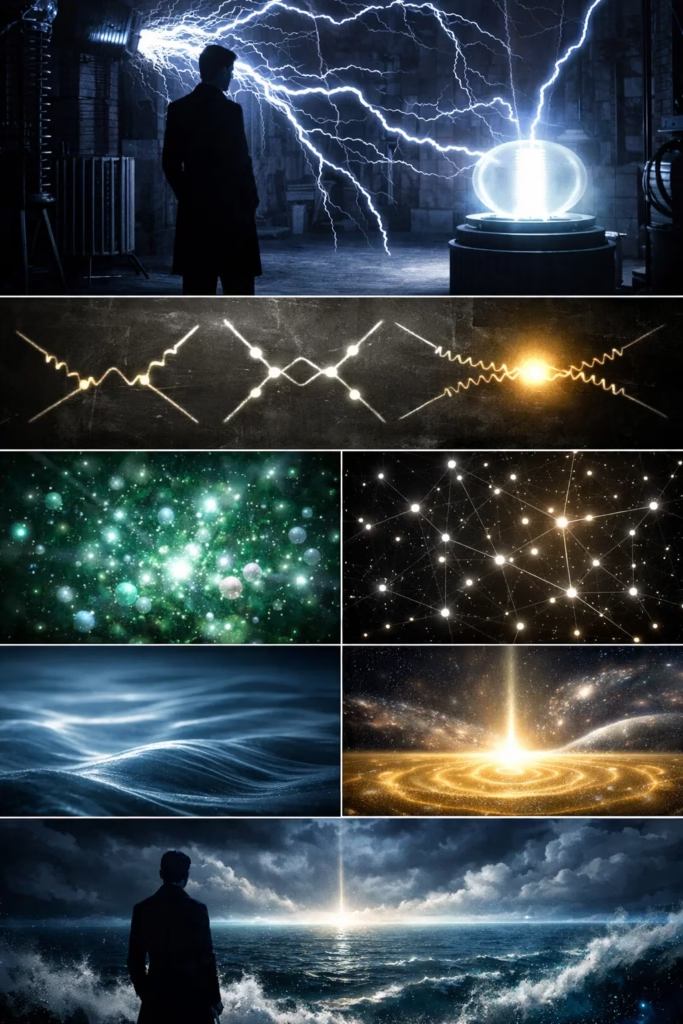
Tesla detected signals where there should have been nothing. Something that even contemporary physics cannot yet decipher, although QED, Higgs, and Casimir have illuminated part of the mystery.
To understand why the man who first stepped into the secrets of the vacuum was forgotten, and why his path remained far from the main highways of 20th-century physics, we must introduce a particular character into the story. Someone who closed the door to Tesla’s world, only to perhaps, in the end, inadvertently crack it open.
That person, of course, is Richard Feynman.
🎲 Feynman’s QED: The Theory That Won
While Tesla at Wardenclyffe was trying to send energy through the Earth, Feynman in the 1940s was developing what would become the most precise theory in the history of science: quantum electrodynamics (QED). Its task was not to transmit energy, but to explain how the photon and the electron actually cooperate.
The key outcome of QED for our story is twofold:
- The photon is exactly as it is. QED confirmed that the photon is strictly a spin-1 particle. This means that in a vacuum, there are no propagating longitudinal waves in the classical sense. Tesla’s “fluid” found no place in the standard model.
- The vacuum teems. Feynman’s diagrammatic formalism describes the vacuum as a noisy marketplace: particle-antiparticle pairs are constantly created and annihilated. This is the quantum picture of the “ether” — but not as a mechanical fluid, rather as a statistical ensemble of virtual states.
Tesla sought a continuous medium with infinite degrees of freedom. Feynman found discrete interactions described by probability which, ironically, could simulate many of Tesla’s “anomalies” (nonlinearities, plasmoids) without introducing new fields.
⚡️ Tesla’s Experiment: Visionary Beyond Formalism
Here lies the crucial divergence. Tesla was an experimenter. He saw effects that he could not explain with Maxwell’s equations. His answer was — the ether. That was the logical answer of a 19th-century engineer: if something transmits a force, it must be some kind of fluid.
However, Feynman’s approach was the opposite: he did not ask what the medium is, but built a mathematical apparatus that accurately predicts the outcome of experiments. QED does not say what the photon is before we measure it. It says: here is the probability that this or that will happen.
Had Tesla lived a decade later, he would probably have said: “OK, QED works for antenna radiation, but what about what I saw in Colorado Springs?“
And QED’s answer would be: “What you saw is not a new type of wave, but the collective behavior of electrons in the plasma of your high-voltage discharges, described by nonlinear effects that are still awaiting their theory.“
🧬 Higgs and the Return of the Scalar Field
However, nature has kept one ace for Tesla’s followers. Although QED does not allow longitudinal waves, the Higgs field is a scalar field (spin 0). It permeates space, has energy, and — crucially — can be seen as a kind of “potential field” that Tesla described.
Higgs is proof that nature does allow fundamental scalar fields. What Tesla did not know is that these fields do not behave like sound waves in air; their excitations are massive particles (Higgs bosons) that do not propagate over macroscopic distances.
But vacuum energy? The Casimir effect? The Lamb shift? These are experimental proofs that “empty space” has structure — exactly what Tesla intuitively felt. Only that structure is not a mechanical ether, but the quantum vacuum.
🧭 The Third Path: Tesla’s Attempt at Unification
Here we come to the boldest part of Tesla’s thought. While 20th-century physics split into two branches — quantum mechanics (governing the microscopic world) and general relativity (governing galactic scales) — Tesla tried to create a third path.
His “dynamic theory of gravity” was never fully published, but fragments show that he tried to derive gravity from electromagnetism via the ether. That was an attempt at unification that contradicted both quantum mechanics and GR.
Today, although mainstream physics has rejected Tesla’s path as a guide to success, GR has passed many tests (at the macro level), while quantum mechanics has become the foundation for the technology that surrounds us — yet we have no complete theory covering all phenomena of the micro and macro world. Our recent voyage through Dirac’s sea has shown that as well. The question remains: did Tesla sense that the theory would have to be nonlinear and would have to include the properties of space itself, before anyone took those concepts seriously?
🧩 Conclusion: Two Cultures, One Nature
What we have today is not a victory of one over the other, but a deep tension:
- Feynman’s QED gave us lasers, transistors, and computers. It is a formalism that works with incredible precision. In its world, Tesla’s “longitudinal waves” do not exist as fundamental propagation in a vacuum.
- Tesla’s intuition reminds us that formalism is not nature. His experiments with millions of volts, steep pulses, and plasmoids are still not fully explained within standard perturbative QED. They lie in the domain of nonlinear, non-equilibrium physics — a field still in its infancy.
Perhaps Tesla was not a precursor of QED in the sense of foreseeing Feynman diagrams. But he was a precursor of the problem that QED (and its successors) have yet to tackle: how to describe coherent, macroscopic states of the quantum vacuum under extreme conditions?
While quantum mechanics and GR still await unification, Tesla’s “third path” stands as a monument — not as a solution, but as a reminder that nature will not always bow to the division into “small” and “large” worlds.
Or, as Feynman might have said: “Whatever nature does, our job is to listen to it. Tesla listened. Only he thought he heard the ether, but perhaps he was actually hearing quantum noise.“
What do you think? Was Tesla’s fluid a dead end, or is his obsession with continuity a hint of some future theory in which quantum fields behave as a fluid — exactly as quantum hydrodynamics is trying to describe today?
Leave a Reply