When we think of intelligence, the first thing that comes to mind is the human mind, and then perhaps primates or dolphins. For a long time, we believed that we were the only intelligent beings on Earth. However, almost all recent research forces us to re-examine this dogma.
From building complex tools and planning for the future, to incredible examples of transmitting knowledge across generations, science shows us that the criteria for “intelligence” are far more complex and widespread than we ever imagined. This is not just a story about animals – it is a story about how nature repeatedly finds solutions to complex problems, often in ways completely different from our own.
Feathered Apes: Why 2025 Was the Year of the Birds
The past year, 2025, was a turning point in the study of avian intelligence. Two groups stood out: corvids (crows, magpies, jays) and parrots.
Corvids: Tool Builders and Memory Keepers
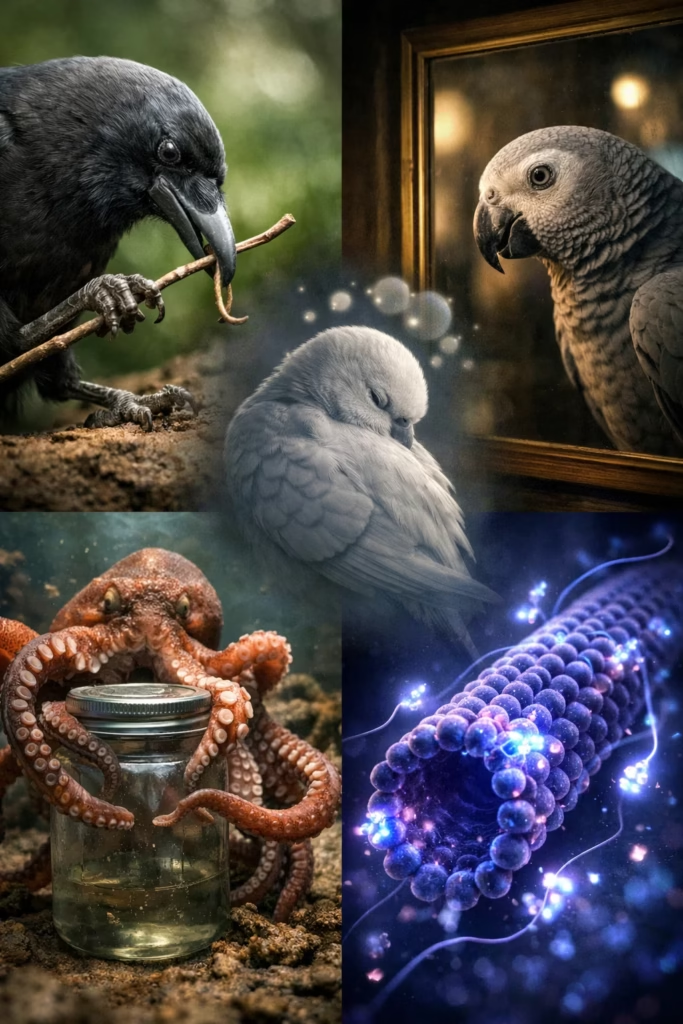
Research has shown that New Caledonian crows not only use but also produce complex tools. They shape branches into hooks to extract food from inaccessible places. This behavior goes beyond mere use – it involves understanding cause and effect and the ability to solve logical problems. One study documented crows using one tool to obtain another tool, which they then used to get food – so-called “meta-tool use” that places them shoulder to shoulder with chimpanzees.
Perhaps even more fascinating, crows remember human faces for years and pass this knowledge to others. John Marzluff’s famous experiment showed that crows captured by researchers wearing a “caveman” mask would attack anyone wearing that mask – even years later, after the original birds had died, with the knowledge maintained through cultural learning.
Parrots: Ancestors of Advanced Communication?
On the other hand, parrots have amazed us with their social learning and linguistic abilities. African grey parrots have been known for decades to learn hundreds of words and use them in appropriate contexts. However, research from 2025 revealed that parrots may have developed advanced communication before primates.
Studies have shown that blue-throated macaws can learn through “third-party imitation” (observing interactions between two other individuals), a skill previously thought unique to humans and crucial for cultural transmission. Parrots also show an exceptional ability to recognize individuals and make complex social decisions.
The Anatomy of Intelligence: How Birds Think Without a Neocortex
What is particularly exciting is that birds lack a neocortex – the brain region considered key for higher cognitive functions in mammals. Yet they have developed other brain structures that perform the same, if not more complex, tasks.
Key structures include the Dorsal Ventricular Ridge (DVR) and the Nidopallium, responsible for processing sounds, visual information, communication, decision-making, planning, and learning. Scientists have discovered that these structures evolved completely independently of the mammalian neocortex but achieved strikingly similar results – a phenomenon called convergent evolution.
These findings force us to re-examine the very definition of intelligence. It doesn’t matter how the brain is built, but what it can do.
Distributed Consciousness: How an Octopus Thinks With Its Arms
If birds forced us to reconsider our understanding of the brain, octopuses forced us to reconsider the very idea of centralized consciousness.
Octopuses have a completely different architecture of the nervous system. Instead of a single centralized brain, they have a distributed system. Over two-thirds of their neurons (about 500 million in total) are located in their arms. Each arm has its own information processing center and can make decisions independently, while the central brain coordinates global goals like hunting or movement.
Research has shown that octopuses can learn and solve multi-step puzzles, adapting their behavior when conditions change. They have also been documented using tools (such as coconut halves for shelter), which is considered evidence of complex planning and learning.
Octopuses are clear proof of convergent evolution of intelligence in beings not taxonomically related to us, yet which have developed incredible cognitive abilities.
Below the Surface: Fish Intelligence and Latest Discoveries
We must not forget the underwater world either. Although long considered “cold-blooded automatons,” fish show signs of advanced communication and social intelligence.
Research on cichlids has shown that these fish use multimodal communication (combining visual and acoustic signals) depending on environmental conditions, optimizing their messages. Cichlids can learn to recognize the people who feed them and react to their presence, remember locations and individuals much longer than previously thought, shattering the myth of short fish memory. Studies have also found a link between sociality and brain size in fish, supporting the hypothesis that complex social environments drive the development of intelligence.
Quantum Biology of Consciousness: Microtubules and Cambrian Roots of Intelligence
The Penrose–Hameroff theory (Orch OR) offers the most serious scientific theory of consciousness we have. According to their theory, consciousness does not arise only from neural networks but from quantum computations within microtubules – protein structures found in the cytoskeleton of every cell. These quantum computations collapse into conscious moments, linking consciousness to the fundamental geometry of space-time.
Although the theory has not yet been fully proven, the last few years have brought very relevant discoveries. For example, it has been discovered that the amino acid tryptophan – a building block of microtubules – can, during electron transfer due to metabolic processes, remain in a coherent state even in the wet, warm, and noisy conditions that characterize living cells. This discovery pushes the boundary of what we thought possible for quantum phenomena in biology.
If consciousness and intelligence are rooted in quantum processes within microtubules, then we might find traces of those processes in the earliest multicellular organisms. Discoveries such as the Jiangchuan Biota show that complex nervous systems and bilateral symmetry appeared much earlier than we thought. This means that the evolution of consciousness may have begun in the Ediacaran, more than 540 million years ago.
You can read more about this in my earlier text on quantum computers and coherence.
Personal Note: When a Budgie’s Grief Becomes Science
Finally, I must share something personal. My little budgie Mici passed away last year. His younger partner, Cici, showed disturbing dreams at night – twitches, eye and body movements characteristic of REM sleep, which in humans and primates is associated with dreaming.
This experience forced me to dive into research on dreams in parrots. It turns out that budgies have a REM sleep phase that is structurally incredibly similar to ours. This suggests that they not only dream but also have a rich inner life – the ability to process emotions, memories, and perhaps even grief.
Science is only beginning to seriously study this topic. But what I saw with my own eyes – Cici sleeping restlessly, making soft sounds, moving her head as if searching for Mici in her dream – is hard to explain without acknowledging that small parrots also have a complex inner reality.
Conclusion: Rethinking Intelligence Again
All these points lead us to one conclusion: intelligence is not an exclusively human characteristic. It has appeared multiple times, in multiple ways, in completely unrelated groups. From crows that remember human faces, through parrots that learn through social imitation, to octopuses that think through their arms – nature has found countless ways to create minds.
And perhaps, deep within the microtubules of every cell, lies the key to the greatest mystery of all: why we are conscious at all.
☕ If you wish to support topics like this – research at the intersection of quantum physics, artificial intelligence, and curiosity – you can buy me a coffee. Every contribution goes directly into research, books, and unpaid hours.
👉 buymeacoffee.com/milovaninnovation
Thank you for being part of this story.
Leave a Reply