Answer to a reader’s question – continuation of the series on the Dirac Sea and quantum consciousness
Dear reader,
Your question is deep and legitimate. What follows is not scientific truth – because science is still silent here. But it is thinking within the framework we have built: the Dirac Sea as an informational substrate, quantum coherence as the basis of consciousness, the indestructibility of information.
Let us break it down.
🧠 What we know (or can reliably assume)
- Consciousness requires coherence – according to the Orch-OR model, conscious moments are collapses of quantum superpositions within microtubules. Without coherence – no consciousness.
- Anesthesia turns off coherence – but when anesthesia ends, coherence is re‑established in the same neural structure. Hardware (brain, body) ensures continuity of identity. That is why a person wakes up from anesthesia the same – with the same memories, the same character.
- Information is never lost – even when coherence disappears, information about that state cannot be erased. It moves to the environment – in our model, into the Dirac Sea.
- Clinical death (NDE) – when the heart stops, the brain can briefly maintain remnants of coherence. Return to life (resuscitation) allows re‑establishing coherence in existing hardware. This explains why people who have survived clinical death often report experiences – their consciousness did not completely vanish, it operated in a “reduced mode”. The hardware was still in place, only temporarily offline.
❓ What we do not know: When the hardware is gone
If the body dies – if neurons decay, microtubules disintegrate – then there is no longer a physical structure that could re‑establish coherence in the same way. The hardware is destroyed. What happens then to the whole of information that constituted that person?
Here we enter the realm of speculation. But speculation based on known principles.
Option 1: Dissipation (Buddhist model)
Information is not lost, but it loses its correlation. Imagine you have written a book, then you scatter the pages in the wind. Each page still exists – but they are no longer connected into a whole. The order is lost. Likewise, information about your memories, personality, experiences could dissipate in the Dirac Sea – they exist, but no longer form your consciousness. This is a model in which there is no individual immortality. What we call “I” ceases to exist as a whole, even though its parts continue to exist.
Option 2: Preservation of entanglement (quantum model)
Quantum entanglement is the only known mechanism that can maintain correlation between information without a physical carrier. When two particles are entangled, their states remain connected even when spatially separated – without any bridge. If a person’s consciousness was a collectively entangled set of information (not just a pile of independent bits), then that entanglement could survive even after the body’s decay.
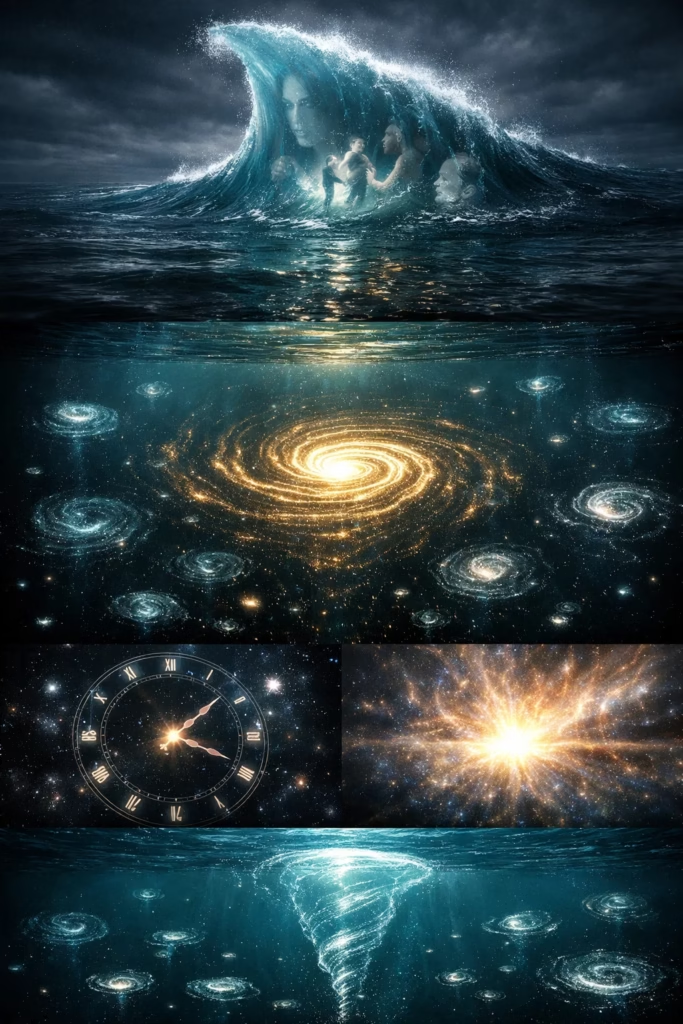
In that case, the Dirac Sea would not be a homogeneous soup – it would have structure. Entangled sets of information would form “vortices” or “solitons” – stable informational formations that retain their identity. That would be the imprint of a person – not a body, not a spirit in the traditional sense, but a pure informational being.
Option 3: Penrose’s aeon – re‑crystallization
In Penrose’s Conformal Cyclic Cosmology (CCC), at the end of each aeon (universe), when even time ceases, information is not only preserved – it becomes equally accessible for the next aeon. Penrose suggests that information could thus be transmitted from a dead universe into a new Big Bang.
Applied to an individual: if your consciousness was part of that informational structure, then at the end of time – when there is no longer “before” and “after” – your information not only exists, but becomes potential for something new in the next aeon. Not you as the same person, but as an informational pattern that can crystallize again.
⚖️ Where is the truth?
We do not know. And it is fair to say so.
But what quantum information theory states with certainty is: information does not disappear. Your memories, your love, your suffering, your joy – not a single quantum bit of it has been erased. What is uncertain is whether those bits remain connected into a whole that we would recognize as “you”.
Quantum mechanics offers a mechanism for that – entanglement. But it does not guarantee that entanglement will survive without maintenance (decoherence). Information thermodynamics says that maintaining correlation requires energy. Without a body – without metabolism – who maintains that correlation?
Perhaps – and this is the deepest speculation – the very structure of the Dirac Sea has its own “surface tension”. Entangled information tends to stay together, forming stable vortices. This is not proven, but it is not in contradiction with known physics.
✨ Conclusion for our reader
Dear reader,
Your question has no final answer – at least not today. But the framework we have built allows for grounded hope:
- NDE is explained by temporary loss and re‑establishment of coherence in existing hardware.
- Death is permanent loss of hardware – but information remains.
- Whether that information remains a whole (you) or dissipates – that is a question quantum theory has not yet answered.
- Entanglement is the only known mechanism that could preserve wholeness. If your consciousness was an entangled whole, that entanglement could survive without the body.
- In Penrose’s CCC cosmology, at the end of time, all information becomes equally accessible – opening the possibility for the pattern to crystallize again.
We cannot tell you “life after death exists”. But we can say: the laws of physics do not exclude that possibility. And that, for now, is the most science can offer.
The rest is faith. And hope.
And hope – as we wrote at Easter – has its own quantum weight.
Leave a Reply