
*From Tesla’s tunneling through the vacuum, through Feynman’s path integrals, to D-Wave’s 4,400 qubits – nature showed us the way through barriers long ago. We are only now building machines that can walk that path.*
⚛️ Introduction: When classical logic hits a wall
At MilovanInnovation, we have already traveled through Tesla’s standing waves, Feynman’s diagrams, Susskind’s landscape of 10⁵⁰⁰ worlds, Dirac’s sea, Bentov’s pendulum, and quantum biology. The common thread in all these stories is the same: nature processes information in ways we are only beginning to understand.
Today we open a new chapter. We will deal with a problem that plagues engineers, logisticians, pharmacists, and AI developers – all those who try to find the best solution among a nearly infinite number of possibilities.
How to find the shortest route through 50 cities? How to arrange machines in a factory to maximize production? How to select the most relevant genes for diagnosing a disease?
Classical computers stumble upon one insidious obstacle: local minima. Then comes Quantum Annealing – a paradigm that uses quantum tunneling to break through walls that classical algorithms cannot jump over.
⛰️ The problem: Energy landscape and the trap of local minima
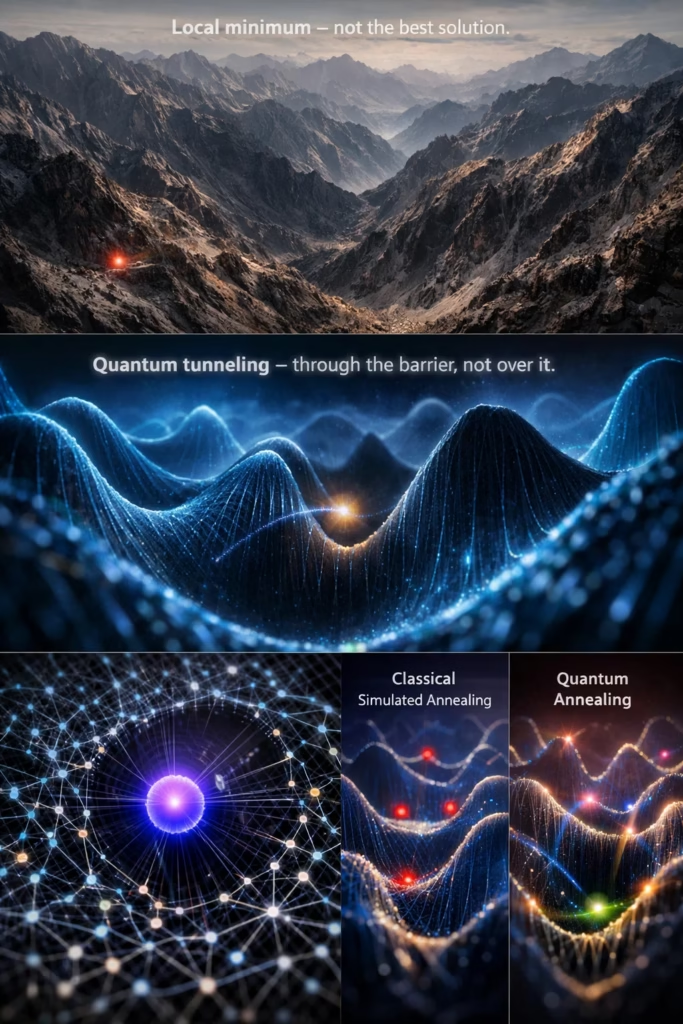
Imagine solving an optimization problem as finding the deepest valley in a vast mountain range. Every point in that landscape has its own energy – the lower the energy, the better the solution.
The problem is that the landscape has many valleys (local minima). Classical algorithms – such as Simulated Annealing – move through this landscape, but often get stuck in the first decent valley, believing they have reached the goal, while the true deepest valley (global minimum) remains hidden behind a mountain range.
Local minimum – a dip that is not the deepest possible.
Global minimum – the deepest valley, the optimal solution.
Classical simulated annealing tries to solve this problem by raising the temperature – the system is heated, allowing it to “jump over” hills, then slowly cooled, stabilizing at the lowest point. At high temperature, thermal energy is sufficient to kick atoms out of a local minimum. But as the temperature drops, this possibility disappears. And then – we are stuck.
🌀 The solution: Quantum tunneling – a path through the mountain, not over it
Here quantum mechanics enters the game with its most powerful asset: quantum tunneling.
While classical particles (and classical algorithms) must climb over an energy barrier to escape a local minimum, quantum particles can do it in a completely different way – passing through the barrier as if it did not exist.
Quantum tunneling allows the system to explore the energy landscape in ways impossible in the classical world. Instead of climbing, it tunnels. This is not merely theoretical beauty – quantum annealing has demonstrated significant advantages over classical simulated annealing.
🔥 How quantum annealing works: From superposition to solution
The quantum annealing process proceeds through several steps:
Initial superposition – All qubits begin in a superposition state (simultaneously 0 and 1). The system explores all possible solutions at once.
Adiabatic evolution – The system slowly changes its “energy landscape,” adapting it to the problem we are solving.
Qubit interaction – Qubits interact, gradually steering toward a configuration that minimizes total energy.
Measurement – At the end of the process, the qubit state is read out, representing the optimal (or near-optimal) solution.
This process is called annealing by analogy with metallurgy – the material is heated, then slowly cooled to achieve a stable, defect-free structure. Only here we use quantum fluctuations instead of temperature.
🧬 Connection to our previous stories: When tunneling appeared in the universe
Long before quantum annealing became a technology, nature was already using it. In our post on quantum biology, we discussed how photosynthesis uses quantum coherence, how enzymes tunnel through energy barriers, and how birds sense Earth’s magnetic field using quantum entanglement.
Evolution discovered quantum tunneling billions of years before we formalized it. What we are now trying to engineer – nature already has in its toolkit.
🔧 Hardware: D-Wave and the path from Chimera to Pegasus
Quantum annealing is not just theory. D-Wave Systems has been building quantum annealing processors (QPUs) for nearly two decades. Their latest machine, Advantage2, has over 4,400 qubits.
But what is key here – and technically fascinating – is the topology of qubit connectivity. Qubits are not fully connected (that is impossible with thousands of qubits). Instead, they are arranged in specific patterns.
Chimera – First generation topology (D-Wave 2000Q). Qubits arranged in cells of 8 qubits, each qubit connected to 6 others.
Pegasus – Topology of the D-Wave Advantage processor (2020). This is what we mentioned earlier – Pegasus brings a significant leap in connectivity. While in Chimera each qubit had only 6 connections, in Pegasus the average number of connections per qubit is about 15.
How exactly does Pegasus look? In the Pegasus topology, a basic cell contains 24 qubits that include three K₄,₄ graphs (fully connected bipartite cores), and the cells themselves are interconnected by K₂,₄ edges. This architecture allows significantly more efficient solving of larger-scale problems, especially those requiring embedding of dense graphs.
Zephyr – The latest topology (Advantage2, 2025). Each qubit connected to 20 others. Zephyr delivers 40% higher energy scale, twice the coherence time, and four times less noise.
This increase in connectivity is not just a technical detail – it directly affects which problems we can solve. Higher connectivity allows larger problems to be embedded into the QPU with shorter qubit chains, leading to better solutions.
🧠 Applications: From artificial intelligence to new alloys
Where is quantum annealing already used today?
Machine learning – Quantum annealing is used for feature selection, data clustering, and training SVM models. Hybrid models combining classical, gate-based, and quantum annealing have shown better accuracy on complex quantum data.
Materials discovery – Recent research used quantum annealing to design a novel alloy (Al₈Cr₃₈Fe₅₀Mn₂Ti₂) with exceptional mechanical properties. Quantum annealing made it possible to avoid local minima in which classical algorithms got stuck.
Logistics and finance – From supply chain optimization to portfolio management.
Drug discovery – Japan Tobacco uses D-Wave’s Advantage2 for novel molecule research.
As one researcher noted: “Quantum annealing finds shallower, more stable regions of the loss landscape – where classical methods sink into deep, narrow valleys they cannot escape.”
🏗️ Challenges: Not all that glitters is gold
Let us admit – quantum annealing is not a silver bullet. There are serious challenges:
- Topological limitations – Qubits are not fully connected, so the problem must be embedded into the topology. This is not always efficient.
- Noise and decoherence – Quantum systems are sensitive to external influences.
- Not universal – Quantum annealing solves a specific class of problems (optimization), unlike universal quantum computers.
Nevertheless, while universal quantum computers have not yet reached commercial maturity, quantum annealing is available today. D-Wave’s Leap cloud service is accessible in over 40 countries.
🧩 Conclusion: When nature tunnels, we build machines that follow
Tesla tunneled through the vacuum with his standing waves. Feynman charted the paths of virtual particles. Bentov sensed the vibrations of the cosmos. And now – we are building machines that tunnel through energy barriers, finding solutions that classical logic cannot reach.
Quantum annealing is not just another computing paradigm. It is a confirmation of something we at MilovanInnovation have always felt: nature processes information in fundamentally quantum ways. Photosynthesis, enzymes, magnetoreception – and now, our quantum processors.
The next time you get stuck on a problem with no simple solution – remember that there is a path through the mountain, not just over it. Nature has always known it. We are only now learning to build machines that can walk that path.
We continue the search.
☕ If you wish to support topics like this – exploration on the edge of quantum physics, artificial intelligence, and curiosity – you can treat me to a coffee. Every contribution goes directly into research, books, and unpaid hours.
👉 buymeacoffee.com/milovaninnovation
Thank you for being part of this story.
Leave a Reply