
Life on Earth never waited. That sentence runs through our previous stories – from the stabilocracy of the “Boring Billion,” through the first giants Prototaxites, to the first land animals. Time and again, new fossils show us that evolution is more like continuous experimentation than a series of sudden explosions.
And now, news arrives that further confirms this rule – from the most renowned scientific journal, Science.
🦴 Treasure from Yunnan Province: What Was Actually Found?
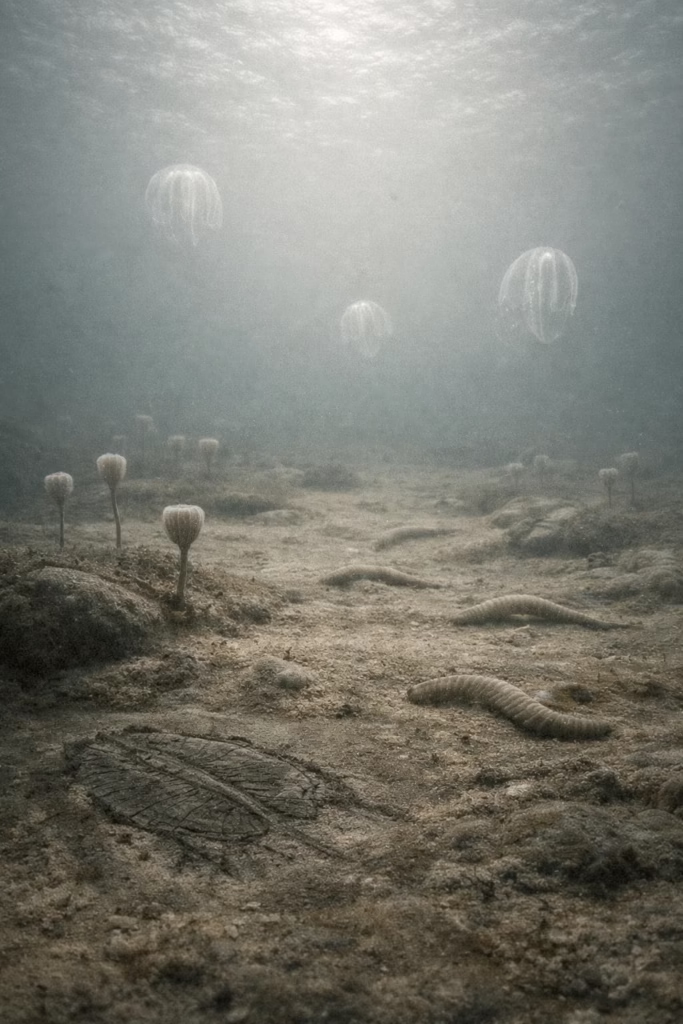
In southern China, in Yunnan Province, a site has been discovered that will be remembered as the Jiangchuan Biota. More than 700 exceptionally preserved fossils, dating between 554 and 539 million years ago – from the very end of the Ediacaran, immediately before the Cambrian Explosion.
What makes this site revolutionary is the mode of preservation. Unlike most Ediacaran sites, which preserve organisms as impressions on sandstone surfaces, the Jiangchuan Biota preserves fossils as carbonaceous films – the same preservation mode that gave us the famous Burgess Shale from the middle Cambrian. This means: an incredible level of detail, including guts, feeding structures, and locomotion organs.
Among these fossils, scientists have identified:
- The oldest known relatives of deuterostomes – the broad group that includes vertebrates, and therefore humans
- Relatives of starfish and acorn worms (the group Ambulacraria) with a clear U-shaped body and a stalk for attachment
- Various worm-like bilaterian animals, some showing complex feeding strategies
- Rare specimens that might be early comb jellies
- Several completely new, previously undescribed forms
🧬 What Does This Discovery Change in Our Understanding?
Before this discovery, it was believed that the rapid diversification of the animal kingdom began at the start of the Cambrian, around 535 million years ago, in an event known as the Cambrian Explosion.
The Jiangchuan Biota pushes that timeframe back by at least 4–5 million years. On a geological scale that seems like a short period, but in evolutionary terms – it is a massive difference.
The discovery shows that the Cambrian type of animal communities did not appear suddenly, but already had clear foundations and transitional forms at the end of the Ediacaran.
In other words: the Cambrian Explosion was not an “explosion from nothing”. It was the culmination of a much longer process whose roots lie deep in the Ediacaran.
This discovery, in a way, confirms Darwin’s intuition. He was puzzled by the sudden appearance of complex animals in the Cambrian and assumed that we simply lack fossil records from the earlier period. The Jiangchuan Biota is precisely that – the missing link.
🐚 Evolution as Experiment: How Does This Fit Into Our Story?
Let us recall our story together:
- Grypania (~2.1 billion years ago) – showed that eukaryotes became macroscopic and photosynthetic early on.
- Jiangchuan Biota (~550 million years ago) – now shows that the first complex animals also appeared much earlier than we thought.
- Prototaxites (~410 million years ago) – showed that on land there were completely independent, extinct experiments in gigantism.
Together, these discoveries demolish the old narrative of “evolution that waits”. Instead, they paint a picture of a world in which life continuously pushed boundaries, experimented with forms, and today we see only those experiments that succeeded in responding to environmental challenges and surviving through deep time.
🔥 Skepticism: Why Caution?
Of course, paleontologists are rightly cautious for several reasons.
- Age and preservation: The fossils are over half a billion years old. There is always a possibility that some fossils are misinterpreted, or that parts of algae, microbial mats, or other organisms are mistaken for animal structures.
- Taxonomic identification: Some of the discovered specimens show unusual combinations of traits (tentacles, stalks, attachment discs) that do not match any known Ediacaran or Cambrian organism.
- Need for replication: Any major discovery must be confirmed by independent research at other sites.
But even with that caution, one thing is clear: the Ediacaran has now become much more interesting, complex, and important than we ever imagined.
🌍 Life as an Emergent Property: Connecting to an Earlier Post
In my earlier text, I spoke about life as an emergent property – about how from quantum randomness, through chemical reactions, to complex biological systems, entirely new properties appear that were not predictable from the simpler parts.
This discovery is a perfect illustration of that principle.
The Ediacaran was long considered the “enigmatic interval” – a period of strange, soft-bodied organisms of unknown affinity, those that looked like “bags, pillows, or fronds.” No one could have predicted that from that “bag-like” phase would emerge bilateral symmetry, deuterostomes, and eventually vertebrates.
But that is precisely what emergence means: new properties that cannot be reduced to simpler parts. Life was not programmed to create vertebrates. It simply – experimented. And we are one of those experiments that proved adaptable, resilient, and successful enough to survive through hundreds of millions of years of changing conditions.
🔭 What Next?
The Jiangchuan Biota reminds us of something we should always keep in mind: the fossil record is incomplete. What we know about the past is always only a small reflection of what actually happened.
But that is why discoveries like this are precious. They not only supplement the picture – they rewrite it from the ground up.
And that is why science is exciting. Just when we think we have understood the rules, nature gives us a new, unexpected insight.
And we, at MilovanInnovation, will continue to follow those insights – from quantum randomness, through the first multicellular organisms, to artificial intelligence. Because, in the end, it is all part of the same story: the story of how complexity arises from simplicity and how it persists through continuous interaction with the environment – without a pre-ordained plan, but also not through mere chance.
💡 Instead of a Conclusion: Back to the “Boring Billion”
Remember – we talked about how the “Boring Billion” was not boring, but stable. And that this stability allowed eukaryotes to experiment for billions of years before the first complex animal forms appeared.
The Jiangchuan Biota is proof that those experiments were more successful than we ever imagined. The Ediacaran was not just a “time of preparation”. It was already a time of serious evolutionary development.
And so we return to that sentence: Life never waited. It continuously experimented, created strange forms, and conquered new spaces. We are one, still ongoing, experiment in a series – the one that, thanks to its adaptability and resilience, succeeded in surviving where many others went extinct.
☕ If you wish to support topics like this – research at the intersection of quantum physics, artificial intelligence, and curiosity – you can buy me a coffee. Every contribution goes directly into research, books, and unpaid hours.
👉 buymeacoffee.com/milovaninnovation
Thank you for being part of this story.
Leave a Reply