Continuation of the series “Emergent Spacetime” and “Us in the Quantum Sea”
Dear friends, explorers at the crossroads of science and spirit,
In the previous post on anesthesia, we touched on microtubules and London forces, but we left out two key concepts without which the picture remains unclear: the gamma rhythm and stage lighting (the spotlight of consciousness). Without them, it is difficult to understand how quantum coherence in microtubules transforms into what we experience at every moment as conscious experience.
Let us dive deeper – but this time, with a more precise map.
🧬 Axons and dendrites: Two roles, one consciousness
Within a neuron, there are two functionally distinct parts:
- Axons – long extensions that carry the action potential over long distances. They are responsible for motor functions (sending signals to muscles) and for gathering sensory stimuli from the external and internal world. Axons are, one might say, the information highways.
- Dendrites – short, branched trees that receive signals from other neurons. But what Hameroff emphasized in his 2006 paper are dendrodendritic synapses – connections between dendrites that do not involve the axon. Precisely at these sites, through extremely weak London forces (a type of van der Waals interaction), something crucial occurs: synchronization of electrical fields.
Dendrites are not passive conductors. They actively shape the signal. Through London interactions in the hydrophobic pockets of dendritic proteins, the resistance of specific pathways changes. The action potential then chooses the path of least resistance – but this choice is not random. It is guided by the collective quantum coherence established precisely through dendrodendritic synapses.
In other words: axons transmit information, but dendrites decide where that information will go. And that decision is not classical – it is quantum.
🎶 Gamma rhythm (30–70 Hz): The heartbeat of consciousness
The electroencephalogram (EEG) of the human brain shows several frequency bands. The highest among them, the gamma rhythm (30–70 Hz, with a peak around 40 Hz), directly correlates with conscious perception, attention, and information integration. When you are under anesthesia, the gamma rhythm disappears. When you are awake and focused, it is strong.
Hameroff and Penrose, in the Orch-OR theory, propose that each wave of the gamma rhythm corresponds to one conscious moment. Approximately 40 times per second, a quantum superposition within microtubules collapses (undergoes objective reduction) and produces a discrete “frame” of consciousness. These frames are strung together – and we experience them as a continuous stream, just as 24 frames per second in a movie create the illusion of motion.
But what drives this oscillation at 40 Hz?
The answer lies in dendrodendritic synapses. London forces in hydrophobic pockets do not act randomly – they are coherent at the level of entire dendritic trees. When thousands of dendrites synchronize, they generate an electric field that oscillates precisely at the gamma frequency. This field then influences the resistance of membrane channels, directing action potentials toward those pathways that are currently “illuminated.”
🎭 Stage lighting (the spotlight of consciousness)
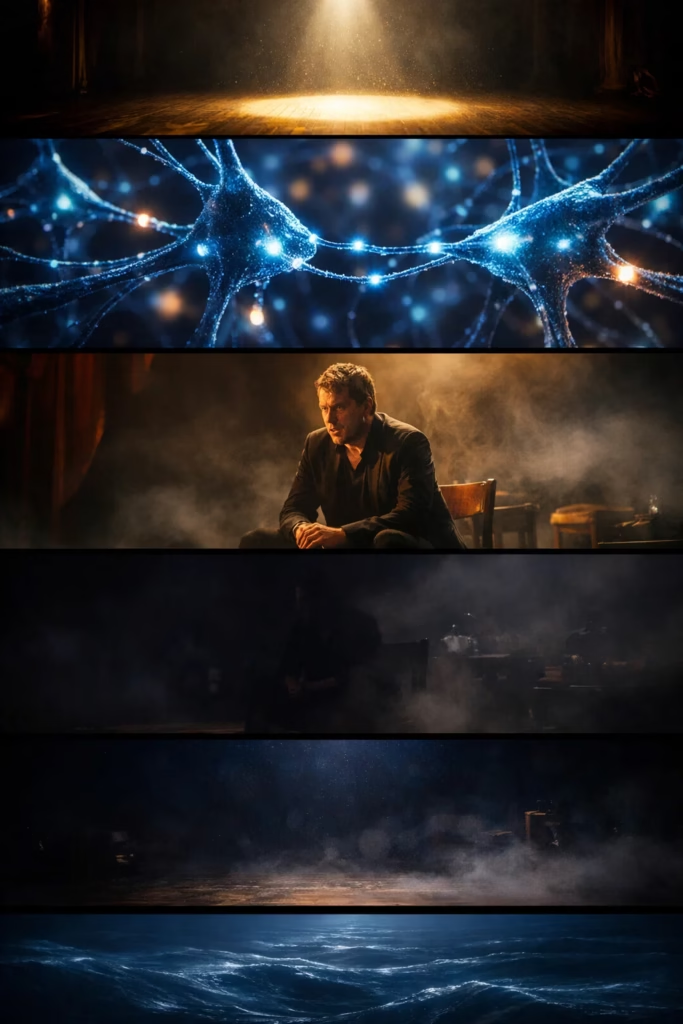
Imagine a theater stage in complete darkness. The audience sees nothing. Then a spotlight turns on and illuminates only one part of the stage – an actor, a table, a single object. The audience’s entire attention is focused on that lit spot. Everything else remains in darkness, even though it physically exists.
Our consciousness functions in a similar way. Out of the vast amount of information that our sensory organs constantly gather – and that axons transmit to the brain – only a small part reaches conscious experience. That small part is illuminated. And the mechanism that decides what will be illuminated is – according to Hameroff – precisely the quantum coherence in dendritic synapses, mediated by London forces.
In other words: the gamma rhythm is the frequency of illumination. Each flash of the spotlight (each conscious moment) occurs about 40 times per second. What gets illuminated is not arbitrary – it is the result of the interaction between the internal quantum state of the microtubules and external stimuli.
Anesthetics, by binding to hydrophobic pockets, turn off the spotlight. Not because the theater is empty – but because there is no longer a coherent field to sustain the illumination. The stage still exists, the actors perform, but the audience (consciousness) no longer sees anything.
🌊 The Dirac Sea: Historical model and our extension
At this point, we must be precise – so as not to confuse concepts.
The historical Dirac model (1930):
Paul Dirac introduced the concept of a “sea” of negative energies to explain the existence of positrons. According to this model, the vacuum is not empty space – it is filled with an infinite sea of negative-energy electrons. When an electron is pulled out of that sea, a “hole” is left, which behaves as a positron.
It is important to emphasize:
- The Dirac Sea is not a two-dimensional surface – it fills all of three-dimensional space.
- In modern quantum field theory, this concept has been replaced by the formalism of creation and annihilation operators.
- Penrose occasionally uses it in his Conformal Cyclic Cosmology (CCC), but it is not part of the standard interpretation of the Dirac equation.
Our extension within MilovanInnovation:
Building on contemporary quantum information theory and information theory, we have given the Dirac Sea a broader meaning – as an informational substrate from which space-time and matter emerge. In this model:
- The Dirac Sea is not only a sea of electrons, but an ocean of quantum information.
- It is more fundamental than space-time – space-time and matter are waves on its surface.
- Consciousness (localized quantum coherence) is one such wave.
This extension does not contradict the Dirac equation – it is a metatheoretical framework that attempts to unify quantum mechanics, information theory, and cosmology. Although there is no broad consensus on it in the academic community, it serves as an intuitive picture that helps readers connect different phenomena (indestructibility of information, anesthesia, the Resurrection) into one coherent story.
⚡ What does this mean for our daily lives?
Understanding the gamma rhythm and stage lighting changes the way we view our own consciousness:
- Consciousness is not continuous – it consists of discrete “flashes” (about 40 per second). What we experience as an unbroken stream is an illusion created by the brain.
- Attention is not abstract – it is a physical process based on quantum coherence in dendritic synapses. When we say “pay attention,” we are actually directing the spotlight.
- Anesthesia is not a mystery – it is experimental proof that consciousness depends on quantum coherence. When London forces no longer maintain synchrony, the spotlight goes out.
And finally, the Dirac Sea – whether understood in Dirac’s original sense or as our informational substrate – reminds us of something crucial: what disappears from our consciousness (during anesthesia, sleep, or at the end of life) does not disappear from reality. Information is preserved. The wave returns to the ocean.
✨ Conclusion: The stage, the spotlight, and the infinite sea
The theater exists even when the spotlight is off. Actors play, decorations stand. But the audience – consciousness – sees only what is illuminated. The gamma rhythm is the frequency at which the spotlight flickers. Dendrites and London forces are the mechanism that sustains that flickering.
And beneath it all – the Dirac Sea. The infinite ocean of information from which all spotlights, all stages, all actors emerge.
So, the next time you catch yourself deeply focused on something – remember: right now, your inner spotlight is shining at 40 Hz. Enjoy the illumination. And thank your dendrites for choosing that particular scene.
If you wish to support topics like this – research at the intersection of quantum physics, artificial intelligence, and curiosity – you can buy me a coffee. Every contribution goes directly into research, books, and unpaid hours.
buymeacoffee.com/milovaninnovation
Thank you for being part of this story.
Leave a Reply