
When we think of small parrots – budgies – we usually picture a sweet, colorful little bird chirping on its owner’s shoulder in a café. Few stop to think: this bird is, by its very nature, prey. And prey with a very long list of predators.
In their natural habitat, budgies (Melopsittacus undulatus) face aerial predators such as hawks, falcons, eagles and owls, as well as ground threats like snakes, lizards and wild cats. Every instinct they have has been shaped by millennia of evolution – and one of the key instincts is relentless: flee from anything that resembles a predator.
But let’s take a peek inside their brains and discover how it is possible that, despite all those inborn alarms, a budgie can calmly close its eyes and fall asleep in the palm of its human – an apex predator at the top of the food chain.
⚡️ Amygdala and Nidopallium: An Ancient Biological Alarm
If we had to single out two key structures responsible for fear and rapid threat assessment in animals, they would certainly be:
- Amygdala – in mammals and birds, it serves as the main center for recognizing threats and triggering fear responses. In mammals, several brain regions are involved in expressing freezing or escape reactions, including the amygdala, hypothalamus and the periaqueductal gray matter. In birds, the amygdala plays a similar role: it processes sensory signals that indicate danger and activates a series of physiological and behavioral responses.
- Nidopallium – the partial avian equivalent of our prefrontal cortex, responsible for executive functions, including decision‑making, processing rules and information from memory, and goal‑directed behavior. Within it, the nidopallium caudolaterale (NCL) stands out – an associative area that integrates information from multiple sensory modalities and is key for flexible, context‑dependent behavior.
These two structures allow budgies to recognize a predator’s attack in a split second and decide whether to freeze or take flight. For wild budgies, any unfamiliar sound, movement overhead or glint in a potential predator’s eye – including the human figure – would be enough to activate that system to the maximum.
🏠 Domestication: When Millennia‑Old Instincts Get Rewritten
In pet budgies, however, an extraordinary transformation takes place. Through the process of domestication and daily, non‑aversive contact with humans, their fear of people gradually decreases. Essentially, their brain performs a kind of deliberate suppression of its own alarm:
- Through positive experiences (food, safety, warmth, gentleness), the nidopallium integrates new information and forms new rules: this large biped is not a predator. He is part of my flock.
- Selection for reduced fearfulness and tameness leads to changes in brain structures. In chickens, for example, domestication has been observed to lead to a reduction in the size of the amygdala, resulting in decreased reactivity to fear and generally lower sensitivity to potential threats.
- Research on red junglefowl (the ancestors of domestic chickens) has shown that selection for reduced fearfulness also changes behavior, reproduction and the immune system. Similar processes likely affected the brains of birds during domestication.
The budgie no longer sees a human hand as a hawk’s talon about to grab her. Instead, she sees safety in that hand – a place where she can rest, sleep, and even purr.
🤝 Trust Above All: The Leap of Faith
This learned behavior – recognizing the human as part of the family and the flock – reaches astonishing proportions. Birds that are fully adapted to a human environment often:
- Sleep on their caregiver’s shoulder or in their palm, with their feathers completely relaxed.
- Approach the human when frightened, seeking protection.
- Show signs of affection such as cuddling, low bowing (which in the bird world indicates acceptance of hierarchy) or bringing small objects.
- Show signs of separation anxiety when the human is away.
Pets that sleep on a human do something absolutely counterintuitive for a prey species: they voluntarily place themselves in a completely helpless state (sleep) in close proximity to a being that, by its size, forward‑facing eyes and teeth (or ability to inflict harm), still resembles a predator. Yet, thanks to the complex interplay of the amygdala and nidopallium, the budgie can overcome this ancient fear and establish complete trust.
🎂 A Special Dedication: To the Mother Who Taught Her Budgies to Trust
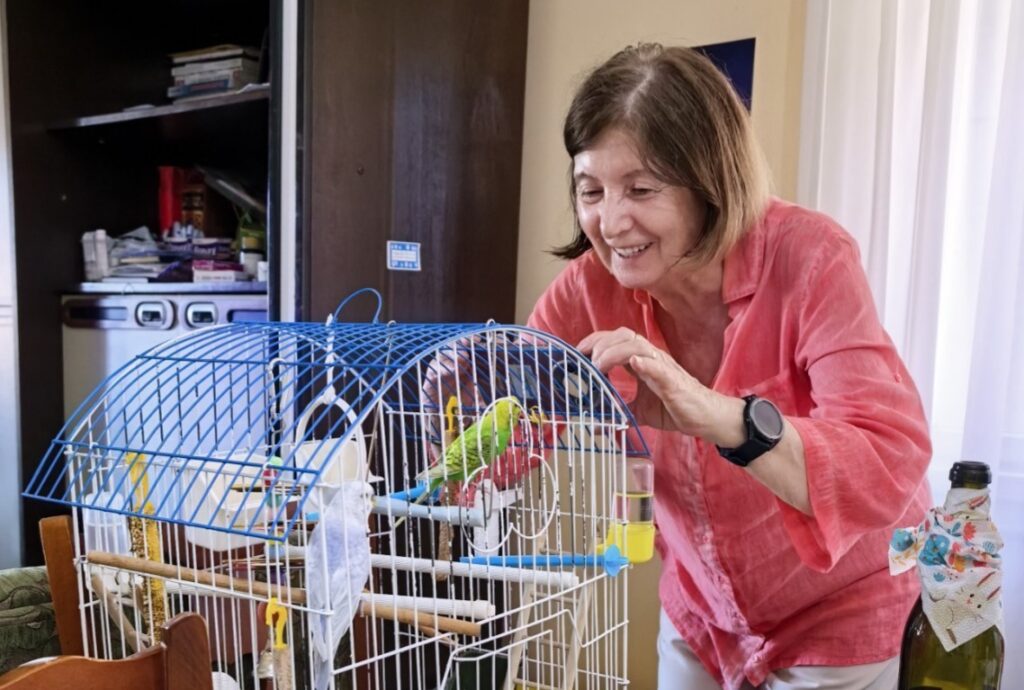
Today’s post has another, special purpose. I dedicate it to my mother, who is celebrating her birthday today.
She is the one who, after little Mici passed away, managed with extraordinary patience and care to build a new bond – first with Cici, and then with Mića, the little male who arrived after Mici. The budgies that could have viewed the human hand with justified mistrust now sleep in her palm, come to her for comfort, and show all the signs of genuine connection.
My mother, perhaps unconsciously, applied day after day the very principle that scientists call “regular, non‑aversive interaction with humans.” Slowly but surely, her voice, her scent and her touch became for Cici and Mića signals of safety, not danger. And that is one of the most beautiful examples of how love, patience and dedication can “rewrite” even the deepest, evolutionarily ingrained patterns.
Happy birthday, Mom. Thank you for showing that even a tiny, feathered creature can learn to trust – when it has the right reasons to.
🔭 Conclusion: Small Brain, Big Abilities
Budgies are a perfect example that brain size is not the only indicator of cognitive complexity. These small birds are capable of:
- Recognizing individual humans and assessing their intent.
- Learning to suppress inborn escape instincts from predators.
- Building and maintaining long‑term emotional bonds.
What happens in them is a triumph of neuroplasticity and learning over genetic inheritance. With their docile and adaptable nervous systems, budgies remind us that evolution is far more than mere “survival of the fittest.” It is, among other things, a story of how even the strongest instincts – like the fear of predators – can be replaced by trust.
And that is, in a way, one of the greatest victories of the mind. And of the heart.
☕ If you wish to support topics like this – research at the intersection of neurobiology, animal behavior and curiosity – you can buy me a coffee. Every contribution goes directly into research, books and unpaid hours.
👉 buymeacoffee.com/milovaninnovation
Thank you for being part of this story.
Leave a Reply