
Dear explorers at the crossroads of science and spirit,
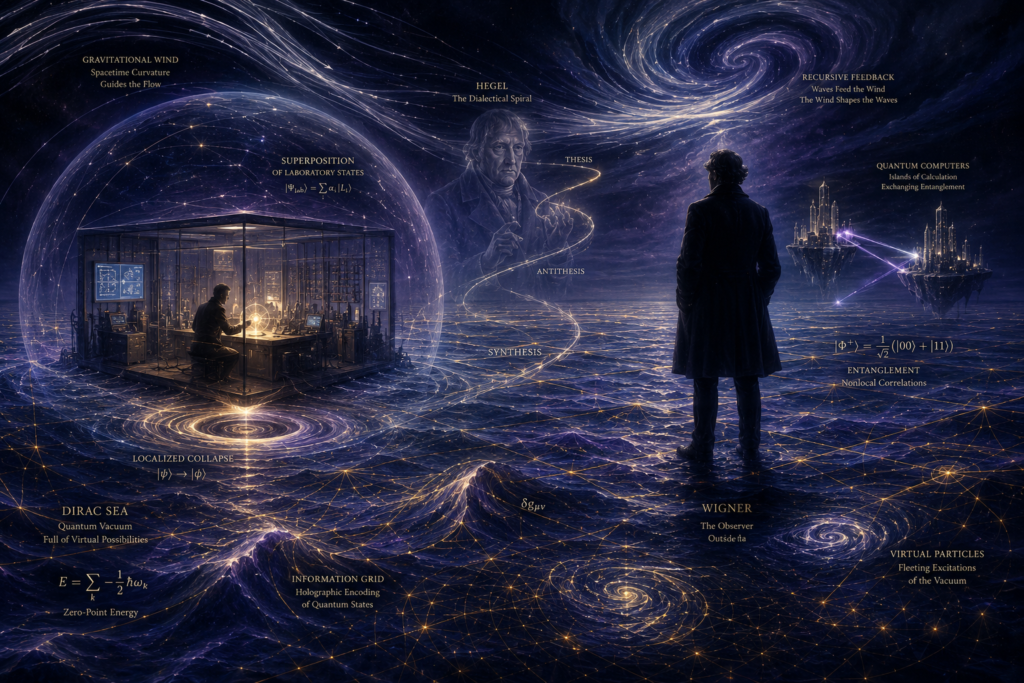
When we built the picture of the Dirac Sea in previous posts – that infinite ocean of quantum fields – we introduced a key metaphor: the gravitational wind as the mechanism that smooths the waves and translates the quantum into the classical. That picture elegantly bypassed a problem that has troubled physics for almost a century: who or what is needed for the wave function to collapse?
But today we will not bypass. Today we dive directly into the measurement problem, the paradox of Wigner’s friend, and a question that reaches to the very foundations not only of physics, but of philosophy: is the observer part of the system they observe? And what does that mean for our Dirac Sea?
🎭 The Root of the Problem: Copenhagen and the Hole at the Heart of Quantum Mechanics
The standard Copenhagen interpretation, as formulated by Bohr, Heisenberg and others, rests on a single postulate that is not derived from any equation: the wave function collapses upon measurement. Before measurement, the system is in a superposition – the cat is both alive and dead, the electron is both here and there. After measurement, we obtain one definite outcome.
But what is a “measurement”? Where is the boundary between the quantum system that evolves smoothly and the classical measuring apparatus that causes collapse? Copenhagen gives no precise answer. It simply postulates that the observer – with their apparatus, or with their consciousness – plays a role that the theory itself does not explain.
This hole at the heart of quantum mechanics is not merely an aesthetic problem. It leads directly to paradoxes that call into question the very consistency of the theory.
🧠 Wigner’s Friend: Two Observers, Two Realities
In 1961, Eugene Wigner, one of the giants of the quantum revolution, proposed a thought experiment that exposed that hole in dramatic fashion.
Imagine Wigner’s friend in a laboratory. He performs a quantum measurement on a system that is in a superposition of two states – say, spin |0⟩ and |1⟩. According to quantum mechanics, the friend will obtain one definite outcome (0 or 1) and the system will collapse into the corresponding state. For the friend, the matter is settled.
But now imagine Wigner, standing outside the laboratory. He knows that his friend has performed a measurement, but does not yet know the result. According to the linearity of the Schrödinger equation, Wigner must describe the entire laboratory – including his friend – as a superposition:
“the system is in state 0 – the friend has measured 0”
+
“the system is in state 1 – the friend has measured 1”
Only when Wigner asks his friend for the result and learns it does the superposition collapse – for Wigner.
Now comes the paradox. Wigner can ask his friend: “What did you feel about the result before I asked you?” The friend will answer that the result was determined long before, at the moment of his own measurement. For the friend, the collapse has already occurred. For Wigner, the laboratory was in a superposition until he learned the result.
When did the collapse actually happen? At the moment of the friend’s measurement? Or at the moment the information entered Wigner’s consciousness?
If both observers are on an equal footing – and quantum mechanics gives no reason why they should not be – then we have two different, contradictory realities.
📜 Wigner’s Reductio ad Absurdum and the Argument About Consciousness
Here it is crucial to understand Wigner’s intention. He did not believe the paradox proved that consciousness causes collapse. According to physicist Leslie Ballentine, who studied Wigner’s writings in detail, Wigner regarded this argument as a reductio ad absurdum – a reduction to absurdity. The paradox is not a solution; it is a red warning light signalling that the postulates of quantum mechanics need to be revised in some way.
Wigner also had a second argument for the influence of consciousness on the physical world – one he personally found more convincing, but which is much shorter and less well known: we know of no phenomenon in which one subject is influenced by another without in turn exerting an influence on it. This is a subtler insight into the nature of consciousness and its interaction with the world, but it does not lead us directly to the heart of the measurement paradox.
What matters for our voyage is that Wigner – just like Dirac, just like Penrose – felt that quantum mechanics was incomplete.
🔬 Frauchiger and Renner: The Paradox Becomes a Theorem
In 2018, Daniela Frauchiger and Renato Renner turned Wigner’s paradox into a rigorous no-go theorem. Instead of a philosophical debate, we obtained a mathematical proof.
Their experiment involves four agents – two pairs of “Wigners” and “friends” (F₁ with W₁ and F₂ with W₂) – who perform predefined measurements and use the laws of quantum mechanics to reason about one another. Each agent is aware of the entire protocol and uses quantum theory to predict the results of the other agents.
Frauchiger and Renner showed that the following three assumptions cannot all be simultaneously true:
- (Q) Quantum theory is correct and agents can use the Born rule for prediction (at least for cases with probability 1, i.e. with certainty).
- (C) The statements of agents are information-theoretically consistent: “I know that they know that x” is equivalent to “I know that x”.
- (S) A measurement yields only a single outcome – when an agent assigns probability 1 to some outcome, they cannot later accept a different outcome for the same measurement.
The result is contradictory. Agents, using the same laws, arrive at inconsistent statements. Therefore, (Q), (C) and (S) cannot all be valid. Something must give.
💻 Why This Is Not Just Philosophy: Networks of Quantum Computers
Although many authors dispute Frauchiger and Renner’s reasoning – because a conscious being is modelled in a simplified way as a quantum object, which is itself problematic – there is one reason why this debate cannot be ignored.
In a not-too-distant future, we will have networks of quantum computers. Each of those computers will be an agent functioning according to the principles of quantum mechanics and exchanging measurement results with other computers. If such a network were to produce contradictory statements – if two quantum computers, using correct quantum theory, were to arrive at inconsistent conclusions about the same physical system – that is no longer a philosophical paradox. It is a technical bug that would prevent the functioning of the quantum internet.
Thus, the question of the consistency of quantum mechanics in multi-agent scenarios is not academic. It is practical. And perhaps it will be the engineers of quantum computers who force us to revise the very foundations.
🌊 Penrose’s OR as an Exit – But Is It Complete?
And here we arrive at our metaphor. Penrose’s objective reduction (OR) offers a way out of the paradox by eliminating the need for an observer. Collapse is not the result of measurement, nor of consciousness, nor of information entering Wigner’s mind. Collapse is a physical process – the gravitational wind blowing over the Dirac Sea and smoothing the waves.
In this picture, Wigner’s friend’s laboratory cannot remain in a superposition indefinitely. The gravitational self-energy () of the difference between two spacetime geometries makes the superposition unstable. It collapses spontaneously, in a time , regardless of whether Wigner has asked his friend for the result or not.
This means that gravity is above the quantum system – not in the sense of being “more important”, but in the sense of playing the role of the ultimate arbiter, a universal observer that needs no consciousness to cause collapse. It is the boundary where the quantum ceases and the classical begins.
But a key question arises: is Penrose’s OR sufficient?
If consciousness arises from Orch-OR collapses in microtubules, and those collapses are triggered by gravity, then there exists a feedback loop: consciousness (as a form of collapse) influences the gravitational field, which in turn influences collapse. This creates a potential infinite loop in our reasoning – a recursive relationship reminiscent of the paradoxes of self-reference in logic and mathematics (Gödel, Turing).
Does this mean we need a more complex version of OR? A version that includes that feedback, and that can guarantee consistency between different agents?
🏛️ Hegel’s Shadow: Dialectics as a Framework
And now we arrive at the place where physics meets philosophy in a way that is not superficial, but structurally necessary.
Recall Hegel and his Phenomenology of Spirit. In Hegelian dialectics, the method is simultaneously the subject matter. You cannot separate the way you come to know from what you come to know. That is precisely the situation quantum mechanics finds itself in when it tries to describe an observer who is also part of the quantum system.
The paradox of Wigner’s friend arises because we attempt to simultaneously occupy two perspectives:
- The view from within: The friend is part of the system. He measures, and for him, reality is definite.
- The view from without: Wigner describes the laboratory from the outside, as if he were “outside” the universe. This is what we might call “God’s perspective” – the view in which the entire universe is one great quantum superposition described by the Wheeler-DeWitt equation, without time, without collapse, without an observer.
The problem is that we are not God. We are inside the system. We are both subject and method. And perhaps that is precisely why we cannot give a consistent answer to the question “when did the collapse occur?” – because every answer depends on who is asking.
Hegel would say: truth is not in the individual statement (the friend’s or Wigner’s), but in the movement between them. In the dialectical process that encompasses both perspectives and transcends them.
🔮 Synthesis: What Have We Learned?
- The measurement paradox is not resolved. Copenhagen postulates it, but does not explain it.
- Wigner’s friend shows that two legitimate observers can have different, contradictory descriptions of the same reality.
- Frauchiger and Renner proved that quantum mechanics, plus the consistency of agents, plus the uniqueness of outcomes – cannot all hold simultaneously.
- Penrose’s OR offers a way out: gravity is the universal observer. But perhaps we need a more complex version that includes the feedback loop with consciousness.
- Hegelian dialectics offers a philosophical framework for understanding the tension between the view from within and the view from without.
And finally, perhaps the most important insight: quantum computers will force us to resolve this question. Not because we are philosophically curious, but because a network of quantum agents that produces contradictory statements simply will not work.
⛵ Epilogue: Who Smooths the Waves?
In our metaphor of the Dirac Sea, we said that the gravitational wind smooths the waves. But now we must ask ourselves: is the wind independent of the waves it smooths?
If the waves (consciousness, measurement, collapse) can influence the wind (the gravitational field), and the wind shapes the waves, then we are in a dialectical circle from which there is no escape. Perhaps that is precisely what reality is: not a picture, but a process. Not an answer, but a question that renews itself.
And perhaps, in the end, it is the sea that smooths itself.
This post continues the series begun with “⚛️ Quantum Archaeology: Reading the Past from the Dirac Sea”, continued through the map of the quantum odyssey, the post on quantum immortality, and now opens a new chapter on the measurement problem and the observer paradox.
Leave a Reply