In our May Day post, we dove into the heart of contemporary capitalism and uncovered a fracture – the anachronism of value, as diagnosed by Moishe Postone. We stated: when machines create ever more wealth with ever less human labour, a system that measures value precisely by that labour enters a structural crisis. Today, we go further. Because if the old world is cracked, the question is: what grows from the fracture? And even more importantly for MilovanInnovation – how is this new thing designed and built?
📜 Distributism – The Forgotten Third Option
When most people think about alternatives to capitalism, they think of state socialism. Yet there is a tradition that rejects both poles – both the concentration of ownership in the hands of the few capitalists, and its concentration in the hands of the state. That is distributism.
Its founders, Gilbert Keith Chesterton and Hilaire Belloc, advocated at the beginning of the 20th century for the widest possible distribution of private property: land, tools, workshops, enterprises. The ideal is not the wage labourer, but a person who owns the means for their own production – an artisan, a small farmer, a member of a cooperative. The central principle is subsidiarity: decisions are made at the lowest possible level, closest to the person.
Why is this important today? Because the original distributism was limited by the technology of its time. Mass production required enormous factories, and these naturally tended toward the concentration of capital. Today, things stand diametrically opposite.
🤖 Neo-Distributism: When Technology Becomes an Ally, Not an Enemy
What we call neo-distributism is the fusion of old distributist principles with 21st-century technologies. And these technologies fundamentally alter the equation of power. Here’s how:
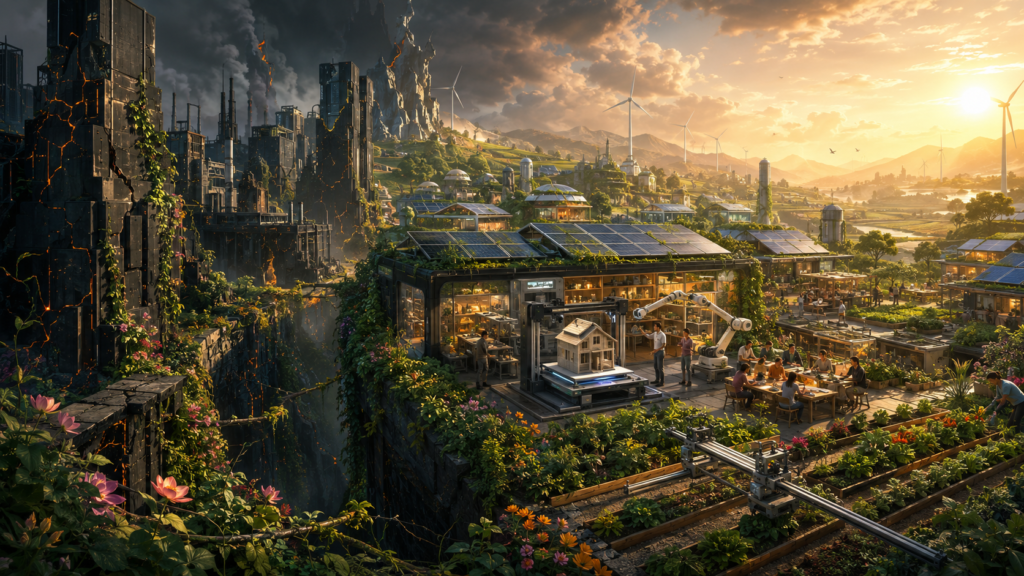
- 3D Printing and Microfactories – Production that once required vast halls and millions of dollars can now fit in a garage. Additive manufacturing enables local, customisable, small-batch production of practically everything – from tools to houses.
- Open Hardware and Software – Projects like Arduino, Raspberry Pi, and open CAD models democratise engineering. Knowledge, which Marx called the general intellect, becomes accessible to anyone with an internet connection.
- Decentralised Energy Systems – Solar panels, microturbines, biogas plants, all connected in local microgrids. Energy no longer has to come from a single source owned by a corporation or the state.
- DAO (Decentralised Autonomous Organisations) – Blockchain technology enables governance without a central hierarchy. A community can collectively own, finance, and manage the means of production.
In a neo-distributist world, the question is not “who is your boss”, but “which part of the production chain do you own and control”.
🌿 Permaculture – More Than Gardening, a Blueprint for an Entire Society
Permaculture is often reduced in the public eye to organic gardening. This is a mistake. At its core, permaculture is a design system for creating sustainable human settlements and productive systems, modelled on natural ecosystems.
What are the principles?
- Care for the Earth – restoring, not depleting, natural resources.
- Care for People – everyone should have access to the resources necessary for a dignified life.
- Fair Share – surpluses are shared and reinvested in the system.
When these principles are applied not only to agriculture, but also to economics, production, and governance, we get something deeply akin to distributism. Both permaculture and distributism reject monoculture and monopoly – whether of crops, energy, knowledge, or power. Both seek resilience through diversity and distribution.
In practice, this looks like:
- Permaculture farms using AI for optimal management of water, soil, and biodiversity, rather than for maximising monoculture yields.
- Urban productive ecosystems where the waste of one unit serves as input for another – much like the natural cycling of matter.
- Fab labs and makerspaces (shared, collaborative workshops that give individuals access to modern tools and technologies for digital fabrication and creative work), arranged according to permaculture principles: modular, repairable, local, open.
⚙️ How Does All This Fit into Postone’s Fracture?
Let us return for a moment to Postone. His key insight is: the measure of value (socially necessary labour time) has become anachronistic. Capitalism has created technological capacities that render this measure superfluous, yet it cannot abandon it because the entire system of wages, profits, and employment rests upon it.
Distributism and permaculture offer a way out of precisely this contradiction. Their fundamental question is not how many hours did you work, but what is your access to resources, knowledge, and tools.
In a neo-distributist and permacultural model:
- AI and robotics do not take away jobs – they reduce the amount of necessary labour required for the reproduction of life, freeing people for what is genuinely human: creativity, community, care.
- Energy is produced where it is consumed, eliminating the position of the energy monopolist.
- Production becomes local and on-demand, shrinking transport chains and economic dependence on global corporations.
- Knowledge is treated as a common good (commons), not as intellectual property that generates rent.
In other words, what is a contradiction under capitalism becomes a synergy under neo-distributism. Technology does not destroy value – it frees it from the shackles of labour time.
🌍 Applied in Practice: Where Is This Already Happening?
We are not talking about mere theory. Concrete models already exist:
- Open Source Ecology – a global project developing plans for 50 essential machines needed to build a self-sustaining village. Everything is open source.
- FarmBot – an open-source agricultural robot that applies the principles of precision permaculture. It is controlled via a Raspberry Pi.
- Microfactories in India and Africa – using 3D printing and locally available materials to produce water pumps, agricultural tools, and even parts for renewable energy sources.
- DAO Communities – such as those experimenting with collective ownership of forests, water sources, or wind farms.
These are engineering answers to societal problems. And that is precisely why their place is on MilovanInnovation.
⚠️ Challenges and Critiques: Scaling and Systemic Resistance
Distributism and permaculture have their weak points, and these must be named openly:
- Scalability – Can such a model function for cities of millions, or is it inherently tied to smaller communities? The answer is complex: it demands modular scalability – the multiplication of small, interconnected units, not the growth of a single centralised one.
- Geopolitical Resistance – Corporate capitalism will not quietly observe the erosion of its own power. We already see attempts to envelop open-source movements and decentralised production in patent wars and regulatory barriers.
- Transition Shock – Moving from the current model to a distributed one is not simple. It requires pilot projects, parallel systems, and political will, which today is largely absent.
- The Danger of Technological Fetishism – Simply owning a 3D printer does not make a society distributist. Conscious organisation, education, and a shift in cultural patterns are necessary.
🌀 Conclusion: From the Fracture – A New Architecture of the World
Moishe Postone showed us the fracture at the heart of capitalism – the contradiction between technological abundance and value-based scarcity. Distributism and permaculture, armed with the technologies of the 21st century, offer a new architecture that can grow through that fracture.
This is not a utopia in the sense of something unattainable. It is a project. An engineering, social, ecological project. It demands the design of systems that are:
- Distributed, so that resilience does not depend on a single centre.
- Regenerative, so that they do not consume more than they give back.
- Open, so that knowledge is not a monopoly.
- Locally rooted, yet globally connected.
At MilovanInnovation, we believe that the future is something built, not awaited. The tools are here. The knowledge is here. What is missing is the courage to abandon the old pattern and start anew – not from the ashes, but from the fracture.
For if the emperor has no clothes, mockery and criticism are not enough. We must tailor a new garment ourselves, and not wait for someone else to tailor our destiny.
MilovanInnovation continues to track and analyse the intersection of technology, economy, and society. If you believe the time has come for a conversation about alternatives, share this post and join the discussion.
Leave a Reply