Dear explorers at the crossroads of science and spirit,
In the previous post, we plunged into perhaps the darkest vortex of all quantum mechanics – the observer paradox. We saw how Wigner’s friend reveals that two legitimate observers can have contradictory descriptions of the same reality. We saw how Frauchiger and Renner turned that paradox into a mathematical no‑go theorem: quantum theory, plus the consistency of agents, plus the uniqueness of outcomes – something must give.
And we saw that Penrose’s objective reduction offers a way out: gravity is that universal observer that needs no consciousness. The wind that smooths the waves of the Dirac Sea.
But, as every experienced mariner knows, there is a difference between a good compass and a complete map. Today we examine one of the most serious critical reviews of Penrose’s theory – the work of Joy Christian – and we ask: is the gravitational wind the only one that smooths the sea, or are there more?
🎯 Christian’s Paper: Why the Quantum Must Yield to Gravity
Joy Christian, a physicist from the University of Oxford, published a paper whose title is itself a provocation: “Why the Quantum Must Yield to Gravity”. The title is no accident. It expresses a stance opposite to the dominant program in physics over the last half‑century.
While most physicists (string theory, loop quantum gravity) attempt to “tame” gravity by quantising it – turning it into yet another quantum field with its own carrier particle – Christian claims this is impossible in principle. The conflict between quantum mechanics and general relativity is not a technical problem that will be solved by better mathematics. It is a fundamental incompatibility of two structures, and it is quantum mechanics that must give way.
This is, of course, precisely Penrose’s heresy – not to quantise gravity, but to gravitise quantum theory. But Christian does not merely repeat Penrose. He critically examines him and points to the places where the OR theory must be further developed.
🧭 Penrose’s Argument: The Superposition of Spacetime
Christian takes over Penrose’s basic argument and elaborates it with rigorous mathematical precision:
- A superposition of a massive object implies a superposition of two different spacetime metrics.
- In general relativity, the metric structure determines the flow of time. Two different metrics mean two different time parameters.
- It then becomes ambiguous to speak of the unitary evolution of a system described by a single Schrödinger time t. The time‑evolution operator cannot be consistently defined.
- Therefore, unitary evolution must break down – not as a consequence of an external “measurement”, but as an inner, geometric necessity.
This is the heart of the argument. Gravity is not just another force acting within spacetime. Gravity is spacetime. And when spacetime itself finds itself in superposition, the very foundation for unitary quantum evolution vanishes.
🔬 Two Key Christian Critiques
What Christian adds – and where he partly diverges from Penrose – are two critical points that we had already glimpsed in the previous post.
First Critique: The Basis Problem
The first, and perhaps the most serious question is: into which basis does the system collapse? Penrose suggests it is the basis of localised states – states in which an object has a definite position. But why precisely that basis? Why not some other?
Christian points out that the choice of basis is completely arbitrary in Penrose’s original proposal. Without a formal mechanism for basis selection, OR remains a phenomenological model – it describes that collapse happens, but not how the system “chooses” the outcome. This is a serious shortcoming that any future version of the OR theory must address.
Second Critique: The Newtonian Limit and Neglect of the Essence of GR
Penrose’s calculation of the gravitational self‑energy (), which determines the collapse time via the formula , relies on a Newtonian approximation. The energy needed to “shift” one mass distribution into another against gravitational attraction is computed – but in flat, absolute space and time.
Christian highlights a fundamental problem with this approach:
- In the Newtonian limit, space and time are absolute. The paradox of metric superposition – which is the core of Penrose’s argument – cannot be consistently formulated in that framework.
- In other words: Penrose uses Newton to describe a problem that only arises in full GR.
- A significantly more sophisticated formulation is needed, one that works directly with curved spacetime and general covariance.
Christian does not reject OR because of this. On the contrary, he considers the direction Penrose has charted to be correct in its basic intuition. But he believes a new mathematical framework is required to overcome these shortcomings.
🌌 What Does Christian Propose?
Christian suggests a framework is needed that would:
- Take into account general covariance – the requirement that physical laws be independent of the choice of coordinates – as a fundamental principle constraining the very form of quantum mechanics.
- Solve the basis problem – perhaps through a geometric criterion for selecting preferred states.
- Overcome the Newtonian approximation and work directly with curved spacetime.
He does not offer a complete solution himself. But his paper is valuable because it precisely maps what is missing – and confirms that the question Penrose opened is legitimate, deep, and worthy of further research.
💎 Gravity as the Dominant, but Not the Only Mechanism
And now we arrive at a point where we can broaden the picture.
Penrose’s OR theory is indeed the most serious candidate to explain the mechanism by which gravity causes the collapse of the wave function. But is it the only mechanism?
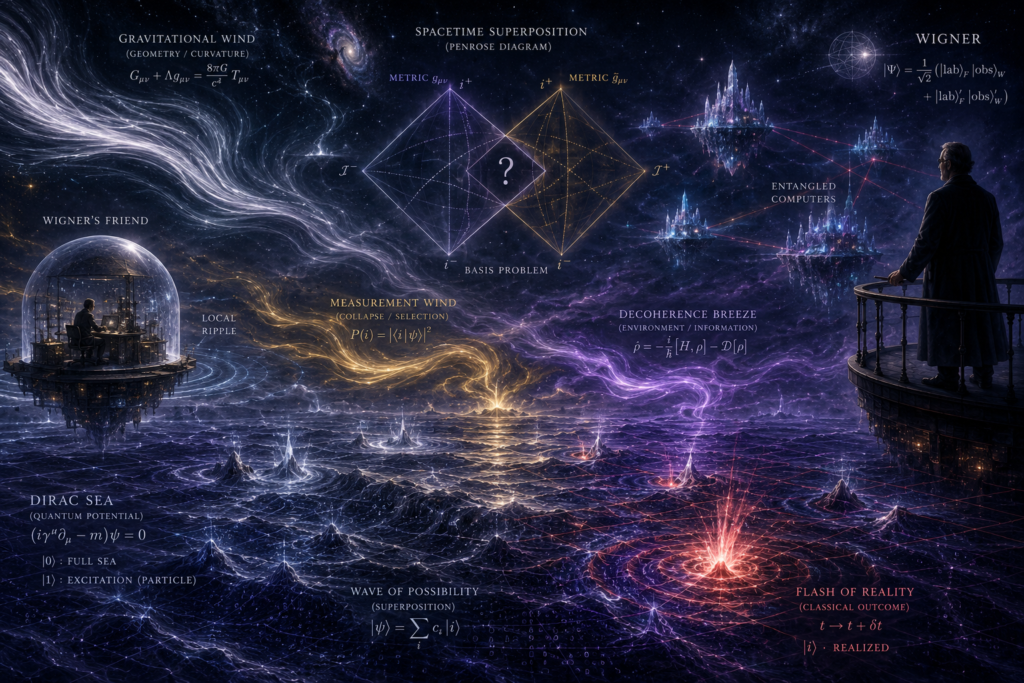
There are good reasons to think it is not. Observation and measurement – whether by conscious agents, by measuring devices, or by the environment through the process of decoherence – are not annulled by OR. They still play a role. What OR does is to provide the dominant mechanism – the one that acts on the macroscopic scale, where gravitational self‑energy becomes large enough for collapse to be almost instantaneous.
In this picture, the Dirac Sea is not shaped by a single wind. There exists:
- The gravitational wind – dominant, geometric, universal – that smooths the great waves and translates macroscopic reality from quantum to classical.
- The winds of measurement and decoherence – weaker, but ever‑present – that act on smaller scales, in laboratories, in neuronal microtubules, wherever a system interacts with its environment or with a conscious observer.
This picture is not in contradiction with Penrose. It complements him. And it opens up space for one of the deepest questions in contemporary physics: the problem of consistent histories.
If there are multiple collapse mechanisms, how can we ensure that they yield consistent outcomes? If Wigner’s friend collapses the laboratory gravitationally, and Wigner collapses it through measurement – will their statements agree? Is there some deeper principle that guarantees all paths of collapse lead into the same classical reality?
This is not an academic question. It is the question that, as we have already said, will become practical the moment we have networks of quantum computers exchanging measurement results among themselves.
🔮 Horizons: From a Dominant Mechanism to a Consistent Whole
What we have learned today is the following:
- Christian confirms Penrose’s basic intuition – the conflict between quantum superposition and general covariance is real and deep.
- But OR has concrete shortcomings – the basis problem and reliance on the Newtonian approximation – that require further development.
- Gravity is the dominant, but not necessarily the only mechanism of collapse – the winds of measurement, decoherence, and conscious observation still play a role.
- The problem of consistent histories becomes crucial – how to ensure that different collapse mechanisms do not produce contradictory realities.
Perhaps this is precisely what we are striving for: a consistent theory of collapse that includes gravity as the dominant mechanism, but also allows other influences, and that guarantees that all of them – in the end – sing in the same chorus.
⛵ Epilogue: Many Winds, One Sea
In our metaphor of the Dirac Sea, we long spoke of the gravitational wind as the only one that smooths the waves. Now we see that the picture is richer.
There are storms (the gravitational collapse of massive superpositions), there are breezes (decoherence through interaction with the environment), there are also puffs (measurements in laboratories). They all shape the sea. They all translate the quantum into the classical. And they all – if the universe is consistent – must sing in the same key.
Who is the conductor? Is it some deeper principle of covariance, as Christian suggests? Is it something we have yet to discover?
The sea gives no answers. It only waves. And we – we continue to listen to it.
This post continues the series begun with “⚛️ Quantum Archaeology: Reading the Past from the Dirac Sea”, continued through the map of the quantum odyssey, the post on quantum immortality, and the post on the observer paradox.
Leave a Reply