
Dear explorers at the crossroads of science and spirit,
In previous posts we sailed through the depths of the Dirac Sea, hunted for monopoles, witnessed the collapse of wave functions, and touched the very boundary where the quantum yields to gravity. But there is an interpretation of quantum mechanics that, like an old nautical chart hidden in a library, is being pulled back into the light – and which fits perfectly into our picture of the sea.
This is Bohmian mechanics, also known as pilot-wave theory or the de Broglie–Bohm theory. This interpretation, pushed to the margins for decades, has been experiencing a renaissance in recent years. And not only that – it revives, in an almost uncanny way, the intuition of Nikola Tesla about the ether as a fluid medium governing all physical phenomena.
Today we dive into a sea that may not be only a metaphor.
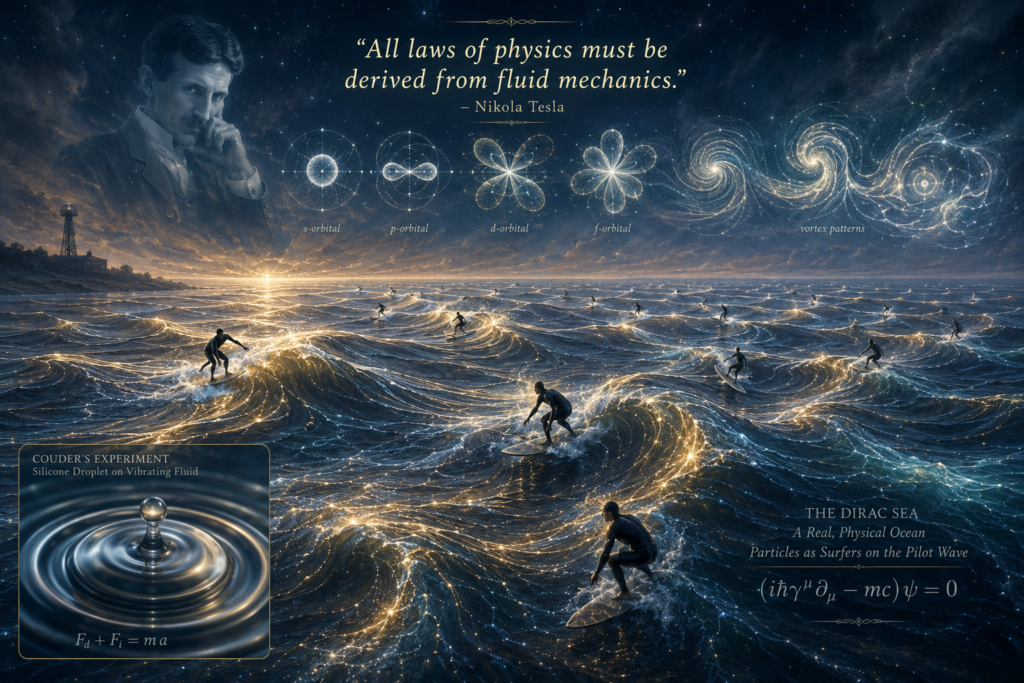
🌊 Pilot Waves and the Dirac Sea: Particles as Surfers
The standard Copenhagen interpretation treats the wave function as a mathematical tool – an abstract object describing probabilities, but not physical reality. Bohmian mechanics takes a radical step in the opposite direction: the wave function is a real, physical field. It is a pilot wave – a real wave propagating through space that guides particles.
In our picture of the Dirac Sea, this means the following:
- The sea is not merely an abstract Hilbert space. It is a physical sea – a real field that exists independently of us.
- Particles are not misty superpositions that “collapse” upon measurement. They are surfers – they always have a definite position, they are always somewhere, but their motion is dictated by the shape of the wave beneath them.
- What we see as the “collapse of the wave function” is simply a change in the shape of the pilot wave due to interaction with the environment (for example, a measuring apparatus), which in turn alters the particle’s trajectory.
In this picture, Born’s rule (which gives the probability of finding a particle at a given location) is not a fundamental law, but a statistical consequence: particles are distributed in accordance with the intensity of the wave simply because the wave guides them there.
What makes this picture especially exciting is that it is deterministic. In Bohmian mechanics, if we know the initial position of a particle and the shape of the pilot wave, we can precisely predict its future trajectory. What appears as fundamental randomness in Copenhagen is here only a consequence of our ignorance of the exact initial position of the particle.
⚖️ Why Bohm’s Theory Was Abandoned – and Why It Is Returning
If Bohmian mechanics is so intuitive and elegant, why was it marginalized for decades?
First, Bell’s arguments. In 1964, John Bell proved that any theory of hidden variables that is local (i.e., that assumes influences cannot travel faster than light) cannot reproduce all the predictions of quantum mechanics. Bohm’s theory is not local – the pilot wave acts instantaneously at a distance, which was unacceptable to many physicists. Although it is ironic that Bell himself was one of the greatest advocates of Bohm’s theory.
Second, the problem of relativity. The original Bohmian formulation is non-relativistic – it works in Newtonian space and time. Extension to quantum field theory and General Relativity remains an open problem, although serious attempts exist.
Third, the dominance of Copenhagen. Bohr, Heisenberg and others succeeded in imposing the view that quantum mechanics is complete and that the question “what is really happening” is not legitimate. Bohm’s quest for ontology – for what really exists – was declared “metaphysics” and pushed aside.
But in recent years, the wind is shifting. More and more physicists are returning to Bohmian mechanics, for several reasons:
- Experiments with walking droplets: French physicist Yves Couder and his colleagues discovered that silicone droplets on the surface of a vibrating fluid can exhibit behaviour astonishingly reminiscent of quantum phenomena – diffraction, interference, tunnelling, and even “quantisation” of orbits. The droplet creates a wave, the wave guides the droplet – just as in Bohmian mechanics.
- Fluid analogies of atomic orbitals: There are papers linking the shapes of atomic orbitals to shapes obtained in certain fluid turbulences and motions. What appears as an abstract mathematical object (a solution of the Schrödinger equation) suddenly acquires a concrete, fluid form.
- Non-locality as an advantage: In the era of quantum entanglement and experimental confirmation of the EPR paradox, non-locality is no longer “scandalous” – it is a fact. Bohm’s theory takes it for granted, without attempting to hide it.
⚡ Tesla’s Intuition and Bohmian Mechanics: The Ether as a Sea
And now we come to perhaps the most fascinating connection – the one with Nikola Tesla.
Tesla perceived electromagnetic phenomena, and even gravity, through the prism of fluid mechanics. For him, the ether was not empty space, but a viscous, elastic substance – a kind of universal fluid – through which waves propagate and which, by its behaviour, explains all physical phenomena.
In Tesla’s words:
“All perceptions and all concepts are based on impressions coming from outside. Therefore, all laws of physics must be derived from fluid mechanics.”
This is astonishing. Although Tesla knew nothing of quantum mechanics (he died in 1943, before Bohm’s papers of 1952), his intuition about the ether as a fluid medium governing the motion of particles almost prophetically anticipated Bohm’s picture.
In Bohmian mechanics:
- The pilot wave is a universal field that fills all space – just like Tesla’s ether.
- Particles are “immersed” in that field and guided by it – just as Tesla imagined matter within the ether.
- What we see as “forces” are only manifestations of the interaction of particles with the pilot wave – just as Tesla believed that electromagnetic and gravitational forces are consequences of the behaviour of the ether.
Of course, Bohmian mechanics is mathematically formalised in a way Tesla could not have imagined. But the spirit is the same: nature, at its deepest level, is fluid.
🔬 Limitations of the Original Bohmian Theory – and New Horizons
As you have probably noticed yourselves, the original Bohmian theory has its limitations. It explains the probabilities arising from the solutions of the wave equation, but does not fully explain the superposition of multiple states and quantum entanglement in an ontological sense.
In Bohm’s picture, a particle always has a single definite position. There is no “superposition” of the particle in two places simultaneously – there is only a superposition of the pilot wave, which can have several “humps” at different locations, but the particle is always on one of them.
This means that phenomena like quantum entanglement – where two particles share a common wave function and “know” about each other at a distance – must be explained through the non-local nature of the pilot wave. The wave function of two entangled systems is a single field extending through the entire configuration space, and a change in one part of that field instantaneously affects the other.
Newer advocates of Bohmian mechanics – such as Sheldon Goldstein, David Albert, Roderick Tumulka and others – are developing extensions that attempt to address these challenges:
- Many-worlds theory in a Bohmian guise: Some authors combine Bohmian mechanics with the Everett interpretation, creating a picture in which many parallel “branches” of the pilot wave exist, and particles “choose” one of them.
- Quantum field theory and Bohm: There are attempts to extend the Bohmian formulation to quantum field theory, where “particles” would be field excitations guided by a pilot wave at the level of the field itself.
- Gravity and Bohm: Some works attempt to connect Bohmian mechanics with Penrose’s objective reduction, suggesting that gravity could play a role in “guiding” the collapse of the pilot wave.
🌌 Is the Dirac Sea Truly a Sea?
And now we come to perhaps the deepest question of this entire voyage.
When we began using the metaphor of the Dirac Sea – an infinite ocean of quantum fields – it was only an image. Poetic licence. A way to make abstract mathematics tangible.
But what if it is not just a metaphor?
Bohmian mechanics, with its pilot waves that are a real physical field, suggests that the sea is real. That waves are not merely mathematical objects, but physical entities filling space. That particles really do surf upon them.
Tesla’s intuition about the ether as a fluid medium, Couder’s experiments with walking droplets, fluid analogies of atomic orbitals – all of this points to the same picture: nature, at its deepest level, is fluid. The sea is not a picture of the sea. The sea is the sea.
Of course, this is not proof. Bohmian mechanics remains an interpretation – one of many ways to understand the same mathematical formalism. But it is an interpretation that is astonishingly consistent, intuitive and in harmony with the picture we have built throughout this entire series.
And perhaps that is precisely what Tesla always knew – that the universe, at its deepest level, is an ocean. And we are waves that have become aware of themselves.
This post continues the series begun with “⚛️ Quantum Archaeology: Reading the Past from the Dirac Sea”, continued through the map of the quantum odyssey and posts on the observer paradox, Christian’s critique of Penrose, and quantum complexity.
Leave a Reply